Polaris

Master Hack

Well-known member
Messages
4,330
Reaction score
6,985
Location
Mountain top Labratory
Well, the Electrathon America program is geared toward student teams (High School &/or Colledge)
So yer going back to school? Or gonna “hire” a school age driver?
Nice project! Way beyond my technology level! It was just a few months ago l heard about these internal combustion things. Now l have all this coal to sell!
 

Functional Artist

Well-known member
Messages
5,654
Reaction score
3,293
Location
Toledo, Ohio
So yer going back to school?
I guess I'm "old-school home-schooled"
...'cause I read, research & try-n-learn stuff, everyday (& encourage others to do the same) :cornut:

Or gonna “hire” a school age driver?
Nope, I'ma gonna be doin' the drivin' :auto:

According to the rule book, schools, individuals & corporate teams can all participate & compete. (see below) ;)

FWIU, it seems like many "individuals" are former students that participated in Electrathon
...& then, after graduation still wanted to be involved
...so, they can still design, build, compete
...& also, are/can be seasoned advisors & help new teams :cheers2:

* Which kinda sounds like me, you, Denny & a quite a few others, right here on this very forum :2guns:

Our MISSION:
To inspire an interest in Science, Engineering, and Technology by involving participants in the design, construction, testing and development of competitive electric vehicles.

COMPETITION OBJECTIVES:
1. To drive electrically powered vehicles as far as possible in one hour on a closed loop course with limited electrical energy.
2. To provide a forum where skill and ingenuity may be displayed, compared and tested.
3. To improve public awareness and understanding of efficient alternative electric vehicles and related technologies.
4. To create an affordable sport defined by established rules in which Schools, Individuals and Corporate Teams can participate competitively and safely.

VEHICLES
Electrathon vehicles are single person, lightweight, aerodynamic, high efficiency, electric vehicles with three or four pneumatic tires.
They must meet specific design and safety rules.
They are powered by standard sealed (won’t leak if damaged) lead acid battery packs not exceeding the weight limit specified in the vehicle design rules section.

SAFETY
Safety is of key concern at all events. The design of the vehicles is only one variable in the safety of an event. A pre-race inspection of the vehicles is required to ensure they are safe. Event courses must be free from obstructions, and ensure participants and spectators are not in harms way. These are just some of the sanctioning regulations.

For these safety reasons local Event Organizers, Promoters, and Event Stewards may not make ANY changes to the Electrathon America Design and Event Rules other than where specific guidelines for deviation are listed.

To be an Electrathon America Sanctioned Event, the Event Rules must be enforced during the event and all vehicles participating in the event must meet current Vehicle Design rules.
(page 3)
Nice project! Way beyond my technology level!
Thanks!
BS it's so simple "a cave man can do it"
...& I'm tryin' ta shows everyone hows ta do it (practically step-by-step) :thumbsup:

** I have no formal electrical education whatsoever (100% self-taught) 🤓
...& I'ma doin' it :cool:
So, there's nuthin' to it, but ta do it :bannana:
 

Functional Artist

Well-known member
Messages
5,654
Reaction score
3,293
Location
Toledo, Ohio
I can’t believe you can’t use lithium batteries.
Hey Denny,

They have an Advanced Battery Class (info about it is kinda hidden, way back on page 12.) :huh: :mad2:

28 ADVANCED BATTERY CLASS
The Advanced Battery Class is intended to foster experimentation on with newer battery technologies that offer higher energy density than the more traditional lead-acid and reflect the rapidly expanding availability and usage in the transportation industry. The weight limits are meant to keep the available power under one kw/hr, or about the same as the current Standard Class. This list will be reviewed and updated periodically. All other Standard Class rules apply with the following exceptions:

1. Any type of the following sealed production batteries may be used as long as their weight does not exceed:
Nickel-Metal-Hydride 41 lb.
Silver-Zinc 23 lb.
Nickle-Zinc 44 lb.
Nickel-Iron 58 lb.
Lithium-Ion 15 lb.
Lithium-Iron-Phosphate 29lb.

2. Maximum output of any battery combination used may not exceed a one-hour rating of one kilowatt/hour according to the manufacturer's data.


* FYI: a ~15lb. 48V Lithium battery pack will be way more powerful (& lighter)
...than them (4) 12V 20AH (~50lb. pack) SLA's that we have been testing with :2guns:
 

Master Hack

Well-known member
Messages
4,330
Reaction score
6,985
Location
Mountain top Labratory
You have the instrumentation to know whats happening. Whats the expected run time? Obviously you engineered enough capacity into the system to complete the event, but can you drive it home?
 

Functional Artist

Well-known member
Messages
5,654
Reaction score
3,293
Location
Toledo, Ohio
You have the instrumentation to know whats happening. Whats the expected run time? Obviously you engineered enough capacity into the system to complete the event, but can you drive it home?
Hey T,
Yup, so, we gots us some data to analyze

The battery pack we are currently testing, consists of (4) 12V 20AH SLA's (Sealed Lead Acid)
...& each of these batteries has a usable voltage range of ~10.5V - ~13.3V

When we wire them (4) together, in series, it creates a 48V 20AH battery pack
...with a usable voltage range of ~42V - ~53.2V 🤓
&
These 20AH batteries should be able to "put out" ~20A for 1 hour
...&/or ~40A for 1/2 hour etc.

So, now we have a 48V battery pack, with a usable voltage range of ~42V - ~ 52V
...with a 20AH (nominal) current rate
...but, "if" we drain it more slowly, like let's say ~10A
...it should be able to maintain that "out put" for ~2 hours ;)

Now, analyzing the data in the last video:

Voltage
When we started, the voltage level, of the battery pack, was 51.46V
...& then, with the voltage drop, upon hard acceleration, the voltage dropped down to 47.72V (~3.75V drop)
&
When we ended, the test run, the voltage level was 50.8V
...& the voltage drop (just before the end of the test) while "under load" was ~46V (~4.75V drop)

Current
Watching the video, the highest Wattage I saw was ~1,223W
...with a corresponding Amperage draw of 26.3A (@~5:39)
&
While cruising at top speed (~22MPH) with a WOT (wide open throttle)
...the Wattage was usually ~500W - ~700W
...with corresponding Amp draws of ~10A - 15A

So, to put everything into perspective, this test lasted for ~20 minutes
...& the kart traveled ~4 miles
...but, only drained a couple of Volts out of the pack

So theoretically, "if" we can maintain a 10A - 15A rate, for most of the time, during a 1 hour race
...we should have enough "in the tank" (of this little battery pack) to finish the race
...& would have traveled ~12 miles
...with a top speed of ~22MPH :sifone:

* There is so much info, I hope this make sense & there's more to come :thumbsup:
 

Master Hack

Well-known member
Messages
4,330
Reaction score
6,985
Location
Mountain top Labratory
Makes perfect sense. I do know the basics and the theory. I actually studied electronics a few years ago, ya just don’t see vacuum tubes much anymore.
Solid state s**t has way more smoke in it, than those glass tubes.

There is this, but its old and yer way beyond this anyway.
 
Last edited:

Functional Artist

Well-known member
Messages
5,654
Reaction score
3,293
Location
Toledo, Ohio
But on one gallon of gasoline with a 212 Rotoderp you could go 50 miles in that one hour!
Hey Denny,
Remember, these tests were with a heavy as heck (~40lbs) 😱
...but, small in capacity, 48V 20AH battery pack :ack2:
&
This kart is only powered by a ~1.2HP motor ;)

We'll get to testin' her, with the Lithium pack (~15lbs) hopefully soon :thumbsup:
&
I'ma also, workin' on fine tunin' the whole package
...to hopefully increase the overall efficiency some
but,
So far, at WOT & while going full speed, it was only drawing ~10A - 15A
...which doesn't seem too bad :2guns:

FYI: Drawing ~25A for a split second, every now & then would be considered a ~1.25C (peak) draw
...& then, drawing ~15A continuously would be considered as less than 1C
...& well within this 20AH battery packs specs 🤓
 

Functional Artist

Well-known member
Messages
5,654
Reaction score
3,293
Location
Toledo, Ohio
Did anyone notice the front wheel goin' all wonky (ex: ~10:55) a couple of times, in the last video? :unsure:

Upon further examination, it seems/looks like the steering shaft is flexing (up to ~1/2") in the middle :furious2:

So, I may have to add a center support
...but, for now, I just stiffened 'er up ;)
...& we'll see how that goes :thumbsup:
 

Functional Artist

Well-known member
Messages
5,654
Reaction score
3,293
Location
Toledo, Ohio
I'ma been workin' on/building a small 14S 48V 15AH Lithium battery pack

It will be made from (14) 3.7V (nominal) ~15AH Lithium cells, harvested from the battery module out of a Chevy Volt electric car

* These cells have a "safe" usable voltage range of (low ~3V) up to a (high ~4.15V)
...so, if we connect (14) of them "in series", we'll have a battery pack with a usable voltage range of (low ~42V) up to a (high ~58.1V)
...& contains ~1,000Wh of energy ;)

** Whereas the (4) 12V 20AH SLA's (that we tested) have a usable voltage range of (low~42V) up to (high ~52V)
...but, only contain ~300Wh of energy :huh:


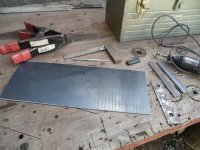
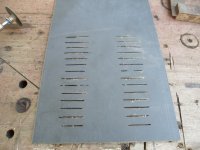
The first thing to do, was to make up a cell terminal separator/holder
...so, I put a bunch of lines (with a scribe, a square & a 3/8" spacer) on the back side, of a piece of plastic, from the back of an old TV
SAM_0962.JPG
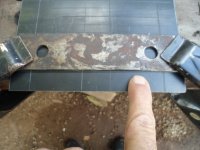
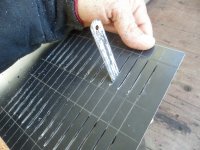
Then, used a straight edge & a couple of clamps, to help make consistent cuts
SAM_0965.JPG
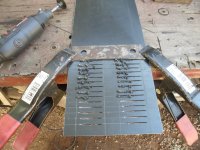
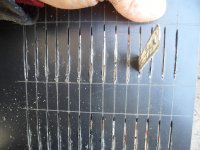
Then, used a Dremel (& cut off wheel) to make the initial cuts
...& made sure to only came kinda close to the side edge lines
SAM_0968.JPG
Here is the top side, after the initial cuts
SAM_0971.JPG
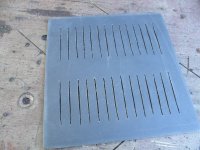
Then, used a hack saw blade to clean up the cuts
SAM_0972.JPG
...& bring the "slits" right up to the edge lines :thumbsup:
SAM_0973.JPG
About like this :sifone:
SAM_0974.JPG
 

Functional Artist

Well-known member
Messages
5,654
Reaction score
3,293
Location
Toledo, Ohio
Hey,
Why are ya bothering to building a battery?
Why not just use a whole 48V 50AH module, like you have on the motorcycle?

Well, I'ma glad you asked
...& it's for a couple of reasons 🤓

1. The Electrathon Rule Book requires Lithium batteries to be no larger, or contain no more than 1,000Wh (or 1kWh) of energy
...& a complete 48V 50AH module contains ~2,000Wh (or 2kWh) of energy

So, we have to "break 'er down" a bit ;)

FYI:
The 48V 50AH Lithium modules contain 36 of the 3.7V (nominal) ~17AH cells
...& they are arranged in a 12S3P configuration

Also,
12S3P is/means (3) cells are connected together "in parallel", to create a cell group
...& then, (12) of them (3) cell groups, are connected together "in series", to create a 12S 3P 48V 50AH battery module :thumbsup:

So, the plan is to divide the (12) cell groups back into the (36) individual cells
...& then, connect (14) of them together "in" series to create a smaller capacity (~1kWh) module
...but, still be in the 48V "range" (even a bit "hotter")

2. The Electrathon Rule Book also, stipulates that Lithium-Ion battery modules cannot weigh any more than ~15 lbs.

28 ADVANCED BATTERY CLASS
The Advanced Battery Class is intended to foster experimentation on with newer battery technologies that offer higher energy density than the more traditional lead-acid, and reflect the rapidly expanding availability and usage in the transportation industry. The weight limits are meant to keep the available power under one kw/hr, or about the same as the current Standard Class. This list will be reviewed and updated periodically.

All other Standard Class rules apply with the following exceptions:
1. Any type of the following sealed production batteries may be used as long as their weight does not exceed:

Nickel-Metal-Hydride 41 lb.
Silver-Zinc 23 lb.
Nickle-Zinc 44 lb.
Nickel-Iron 58 lb.
Lithium-Ion 15 lb.
Lithium-Iron-Phosphate 29lb.

2 . Maximum output of any battery combination used may not exceed a one-hour rating of one kilowatt/hour according to the manufacturer's data.
(page 12.)
 

Functional Artist

Well-known member
Messages
5,654
Reaction score
3,293
Location
Toledo, Ohio
still be in the 48V "range" (even a bit "hotter")
Whadda ya mean by "hotter"? :popcorn:

Well, the (4) 12V 20AH SLA battery pack had a voltage range of ~42V low (dead batteries) up to ~52V (fully charged pack)

Now, this 14S Lithium battery pack has a usable voltage range of ~42V (low) all of the way up to ~58V (fully charged &/so, "hotter") :sifone:

Also, using a battery pack with a higher top charge voltage, should translate into a bit more speed, too :thumbsup:

Why?
Because these little electric motors usually produce ~70 RPMs per volt of input
...& so, if powered at ~52V they produce ~3,640 RPMs (probably ~3,000 - 3,500 RPMs under load)
...but, if powered by a 58V battery pack they should produce ~4,060 RPM's (~500 more RPMs) :2guns:

So, the Lithium module will give us a larger, usable voltage range

...& a higher top charge voltage
...which should make the kart go a bit faster :bannana::auto:
 
Top