Diamonite Electrathon America Racer

Denny

Canned Monster
Messages
11,530
Reaction score
7,962
Location
Mayberry, Indiana
Time to start building stuff and stressing it. That’s the only way you’ll get your questions answered satisfactorily. Just don’t wash your clothes at home or your family will hate you. They will curse you for giving them the itchies.
 

Functional Artist

Well-known member
Messages
5,287
Reaction score
2,725
Location
Toledo, Ohio
It's winter time here in Toledo (currently ~34* & snowy) :ack2:
...so, no fiber glassing anytime soon :huh:
...maybe ~May 2025 :furious2:
...& that's almost 6 months away :mad2:
So, I gots lots of time to research, read, contemplate, design, re-design & jabber about it though :bannana:

My future ex-wife??
...its gonna take more than just messin' up the washer (again) :surrender:

If ya remember, I built an entire mini-Jeep in our family room, a couple of winters ago :innocent::devil2:
...& she's still "my gal" :sifone:
&
My clothes already get washed separately
...but, when I get to it, I'll be working with this stuff (as most of my projects) out of doors
...& any sanding will also be done outside, with a good fan, sucking the itchy stuff away from me :cheers2:
 

Functional Artist

Well-known member
Messages
5,287
Reaction score
2,725
Location
Toledo, Ohio
Still learnin' :smartass:

Another building concept or technique, mentioned in the Composite Construction for Homebuilt Aircraft book is called "moldless fuselage"

Long, thin strips of wood (or foam) are layed over "formers"
...then, the outside is covered with a couple of layers of fiberglass

After the fiberglass is cured, ya remove the "formers"
...& then, the inside gets covered with a couple of layers of fiberglass too :thumbsup:

A kool benefit of this method is that
...the "formers" are kept aligned with a "pole"
...so, the whole unit could be turned like a "rotisserie"
...which allows for easier access, while "working" on all sides ;)
SAM_3832 (1).JPG
This pic shows how some "ribs" can be installed/used, to help strengthen the body
...or maybe just incorporate the "ribs" into the "formers" :2guns:
SAM_3821 (1).JPG
 

ezcome-ezgo

G'me sumthin to write on
Messages
5,861
Reaction score
2,822
Location
Atlanta, GA
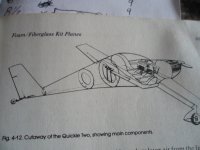
This is cool. Small airplanes typically have a "skeleton" made of a lightweight metal, and the fiberglass "skin" to help it slip through the air. The fiberglass of course supports certain elements structurally, but the vast majority of the loads and dynamic forces are supported by the skeleton (meaning the wings, engine, landing gear). But I like how you are thinking here, I really do. The compromise might be blending some structural metal elements with the fiberglass, essentially marrying them together.

1734706296444.png
 

Functional Artist

Well-known member
Messages
5,287
Reaction score
2,725
Location
Toledo, Ohio
Getting purdy high tech here! I like it!
I have witnessed extreme fiberglass testing, but don't recommend it.

View attachment 151029
Hey T,

Still reading, studying & learning
...& some thinking
...& maybe even some drawing
...& then, more reading, studying & learning :thumbsup:

The airplane books & videos have lots of info about aerodynamics
...& lightweight construction & building techniques

The boat books & videos have lots of info about fiberglass construction
...& the many different methods & procedures, to do it

A couple of things that I've noticed
...& we'll have to "keep in mind"
...is that both airplanes &/or boats, in their regular/intended use don't really have to deal with concentrated weight
...or hard "shock" loads, like "land traveling" vehicles do

Weight
1.) in airplanes the weight is spread out, across both the wings & the fuselage
2.) in boats the weight is spread across the bottom of the entire structure
3.) but, in land traveling vehicles, the weight is concentrated at the connection "point" between the suspension/wheels & the chassis

Shock loads
1.) airplanes have to "deal with" wind gusts & turbulence but, the "loads' are spread out
2.) boats mainly have to "deal with" waves (& wind) but, the "loads" are spread out, too
3.) but, land traveling vehicles, have to "deal with" lumps & bumps in the road but, the "loads" are concentrated at them connection "points"

Still thinkin' & figurin' & designin'
...& just figured I'd "throw" that out there for you'all :cheers2:
 

Functional Artist

Well-known member
Messages
5,287
Reaction score
2,725
Location
Toledo, Ohio
This is cool. Small airplanes typically have a "skeleton" made of a lightweight metal, and the fiberglass "skin" to help it slip through the air. The fiberglass of course supports certain elements structurally, but the vast majority of the loads and dynamic forces are supported by the skeleton (meaning the wings, engine, landing gear). But I like how you are thinking here, I really do. The compromise might be blending some structural metal elements with the fiberglass, essentially marrying them together.

View attachment 151027
Hey Ez,

I'm trying to avoid using a complete metal sub-frame
...&/or any sub-sub-frames

I'm not opposed to the concept of "blending" some "minimal" & "localized" metal re-enforcement into the design ;)
...but, it seems like it would be best to keep it "topical" :sifone:

From my reading/research, I've found that there have been reported issues with metal pieces/attachment points
...that have been embedded, in a fiberglass structure :huh:

One issue was "if" the metal "inserts" had sharp edges or corners
...that sharp edge (or corner) could potentially help the piece "cut" thru or "wear" thru the fiberglass (especially in a "heavy load" situation)

* "If" used, any sharp corners or edges on the metal insert, should be smoothed &/or rounded :thumbsup:

Another issue was with the differing thermal expansion properties & rates, of the different materials (fiberglass & metals)
...like "if" the vehicle sat out in the sunshine long enough, on a hot summer day, the structure would "warm up"

When heated, the fiberglass & resin have a certain expansion rate
...but, the metal inserts (being a totally different material) have different expansion rates
(steel or Aluminum have different expanding rates but, that's another story)
&
If/when the metal insert expands, at a different rate than the fiberglass, it "can" potentially fracture/break the bond between the fiberglass epoxy/resin & the metal insert

If that happens, the insert "can/would be" basically "floating" or can move around, inside/inbetween the inner & outer layers of fiberglass
...which would lessen the strength of the "unit"
...&/also, the potential "movement" of the insert, inbetween the inner & outer layers of fiberglass, could increase the "wearing thru" effect :ack2:

Just wanted to 'throw" that out there too :2guns:
 

Functional Artist

Well-known member
Messages
5,287
Reaction score
2,725
Location
Toledo, Ohio
Hey T,

American Ingenuity :sifone:

Super simple...I like it :thumbsup:

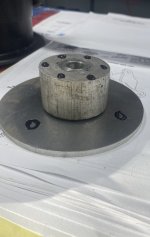
Is the flange to be bolted on?

The axle will be 5/8"
...& then, we'll need a "spacer" (with probably ~1/16" walls) over it

So, the hub will probably need a ~1" ID hole, going thru the center

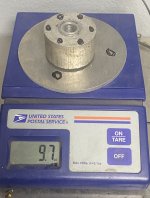
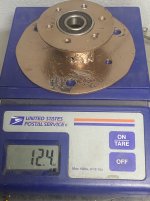
Is there much weight difference between the aluminum hub (& flange)
...& the mock hub, that I made up?
 

Master Hack

Well-known member
Messages
4,046
Reaction score
6,436
Location
Mountain top Labratory
Is the flange to be bolted on
It can be, or welded.
So, the hub will probably need a ~1" ID hole, going thru the center
Why? If the axle is 5/8 put a .626 hole through?
Is there much weight difference between the aluminum hub (& flange)
...& the mock hub, that I made up
haven't checked that. I will and report back.
This is some weird prearanged destiny shyt going on here. Those two pieces were sitting together just like that, waiting to be discovered. Engineering effort was minimumal.
 

Functional Artist

Well-known member
Messages
5,287
Reaction score
2,725
Location
Toledo, Ohio
Why? If the axle is 5/8 put a .626 hole through?
Hey T,

Because there will be a ~1" space between the bearing, in the rim
...& the backing plate, on the spindle

So, we will need a "spacer" that goes over the 5/8" spindle
...& under the mini-hub (not touching)
&/also
In between the bearing, in the rim
...& the backing plate

This "spacer" is to "hold" the wheel/hub/rotor in the proper position

Hopefully that makes a little bit of sense :innocent:
...or I could probably make up a mechanical drawin' :cheers2:

I don't know if it will help
...bit, this video, shows the mini-hub, on the spindle

But, doesn't show the "spacer" that I'm talking about
...or the backing plate (that the caliper mounts to) either :mad2:
 

Functional Artist

Well-known member
Messages
5,287
Reaction score
2,725
Location
Toledo, Ohio
I still say you need steel attachment points for the suspension.
I've done a bit more thinkin' about this
...& some drawin' too ;)

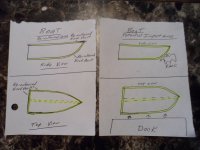
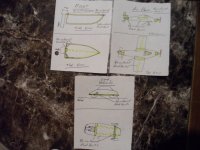
Here are the designed "strong areas" &/or Hard Points on a:

Boat
Left side, of the pic shows (highlighted in yellow) how a boat has a re-enforced "rim" going around the structure
...&/also, a "spine" going down the center/bottom of the structure

Right side shows some of the potential impact areas
...& how/why these re-enforced areas are necessary
SAM_3867 (1).JPG
Plane
Top pic shows (highlighted in yellow) how a plane has re-enforced areas where the wings & tail section attach
...&/also, re-enforced areas where the wheels mount, that support the structure while parked & on take-offs & landings too

Bottom image shows another view of some of these "Hard Points areas
* Notice how the "hard Points" are strategically placed
...& NOT just all over the place/everywhere?
SAM_3868 (1).JPG
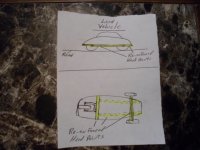
Land traveling vehicle

Top pic shows (highlighted in yellow) how a "car" has a re-enforcements where the wheels/suspension attaches
...&/also/maybe a couple re-enforced "strips" lengthwise, to kinda "connect" the front & rear "Hard Points" of the structure together

Bottom image shows another view
...of how/where the "Hard Points" are located
...& how they "connect" the front & rear sections together
SAM_3869 (1).JPG
These drawings show the various propulsion (thrust) Hard Points on these different type of vehicles/vessels
SAM_3870 (1).JPG
Making these drawings
...& then, doin' ALL of this "jabbering" about this stuff, helps me to get a better understanding :thumbsup:

Thanks for following along
...& Merry Christmas to ALL :cheers2:
 
Top