Brake Linkage
This is something that could have been left as the factory built it, but it was bugging me that it was not done properly. It's bad enough when the factory slim shadies something; with a go-kart there is a chance some kid will see it down the line and think that this is the right way to do things.
In this case I am referring to the way the factory rigged the brake linkage. The brake cable clevis is attached to the trunnion at the end of the actuating rod with a bolt. I spotted these problems when I took the kart apart, as all of these are sandwiched between the seat and the floor pan so it is not like you can see it.
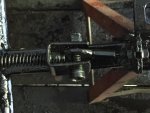
As you can see in the photo, the clevis is riding directly on the threaded shank of the bolt and that the clevis is not located side-to-side in the trunnion. Both of these are fails.
What you cannot see is that the amount of brake actuating rod travel is gated by the return spring being in full bind. That's right, the amount of braking is determined by when that spring is fully compressed, not by the lining or brake actuating band. This is a major fail.
Why do things like this leave the factory? We usually say 'cost' because it is cheaper to do it this way. That is only part of the cost equation. Frankly, the factories don't have the resources to do the integration testing or production line quality control. Maybe they switched suppliers, and this spring is different than the original design. Maybe the bracket was welded in place a half inch off. Maybe this was a rush design. Who knows.
The point is that you cannot take anything for granted on a go-kart because they do not have the breadth and depth of engineering behind them as does, say, a Corvette or Mustang.
On to the fix. First the bolt that attaches the trunnion and the clevis.
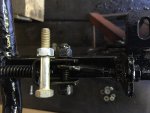
The clevis needs to ride on a solid surface, not the thread of a bolt. The bolt size used is 5/16 x 14. I used a longer one because that way I could use the unthreaded portion of the bolt shank. Here you see what I mean:
I spun a nut all the way onto the bolt, cut off the excess, and then unscrewed the nut. Doing it this way lets you use the nut to remove the burr that forms when cutting a thread. That burr can make it hard to start the nut. I switched to a Nylock nut for final assembly. BTW, you want at least two threads showing any time you use a Nylock nut. That is important as otherwise the nylon lock does not have enough thread to grab.
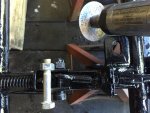
I used washers on both sides of the clevis to center it in the trunnion.
The brake spring issue was addressed with two adjustments. First, the brake cable was moved towards the back of the cart. This is at the right of the above photos. I was able to move it out about 3/8", which was plenty. Then, I adjusted the brake actuating rod, first at the trunnion ( so that the end of the threaded portion of the rod would not hit the clevis), and then at the front of the kart by the brake pedal.
Now, the maximum amount of brake application is governed by the brake assembly itself - by how tightly the brake band can grip the brake drum - instead of by when the spring binds.
Maybe ten minutes of work, and now the brakes are set up right. There is absolutely no play in the brake linkage and that is quite a difference over stock.