Diamonite Electrathon America Racer

Functional Artist

Well-known member
Messages
5,297
Reaction score
2,742
Location
Toledo, Ohio
Hey Bob,
Interesting...very interesting
...& thanks for sharing more info

IMO more info & more discussion, is best :cheers2:
People don’t do physics with words.
got to draw the free body diagram with force arrows otherwise you get zero credit for the problem. Lol

Physics is just drawings, then math is letters and numbers. Words have no place in physics lol
Oh...yea...I got some Remedial Aerodynamics 101 drawin's ;)


Let's get back to/start with this one

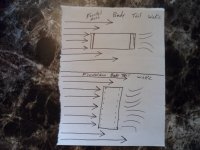
So, FW(I think)IU when a board is laying flat (top image)

It's kinda like a flat/horizontal hand in/against, oncoming wind/air
...& I can "see" that the "face" would encounter a "pushing force" (action)
...& then, (according to Newtons law) the object would resistance or "push back" an equal amount (reaction)

But, it doesn't seem like the "pushing force" (action) of the oncoming air, impacting against this object
...would be able to initiate &/or cause any kind of "lifting" (reaction)

Then, it seems like if the shape is turned sideways (bottom image)

It would be kinda like a vertical hand in/against, oncoming wind/air being pushed back
...& I can "see" that the "face" would encounter a larger "pushing force" (action)
...but again, (according to Newtons law) it seems like the only (reaction) the object could/would do is to resist or "push back" (reaction)

So again, it doesn't seem like the "pushing force" (action) of the oncoming air, against (or flowing over) a shape sitting level
...would be able to initiate &/or cause any kind of "lifting" (reaction)
SAM_3859 (1).JPG
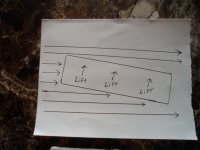
Now, "if" the front of the board is angled upward, changing the "angle of attack"
...it would still encounter some resistance (reaction) to the incoming air (action)

But also, some of the oncoming air (action) is now being deflected downward (reaction)
...so, the collision (action) of the oncoming air, impacting the uplifted "face" of the board, causes it to (reaction) rise upward or create lift :thumbsup:
SAM_3855 (1).JPG
 

Functional Artist

Well-known member
Messages
5,297
Reaction score
2,742
Location
Toledo, Ohio
See, deep deep dark rabbit hole.
Hey Denny,
I'm/we gonna try-n-shine a big 'ol light in that hole :2guns:

The previous discussions, on "lift", was mainly for informative purposes
...'cause I'm not designing an airplane
...& we don't really want to design in much, if any lifting action (or reaction)

But, I think it's important to know & understand the "forces"
...that will be imposed on the body of the racer
...to be able to design a good fiberglass monocoque :thumbsup:

Then, (maybe) design "in" some "pluses", wherever they may be helpful

...try to design "out" any things that may be detrimental to the racers efficiency
...& also, (maybe) able to use some characteristics to "cancel out" some unwanted characteristics :bannana:
 

Functional Artist

Well-known member
Messages
5,297
Reaction score
2,742
Location
Toledo, Ohio
Rather than concentrate on the aerodynamic aspect of things I think I would be looking more into designing it to take the stresses of the suspension and bumps and impacts.

Hey Denny,

Remember,
"were starting off with "baby steps"
...to make this stuff super simple
...which should help (me/us) get a grip of & understand the different/individual concepts better

Then, we can start "stacking" the different "layers"
...& then, discuss & even (hopefully) expand on how the different concepts affect each other (beneficially or detrimentally)
...but also, how each of these concepts interacts with each other (enhancing &/or cancelling)"

Also, I've never designed a monocoque racecar
...or ever built an entire chassis out of fiberglass

So, IMO this "baby steps" concept applies to:
...Aerodynamics
...Monocoque structure
...Composite fabrication
...& even the actual use &/or application of the object (race car)

* Also, keep in mind that the "shape" of the fiberglass monocoque is/will be the "shape of the body"
...so, any style
...or aerodynamics
...& everything, has to be included "in the mix" or designed in, before any fabrication starts :thumbsup:
 

Functional Artist

Well-known member
Messages
5,297
Reaction score
2,742
Location
Toledo, Ohio
Remedial Aerodynamics 101

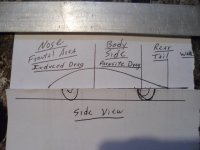
It seems to me that studying the airfoil shape, for an automotive application, is probably best thought about as streamlining
...& ways to increase flow over & around the vehicle
...while/&/or also, reducing drag
...but, (as I mentioned previously) we don't really want to create much lift

So, to help understand this better, I drew an airfoil "cut" in half (lengthwise) because
1.) we don't want a curved upwards shape (to help reduce any potential lifting)
&
2.) a smooth underside would be best (to reduce any potential parasite drag, from anything under there)

I also, remember from previous research, where they recommended the underside of the vehicle be angled upwards toward the rear
...like in a hod rod stance :auto:
...more on that concept...later
SAM_3854 (1).JPG
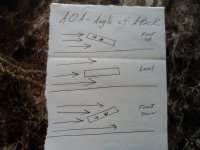
Here's another simple drawing, showing how the AOA (Angle of Attack) of the surface, of an object or shape
...that the incoming air impacts (action)
...effects the direction of the of that "force" (reaction)
SAM_3856 (1).JPG
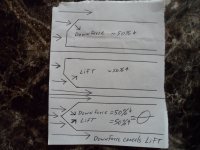
A simple drawing showing a couple of shapes with partial resistance
...& partial lift or down force

The (bottom image) shows how the (2) forces may be able to "cancel" each other out ;)
SAM_3880 (1).JPG
 

Functional Artist

Well-known member
Messages
5,297
Reaction score
2,742
Location
Toledo, Ohio
This shyt is giving me headache!
let me know when this conversaton is back on solid ground. :ROFLMAO:
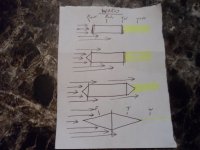
Well...Bob said I had to draw pics to get any credit :thumbsup:
...&/so, I'm drawin' pics
...& "jabbering" about them

So, here is a drawing that shows the frontal area, body, tail & wake, of a few different simple shapes

* Notice that it would seem like
...shape in the bottom image would be the most aerodynamic
...& the "wake" at the rear, of the bottom image, would be the smallest
SAM_3863 (1).JPG
But actually, because of the large frontal area
...it would have a lot of induced drag
...& also, probably lots of parasitic drag too

Plus, the "sharp" or abrupt "turns", in the middle of the body, of this shape
...would NOT allow or aid, the air flow in "turning the corner"

So, it would just "fly" off or away from the body
...instead of gently coming back together

Which would leave or create, a HUGE "wake" behind the object
...& the bigger the "wake" is
...the larger the drag "pulling back" on the racer is :mad2:
SAM_3873 (1).JPG
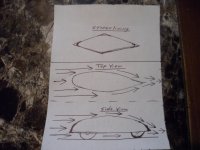
So then, if we take that shape
...& round or streamline the corners a bit (top image)

Were kinda back to an airfoil shape (middle image)

Then, (again) we don't want any uplifting features, in the lower front
...& a smooth bottom
...&/so, were back to :auto:(bottom image)
SAM_3865 (1).JPG
 

Denny

Canned Monster
Messages
11,563
Reaction score
7,986
Location
Mayberry, Indiana
If air only flowed like that you’d be golden. Instead think of a twisty swirly mess. Take and tape 2” long pieces of yarn all over your car every couple of inches apart. Now drive down the road at a variety of speeds. You’ll learn much more and faster about aerodynamics!!!
 

Functional Artist

Well-known member
Messages
5,297
Reaction score
2,742
Location
Toledo, Ohio
If air only flowed like that you’d be golden. Instead think of a twisty swirly mess. Take and tape 2” long pieces of yarn all over your car every couple of inches apart. Now drive down the road at a variety of speeds. You’ll learn much more and faster about aerodynamics!!!
Hey Denny,

FWIU there is "clean" air which is just nicely & smoothly flowing along, undisturbed
...& there is "dirty" air, which is air that has been "banging" into & "bouncing" off of stuff & has become a "twisty swirly mess"

I'm thinking that "if" we can get a better understanding of "why" everything is happening
...we can come up with a good design
...that may be able to "tame" the air, a bit :thumbsup:

* I think the yarn thing is called "tufting"
...& IMO that is more for testing a shape/design, after the fact
...to see how well your "educated guesses" worked out

Starting off the new year (2025) I'ma gonna talk about "forces" a bit more
...not actual air flow itself (we'll get back to that)
...but, the reaction "forces" that are produced by the air flow, impacting against an object or shape

Yup, more drawings ('cause Bob said) :cheers2:
SAM_3919 (1).JPG
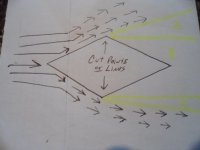
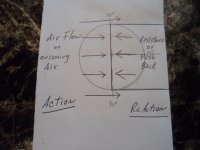
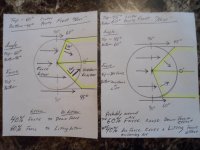
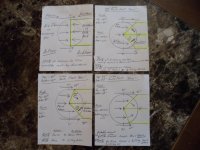
First an object/shape with a simple 90* flat face
...with air (represented by arrows) flowing toward it (Action)
SAM_3915 (1).JPG
Then, when the air flow impacts the object/shape there is an equal & opposite reaction, resistance (Newtons law)
...the resistance or push back is represented by arrows (on the right side of the front edge line)
...so, ~100% of the oncoming "force" is being directly resisted by the "face" of the object
SAM_3916 (1).JPG
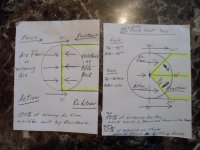
Now let's compare the shape with the 90* flat face & the "forces" involved
...to a shape with the front edge "split" in the middle
...with the top 50% angled back at ~45*
...& the bottom 50% also, angled back at ~45*

So, it seems that the flat face shape would directly resist the oncoming "forces" (image on the left)
But,
Looking at the shape, with the upper 1/2 & lower 1/2 angled both back ~45* (image on right)
1.) there should be less resistance
2.) it seems like the upper 1/2 should produce a bit of down force
3.) the lower 1/2 should produce a bit of a lifting action or force (essentially canceling each other out)
SAM_3917 (1).JPG
So, to take this a step further (Denny always loves it when I take it a step further)

Let's see what may happen "if" we have different angles on the front
...like, the top 1/2 of the front (face) angled back ~60*
...& the lower half angled back ~45* (image on the left)
or
The top 1/2 of the front (face) angled back ~45*
...& the lower half angled back ~60* (image on the right)

* Notice the "face" of the image on the left should create (or produce) a bit more lifting action (~60%)
...than, down force (~40%)

Whereas the "face" of the image on the right should create a bit more down force (~60%)
...than, lifting action (~40%)
SAM_3918 (1).JPG
 

Functional Artist

Well-known member
Messages
5,297
Reaction score
2,742
Location
Toledo, Ohio
You’re leaving out boundary layers and speed. All go hand in hand.
Hey Denny,

Yup, layers on top of layers, on top of layers, on top of layers
...we'll get to them :thumbsup:

Told ya this shyt (as my buddy T would say) was DEEP :2guns:

Currently, I'm just "talking" about "forces" (Actions)
...& the (potential) resistance (Reaction)
...&/or any re-active forces that may occur when, applied to different shaped objects :smartass:

Like
1.) what could/should happen when a "force" impacts a "flat" surface (~90* to the incoming air)
&/or
2.) what could/should happen when a "force" impacts an angled (45*, 60* etc.) surface ;)

Sometimes looking at stuff another way
...helps me understand concepts better

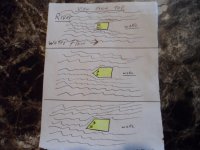
So, let's say we have a boat sitting in the middle of a flowing river

The "boat" in the top image has a flat front or "nose"
...&/so, when the oncoming flow impacts that flat "nose"
...it applies "force" to push the boat back

The "boat" in the middle image has a common pointed "nose" (like most boats do)
...&/so, when the oncoming flow impacts that pointed "nose"
...the "force" trying to push the boat back, should be reduced

The "boat" in the bottom image has an offset pointed "nose"
...&/so, when the oncoming flow impacts that offset pointed "nose"
...the "force" trying to push the boat back, should be reduced a bit
...but also, kinda "pushing the "boat" to (1) side too
SAM_3920 (1).JPG
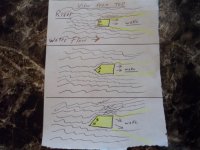
To add another "layer" lets add any wake that may be created

So, the "boat" in the top image still has a flat front or "nose"
...&/so, when the oncoming flow impacts that flat "nose"
1.) the flow being "moved" out of the way, for the "boat" to pass thru, "bumps" into the flow that's already passing by, creating "turbulence"
2.) & because of the turbulence created, the wake behind the "boat" should be kinda big

The "boat" in the middle image still has a common pointed "nose" (like most boats do)
...&/so, when the oncoming flow impacts that pointed "nose"
1.) the flow being "moved" out of the way, for the "boat" to pass thru, shouldn't "bump" into the flow that's already passing by, as much, creating less "turbulence"
3.) & because there's less turbulence, the wake behind the "boat" should be smaller (tamer) :thumbsup:

The "boat" in the bottom image still has an offset pointed "nose"
...&/so, when the oncoming flow impacts that offset pointed "nose"
...the "force" or flow impacting the angled surface should push the "boat" on an angle
...while also, possibly causing the "boat" to turn to (1) side &/or even start spinning :ack2:
...& depending on the "reaction" of the object to the oncoming "forces" the wake would/could be "all over the place"
SAM_3921 (1).JPG
Um...Idunno "if" that helped any
...but, "that's that!"
...or there's that
...or whatever...:smartass:
 

Whitetrashrocker

Inmate #952016
Messages
4,538
Reaction score
3,541
Location
Southern New Mexico
Don't forget effects aft of the craft.
The water in your boat theory has to go back to where it was before it was displaced.
With a flat rear like your diagram the water is messily moved back to the centerline of displacement. Lots of turbulence there.
If you were to point the rear like the front, the water will smoothly return with little wake. A kayak is a good example.
Notice a boat wake is V shaped a ways behind the boat. That's the angle the water is returning and the waves from each side are adding or subtracting from each other.
You'll see on semi trailers some have tail feathers that can be deployed for better slipstream. Most don't bother to use them though.
 

Whitetrashrocker

Inmate #952016
Messages
4,538
Reaction score
3,541
Location
Southern New Mexico
Yeah, a car behind another car, become one, and the air flows around as if it's just a longer car.
On a bike your like a flea on a dog.
The foward rushing air is going to fill the void behind the trailer. Your just being sucked foward into the void at that point.
Quite exhilarating!
 
Top