Diamonite Electrathon America Racer

Functional Artist

Well-known member
Messages
5,296
Reaction score
2,742
Location
Toledo, Ohio
The term empirical was originally used to refer to certain ancient Greek practitioners of medicine who rejected adherence to the dogmatic doctrines of the day, preferring instead to rely on the observation of phenomena as perceived in experience.
I may be overstating this
...but, I feel like I had an epiphany yesterday :bannana:

I realized (Ahhhhhhh:innocent:) that I've been using this empirical concept...like literally...forever
...& IMO it seems to help explain why I've been "butting heads" with so many folks, for so long

Over the years, I've been told 1,000's of times..."you can't do that!"
...& my response was usually something like "I think, I already did" (quoting Tony Soprano) :thumbsup:
or
"that's not how your supposed to do it"
...& my response was something like, "but, it worked"

Thinking about it, it's not like I'm "rejecting adherence to the dogmatic doctrines of the day"
...or prefer to "rely on the observation of phenomena as perceived in experience"
...it's just that haven't had any "higher" formal educated (just a standard issue USA HS diploma)

So, for many things in life
...& now this stuff (electrical systems or now, designing a monocoque)
...it seems like I've been (unknowingly) using the Empirical way/concept/theory

Now, I kinda understand how/why I'm always driving folks "nuts" with my "ways" :cornut:
 

Functional Artist

Well-known member
Messages
5,296
Reaction score
2,742
Location
Toledo, Ohio
Hey Denny,

I'm just about done "jabbering" about the front
...then, we'll move on to the rest of the body :cheers2:

I guess, I've been trying to keep these concepts as simple as possible to help folks/students understand how knowledge of how some things "work" can & quite often does, "relate" to how other things "work" :thumbsup:

Another quick "story"
I have memories of me & a buddy carrying 4' x 8' sheets of plywood, on a windy day
...& that "if" we kept it nice-n-level, while carrying it, the wind didn't seem to affect it very much

But, "if" we accidentally tilted the front of the board upward (into the wind)
...the wind would try to push or pick up the front upwards (lift)
&
Then, "if" we tilted the front of the board downwards
...the wind would push downward on the board (downforce)

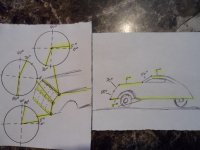
The second drawing shows sheets of plywood with a 60* "break" & a 45* "break"

The top image, shows what it would "look like" "if" the front 2' of the board was "tilted" downward
...& the remaining 6' was still level or "flat"
The middle image shows what it would "look like" "if" the front 4' of the board was "tilted" downward
...& the remaining 4' was still level or "flat"
The bottom image shows what it would "look like" "if" the front 6' of the board was "tilted" downward
...& the remaining 2' was still level or "flat"

Now, imagine how much more "area" the wind would have to "push down" on the boards, with the longer part (6') tilted downward
...& also, how much "more" push down would happen by the board with the 45*
SAM_3932 (1).JPG
Then, to help show how this info applies to the body of a race car
1.) there are surfaces of a car that are relatively wide/flat, just like a sheet of plywood

So, it seems to reason that some of the same effects, should apply to some surfaces of a car ;)
(to varying degrees, of course, depending on angle & surface area)
SAM_3931 (1).JPG
 
Last edited:

Functional Artist

Well-known member
Messages
5,296
Reaction score
2,742
Location
Toledo, Ohio
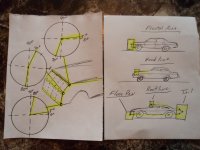
I did another simple drawin'
...ta help add a bit more context :thumbsup:

* These are just some "off the top of my head" baseline numbers :cornut:

Notice, how in this example, the hood & roof line both angle upwards (~5*) slightly, which should:
1.) not add much "induced" drag
2.) not add much downforce
3.) & also, "if" curved could take advantage of the Bernoulli effect (helping to speed the air up)

Also, notice the floorboard would angle upwards (~5*) which should:
1.) reduce the risk of much if any "lift" in the front
2.) help to reduce the pressure of the air, as it "passes" under the body
SAM_3937 (1).JPG
 

Functional Artist

Well-known member
Messages
5,296
Reaction score
2,742
Location
Toledo, Ohio
Been doin' more thinkin' & drawin'
...& addin' some 3Dness :thumbsup:

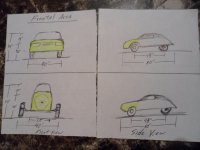
So, here we have (2) different cars

They both have a ~40" "track" & a ~48" wheelbase
...& both are ~34" tall & ~60" long overall
&
If you look at them from a side view, they look about the same
But,
"if" we look at them from a front view, you'll notice that the top car has a much larger "face" or frontal area

So, it should be pretty easy to see how the car (on the bottom) with less frontal area, or smaller "face" should have less "induced" drag
...than, the car with the wider body
...&/so, should cut thru the air more easily ;)
SAM_3942 (1).JPG
 

Master Hack

Well-known member
Messages
4,071
Reaction score
6,471
Location
Mountain top Labratory
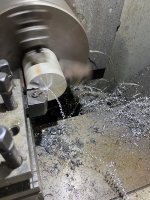
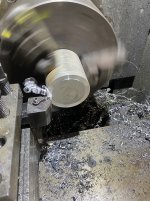
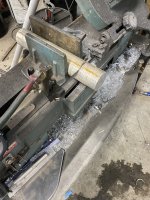
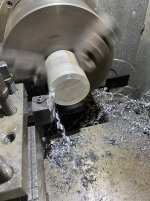
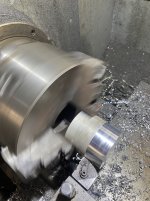
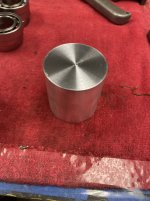
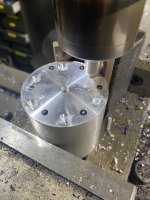
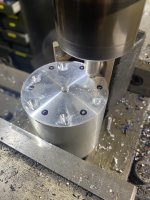
On another note, since ya all ben thinkin i ben slakin, i had the spinna machine runnin, so l thought i would werk on sum hubs.
Well actually i had egor and the film crew do phase one. Tonights episode is the first in a series, titled "from bullion to billet".
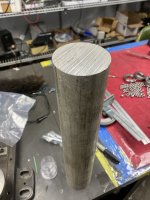
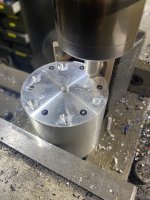
In the vault here at the Mt. Top lab, l found a 2.5 inch aluminum bullion thingy.
So, follow along as we turn bullion into billet stuff.

27788F82-4A56-4D46-9713-2BBDD101001B.jpeg0EED4EC2-A1FA-4691-9F98-402E048FBDD7.jpeg71695311-2B6E-430A-8139-268A7E027920.jpegA4DC23BE-1232-4D98-B324-75C8C0EA81A9.jpegCF6EFE6F-5340-490E-972E-32074A64325D.jpegFD986D57-4115-474D-AFC6-B4883A701D9D.jpeg0D6B57BF-58E3-4729-8B81-F09A619F49CA.jpeg
 

Master Hack

Well-known member
Messages
4,071
Reaction score
6,471
Location
Mountain top Labratory
Returning to our regular programming....
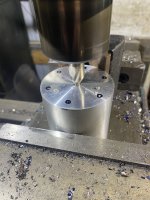
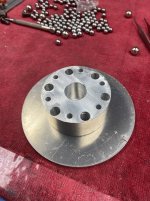
Today the slaves decided to strike. Left with no options Egor and l stumbled through some machine work and started making hub thingys.

This is a cool little gadget:
https://youtube.com/shorts/ngawD-n4x9A?feature=share
an edge finder. If l knew how to use it, it can find an edge. If ya find the edge then ya can find center.
IMG_4667.jpeg

then a center drill
IMG_4669.jpeg


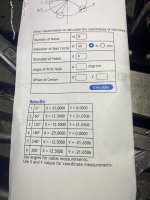
then get a cheat sheet.

IMG_4668.jpeg

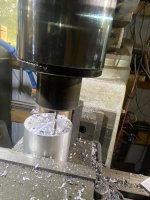
then drill some holes

IMG_4671.jpeg IMG_4673.jpeg
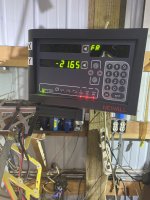
don't know why the DRO doesn't photograph well?
shyt! Missed all of 'em


IMG_4674.jpeg


that conculdes this cluster...
 

Attachments

  • IMG_4669.jpeg
    IMG_4669.jpeg
    2.6 MB · Views: 5
  • IMG_4669.jpeg
    IMG_4669.jpeg
    2.6 MB · Views: 3

Functional Artist

Well-known member
Messages
5,296
Reaction score
2,742
Location
Toledo, Ohio
Been doin' lots of research (reading another book & watchin' some videos) ;)
...& drawin' :2guns:

Hey T,

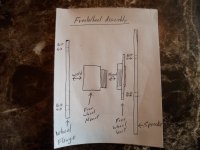
I did a drawin' of the free-wheel assembly mounting
...to help explain :thumbsup:

The wheel flange (left)
...would be welded to the free-wheel mount (middle left)

The free-wheel mount, would then thread into the free-wheel unit (middle right)
...& then, the sprocket (right) would be bolted to the free-wheel unit :cheers2:
SAM_3954 (1).JPG
 
Top