Torque Converter Help

Barnfresh1

New member
Messages
12
Reaction score
5
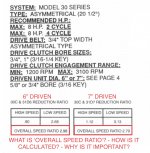
As I understand it the low and high speed ratios are the beginning and end points for the continuously varying ratios in between. Can anyone tell me what the ‘overall speed’ ratio is, how it’s determined or calculated and what the importance of it is or how it’s used in CVT tuning?
 

Attachments

  • D6334D20-7879-4AD1-9535-81055631E8B7.jpeg
    D6334D20-7879-4AD1-9535-81055631E8B7.jpeg
    425 KB · Views: 8

bob58o

SuckSqueezeBangBlow
Messages
9,646
Reaction score
1,857
Location
Chicago-town USA
As I understand it the low and high speed ratios are the beginning and end points for the continuously varying ratios in between. Can anyone tell me what the ‘overall speed’ ratio is, how it’s determined or calculated and what the importance of it is or how it’s used in CVT tuning?
Tell me tire and sprocket size and I’ll give you an example with math. It’s fun for me. Hell for everybody else.
 

bob58o

SuckSqueezeBangBlow
Messages
9,646
Reaction score
1,857
Location
Chicago-town USA
2.68 / 0.9 = 2.98 over all ratio is just division.

3.13 / 1.12 = 2.79

The 6” pulley gives a bigger spread than the 7” pulley. There is a bigger difference between lowest and highest gear.

The gear reduction is greater with the 7” pulley but the spread is smaller.

Lowest gear will be closer to highest gear than compared to using the 6” pulley
 

bob58o

SuckSqueezeBangBlow
Messages
9,646
Reaction score
1,857
Location
Chicago-town USA
But with that bearing, the high gear ratio number is unknown to me.

Also remember 7” driven pulley will require a longer belt than if using the 6” pulley with the same pulley to pulley center spacing.
 

bob58o

SuckSqueezeBangBlow
Messages
9,646
Reaction score
1,857
Location
Chicago-town USA
People have been talking about locking out overdrive in the 6” units for ever. It never made sense to me. If you couldn’t rev your engine, your gear ratio was wrong, and then they blamed the clutch they selected.


7” driven unit, 8T sprocket small enough rear tires, big enough sprocket, and a diet and the engine will turn.

Added (at least to 8500 rpm on a mini bike with 175lb rider, or 7000 rpm on a heavy buggy, can’t speak for much higher than 8500 rpm but I don’t imagine you’re talking those rpm’s)
 
Last edited:

BrownStainRacing

Well-known member
Messages
1,367
Reaction score
1,486
But with that bearing, the high gear ratio number is unknown to me.

Also remember 7” driven pulley will require a longer belt than if using the 6” pulley with the same pulley to pulley center spacing.
I agree.
It jus won't go into high with those bearings.

We definitely need more info, tire size, weight, gear ratios you have tried, rpm's???

Whats it going on, wheel barrow, uni cycle, pogo stick???
 

Barnfresh1

New member
Messages
12
Reaction score
5
8T -10T front sprocket. 60T rear sprocket, 13” or smaller tires and you’ll be fine. Just make sure the rear sprocket is small enough to give you ground clearance if in the middle of a live axle
So if 10/60t on a 13” dia. tire is fine wouldn’t 10/83t on an 18” tire net the same or similar results? Not those big floaty dune buggy tires but narrower low rolling resistance tire using higher air pressure.
 

bob58o

SuckSqueezeBangBlow
Messages
9,646
Reaction score
1,857
Location
Chicago-town USA
And as far as tuning, you’re best bet for performance is to set clutch engagement at peak TQ.

IMO if the engine makes peak torque at 3000 RPM, for top performance, the clutch engages at 3000 RPM.

If peak HP is at 4500 RPM, you want to stay around 4500 while the CVT is shifting through its range, then rpm will continue to climb as speed increases past peak HP until you reach top speed
 

Barnfresh1

New member
Messages
12
Reaction score
5
People have been talking about locking out overdrive in the 6” units for ever. It never made sense to me. If you couldn’t rev your engine, your gear ratio was wrong, and then they blamed the clutch they selected.


7” driven unit, 8T sprocket small enough rear tires, big enough sprocket, and a diet and the engine will turn.

Added (at least to 8500 rpm on a mini bike with 175lb rider, or 7000 rpm on a heavy buggy, can’t speak for much higher than 8500 rpm but I don’t imagine you’re talking those rpm’s)
My 3 horse was only turning 6400 RPM with the centrifugal clutch & jackshaft setup. I weigh a buck fifty and the little bike another 70.
 

Barnfresh1

New member
Messages
12
Reaction score
5
You got an 83T 1/2” pitch sprocket?
I get sprockets made any pitch and number of teeth I need, Azusa, ESP, Rebel Sprockets etc. Due to price increases these past few years I’ve taken up using adapters so that I can utilize what sprockets I have, for trial anyways just to see what works best.
 

bob58o

SuckSqueezeBangBlow
Messages
9,646
Reaction score
1,857
Location
Chicago-town USA
Ok let’s math.

Im going to use 13” diameter tires in this example.

13” = (13/12) = 1.08’ diameter
D = 1.08’
C= Circumference = 3.14 * D
C = 3.14 * 1.08’ = 3.4’

This means every time rear axle turns one revolution, the bike moves 3.4’ forward,

Now let’s look at 8T and 60T sprockets with the 7” driven unit.

60/8 = 7.5 : 1 sprocket ratio
Low gear with 7” driven is a 3.13 to 1 reduction.

This means in lowest gear (at engagement) the total reduction ratio from crank to axle is about 25 : 1.

Every time the crankshaft turns one revolution, the axle turns 1/25th of a revolution.

If clutch engagement is 2200 rpm, the axle would be turning 2200 / 25 = 88 RPM.

Each axle revolution moves the bike 3.4 feet.

88 rev per minute= 88*60=
5280 revolutions per hour
(This number is a strange coincidence)
5280 * 3.4 feet per revolution=
17,952 feet per hour
17,952 feet / 5280 feet per mile=
(See the coincidence)

3.4 mph at clutch engagement.
This low speed is good. A belt or clutch will need to slip until the vehicle and engine sync up at this speed.

Now let’s assume no bearing so we can get to high gear with the 7” driven unit.

7.5 : 1 sprocket ratio
1.12 : 1 pulley raio
8.4 : 1 overall ratio

6400 engine rpm
6400 / 8.4 =
762 axle rpm
3.4 feet per axle revolution
762 * 3.4’ =
2591 feet per minute=
2591 * 60 =
155,448 feet per hour
155,448 / 5280 feet per mile =

29.44 miles per hour.
 

bob58o

SuckSqueezeBangBlow
Messages
9,646
Reaction score
1,857
Location
Chicago-town USA
Let’s pretend the 3hp engine makes 4 lb*ft of TQ at 2200 rpm.
Multiply that by the 25 x reduction at engagement

and

4x25 = 100 lb*ft of TQ at the axle.

13” tires = 1.08’ diameter = 0.54’ radius

TQ = Force * Radius
100 lb*ft = F * 0.54 ft
F = 100 / 0.54 =

185 lbs

4 lb*ft of tq at the crank becomes 185lbs of linear force where the rubber meets the road.

Now subtract about 15% of your force cause it probably gets lost in the belt drive.
 

Barnfresh1

New member
Messages
12
Reaction score
5
But with that bearing, the high gear ratio number is unknown to me.

Also remember 7” driven pulley will require a longer belt than if using the 6” pulley with the same pulley to pulley center spacing.
So if 10/60t on a 13” dia. tire is fine wouldn’t 10/83t on an 18” tire net the same or similar results? Not those big floaty dune buggy tires but narrower low rolling resistance tire using higher air pressure.
The way I see it, the bearing prevents the driver unit’s movable sheave from moving as close to the stationary sheave as would be needed to “shift” into “highest gear”

If the belt doesn’t ride high on the driver unit pulley, the belt won’t try to “pull” the driven unit forward. This “belt pulling of the driven unit” is what forces the spring to compress in the driven unit allowing the driven unit’s sheaves to spread apart. This allows the belt to ride lower on the driven unit.

Measure the hole on the driver unit’s movable sheave and see if it slides over the bearing? If it doesn’t slide over the bearing, I can’t see how it will ever shift all the way into high gear.

I think it will constantly be in a “lower” gear and not shift into “highest” gear. I imagine this might cause belt slippage.

I can’t tell you the gear ratio in highest gear if the bearing prevents that from happening.

Also did you ever say what the kart was or diameter of the tires?

Pretty sure the bearings aren’t stopping the driver from shifting into high gear. You can watch the belt climb to the top when free revving with the rear wheel in the air (cringe), I know I know.

So again, if 10/60t on a 13” dia. tire is fine will 10/83t on an 18” tire net the same or similar results? - Not those big floaty dune buggy tires but narrower low rolling resistance street tire, higher air pressure.

In other words wouldn’t you expect to net the same acceleration, climbing and top speed results if you increase the rear sprocket diameter at the same rate you increase the tire diameter? Hypothetically speaking, let’s say the tire/wheel gets lighter not heavier and rolling resistance (friction loss) decreases as the said diameter increases.
 

bob58o

SuckSqueezeBangBlow
Messages
9,646
Reaction score
1,857
Location
Chicago-town USA
185* 0.85 =
Ending up with 157 lbs of linear force… converts to newtons because of science as…

700 Newtons (according to Google)

150lbs + 70lbs = 220lbs
220lbs = 100kg

Force= Mass * Acceleration
F=ma
700 Newtons
220 kg
700N = 220kg * a
a = 700N / 220kg
a = 3.18
Newton is (kg*m) / s^2
a= 3.18 meters per second per second at engagement

This acceleration is about 1/3 the acceleration due to gravity (9.8 meters per second per second)
 

bob58o

SuckSqueezeBangBlow
Messages
9,646
Reaction score
1,857
Location
Chicago-town USA
For sure, tire diameter and sprocket ratio are directly linked.

If you increase tire circumference by 1.39x, you can go from 7.5 : 1 sprocket ratio to a 10.4 : 1 sprocket ratio and get exactly the same results.

So yes, to answer your question 6:1 sprocket ratio with 13” is the same as 8.3 :1 sprocket ratio with 18” tires.

But the moment of inertia of an 18” tire and 83 T 1/2” pitch sprocket makes it more difficult to turn.

Imagine a skinny man spinning on ice skates with his arms tucked at a certain speed. Now when he extends his arms out and grabs weights in his hands. His moment of inertia has changed and his rotations will slow. Otherwise, ya… it’s basically the same if you forget about overall weight and rotating mass.
 

Barnfresh1

New member
Messages
12
Reaction score
5
And maybe the best go kart speed/gear ratio calculator out there, interactive too with sliders and stuff.

https://www.gokartguide.com/gear-ratio-chart-speed-calculator/

But you really have to know what it all means on the ground, in the real world application otherwise it's just numbers on a page.

I’ve found that is a really handy quick calculator Hellion, I use this one too. Speed, RPM, Ratio Calculator. You can manually plug in the high or low 6” or 7” driven CVT ratios in place of sprocket teeth to get theoretical results.
 
Top