Ok let’s math.
Im going to use 13” diameter tires in this example.
13” = (13/12) = 1.08’ diameter
D = 1.08’
C= Circumference = 3.14 * D
C = 3.14 * 1.08’ = 3.4’
This means every time rear axle turns one revolution, the bike moves 3.4’ forward,
Now let’s look at 8T and 60T sprockets with the 7” driven unit.
60/8 = 7.5 : 1 sprocket ratio
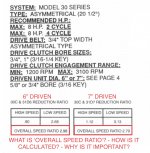
Low gear with 7” driven is a 3.13 to 1 reduction.
This means in lowest gear (at engagement) the total reduction ratio from crank to axle is about 25 : 1.
Every time the crankshaft turns one revolution, the axle turns 1/25th of a revolution.
If clutch engagement is 2200 rpm, the axle would be turning 2200 / 25 = 88 RPM.
Each axle revolution moves the bike 3.4 feet.
88 rev per minute= 88*60=
5280 revolutions per hour
(This number is a strange coincidence)
5280 * 3.4 feet per revolution=
17,952 feet per hour
17,952 feet / 5280 feet per mile=
(See the coincidence)
3.4 mph at clutch engagement.
This low speed is good. A belt or clutch will need to slip until the vehicle and engine sync up at this speed.
Now let’s assume no bearing so we can get to high gear with the 7” driven unit.
7.5 : 1 sprocket ratio
1.12 : 1 pulley raio
8.4 : 1 overall ratio
6400 engine rpm
6400 / 8.4 =
762 axle rpm
3.4 feet per axle revolution
762 * 3.4’ =
2591 feet per minute=
2591 * 60 =
155,448 feet per hour
155,448 / 5280 feet per mile =
29.44 miles per hour.

 D6334D20-7879-4AD1-9535-81055631E8B7.jpeg425 KB · Views: 8

