Sequoia Electrathon Racer

Master Hack

Well-known member
Messages
4,085
Reaction score
6,478
Location
Mountain top Labratory
It takes 7 seconds in the Midwest for rust to form on freshly machined steel surfaces. I imagine in the great pnw it might be less
True dat fact.
the weird thing is it doesn't look like that. Must be a lighting thing.
here at the Mt. Top lab there is an "inspection room". With a bunch of climate change s**t. No,wait! It's climate control s**t. Anyway,the room is kept at 68F and 30% humdidily, some hi teck filter crap, bla, bla, bla.
things just don,t rust. (Visible anyhow)
l should see what its like in there, someday!

that thing about the "great Northwest" has been updated. We now prefer to be referred to as the "grape northwest". We have been over run by overpriced snooty fermented grape juice and their outlets. Remember way back when gas stations were on every corner? Here its wine. Does anyone really pay $80+ for a bottle of grape juice?
 
Last edited:

Functional Artist

Well-known member
Messages
5,303
Reaction score
2,744
Location
Toledo, Ohio
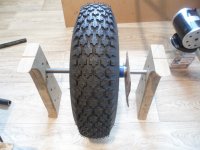
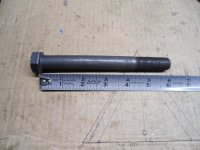
I rounded up a piece of 5/8" steel rod
...& a couple of pieces of scrap wood, to set up a "prop stand" for the rear wheel (ta work on the swing arm) 🙂

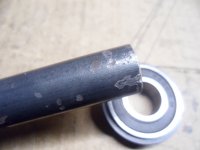
But, there was a thick coating on the rod, that got in the way :ack2:
...& wouldn't allow a 5/8" ID bearing to slide over it
SAM_1807 (2).JPG
I tried a quick scuffin' with some sand paper
...but, that coatin' was pretty tough :mad2:

So, I thought ta myself "How would T make this sh*t, fit ta gether?" :popcorn:

Well, he would probably put 'er on the spinny thing
...& just "take a bit off the top"

But, I don't have a spinny thing
...or :unsure:"do I?"

Well, my drill could spinn it
...but, it's a 5/8" thick rod (my biggest drills only have 1/2" chucks)
...&/so, how am I gonna get 'er "chucked up" in the drill

:idea2: Hey, I could probably use an adapter/coupler :thumbsup:
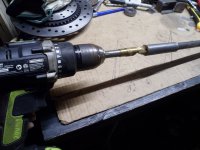
...which is a 5/8" drill bit (chucked in the drill)
...& a piece of 5/8" ID pipe "jammed" on the end of the drill bit
...with the end of the 5/8" rod "jammed into the other end of the pipe :2guns:
SAM_1810 (2).JPG
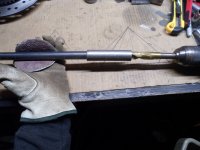
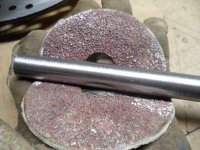
My gloved left hand held the "cutter"
SAM_1812 (1).JPG
* Cutter is/was an old, broke in half piece of rough sanding disc)
SAM_1813 (1).JPG
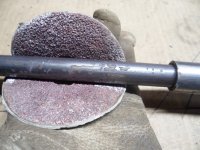
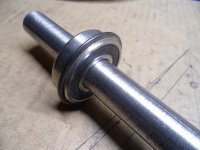
Here is how it looks after a bit of spinnin' :bannana:
SAM_1814 (1).JPG
Now, the bearing slides on nicely ;)
SAM_1815 (1).JPG
Now, we gots us a "prop stand" for the rear wheel :sifone:
SAM_1798 (1).JPG
 

Denny

Canned Monster
Messages
11,569
Reaction score
7,992
Location
Mayberry, Indiana
True dat fact.
the weird thing is it doesn't look like that. Must be a lighting thing.
here at the Mt. Top lab there is an "inspection room". With a bunch of climate change s**t. No,wait! It's climate control s**t. Anyway,the room is kept at 68F and 30% humdidily, some hi teck filter crap, bla, bla, bla.
things just don,t rust. (Visible anyhow)
l should see what its like in there, someday!

that thing about the "great Northwest" has been updated. We now prefer to be referred to as the "grape northwest". We have been over run by overpriced snooty fermented grape juice and their outlets. Remember way back when gas stations were on every corner? Here its wine. Does anyone really pay $80+ for a bottle of grape juice?
And it’s spoiled grape juice at that! It ain’t even sweet. $40 bucks a fifth for Jack Daniels and you’ll get twice as shnockered!!
 

Master Hack

Well-known member
Messages
4,085
Reaction score
6,478
Location
Mountain top Labratory
That “coating” or bark as it is often referred to, is just mill scale. You’ll see it on all hot rolled steel. It is just oxidized steel and crap. Your welds will improve if ya can remove it first. Being as lazy l am, l dip parts in acid, before resorting to mechanical means to remove it.

l don’t drink wine, but its everywhere around here. This is Napa valley north.
Don’t care for Jack, but XO will sufice nicely.
Shnockerd? Can’t remember when that happened last, maybe 25 years ago?

Oh, and BTW nice work K!

lf ya ever come across old reamers grab ‘em if ther’re cheap. Even dull they work for stuff like that. Reamers come in a million different sizes….
 
Last edited:

Functional Artist

Well-known member
Messages
5,303
Reaction score
2,744
Location
Toledo, Ohio
"Wine is fine
...but, whiskey is quicker

Suicide is slow with liquor" -Ozzy

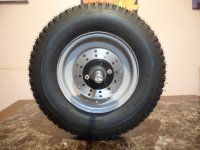
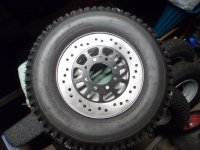
Notice how small a 5" rotor looks on a 16" wheel
...& so, a 16" wheel would have a ~3:1 leverage advantage over a 5" rotor
SAM_1820 (1).JPG
But, if using an 8" rotor, the leverage advantage (of a 16" wheel) would drop down to ~2:1 (pretty simple math) :thumbsup:
SAM_1214 (1).JPG
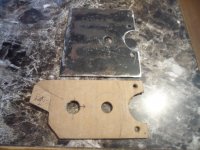
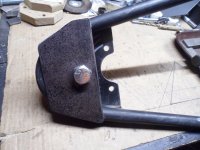
I also, re-used the CAD caliper mounting bracket template, that I made up for the 8" rotors on the front wheels
...& just installed another spindle hole (for use with 5" rotors)
...& then, transferred it to steel ;)
SAM_1819 (1).JPG
 

Functional Artist

Well-known member
Messages
5,303
Reaction score
2,744
Location
Toledo, Ohio
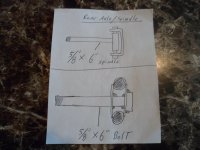
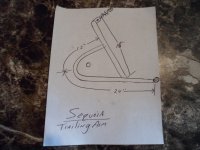
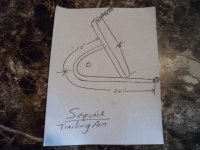
Rear swing arm drawings

Top depicts a standard turn able front spindle (just a 5/8" bolt, welded to a piece of steel tube)
...& the lower drawin' is "an idea" of a dual-walled stationary spindle

The dual walls spread out the mounting area (~1")
...& then, the spindle/bolt can be welded in multiple places &/or on multiple "levels" ;)
SAM_1802 (2).JPG
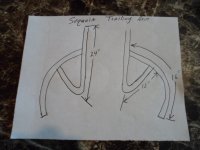
Swing arm tube specs diagram
...but, it's not really representative, of what I have in mind :huh:
SAM_1804 (2).JPG
Probably, something more like this :thumbsup:
SAM_1801 (2).JPG
 

Master Hack

Well-known member
Messages
4,085
Reaction score
6,478
Location
Mountain top Labratory
Today Egor and the Skunksworks team started on the rear hub thingy. There are a few things that can be done while waiting on the final drawings to get approved.
Any excuse to get to play on the spinna thing.

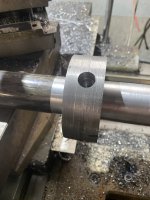
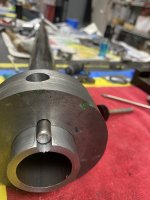
First remove the bark.

IMG_4051.jpeg

Indicate in the hub thingy.

IMG_4052.jpeg
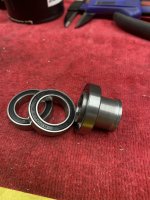
Bore the hub thingy to fit the tube

IMG_4053.jpeg
Wow, it fits. First try!

IMG_4055.jpeg
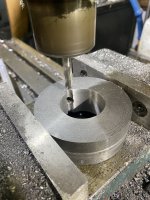
Then we need a keyway to keep things in place.
The Skunkworks division reported that they do not have broach to cut "normal square keyways"
So after million$ spent on research and development a round keyway was developed.
There have been countless hours of testing this design on the Nerdbergring here @ the Mt. top.
The design has been proven reliable and durable,
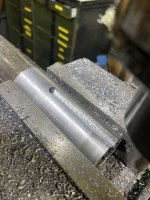
The final key will be 5/16 inch diameter. To cut the slots the correct depth we need to go half of 5/16 = 5/32 = .1562 inch.
IMG_4056.jpeg
both pieces need the same groove. (groovy)
IMG_4057.jpeg
So it looks like this
IMG_4058.jpeg

Now where is the 5/16 key stock?
IMG_4059.jpeg
 
Last edited:

Functional Artist

Well-known member
Messages
5,303
Reaction score
2,744
Location
Toledo, Ohio
Wow! Lookin' good! :2guns:

1.) I don't think I have ever seen a round key
...but, seems ta be a pretty clever solution :thumbsup:

2.) Most go kart axle keys are 1/4"...interested in the reasoning for 5/16"? :unsure:
 

Master Hack

Well-known member
Messages
4,085
Reaction score
6,478
Location
Mountain top Labratory
Wow! Lookin' good! :2guns:

1.) I don't think I have ever seen a round key
...but, seems ta be a pretty clever solution :thumbsup:

2.) Most go kart axle keys are 1/4"...interested in the reasoning for 5/16"
It’s a cheap hack solution to an expensive problem. A good (not chinese) broach is bux. I’m cheap, i’m a hack, and l have a 5/16 ball end mill.
for 1 or 2 keys a year its not worth the expense.
1/4 would work, but 5/16 stuff is all right here. The biggest reason is it adds another layer of WTF? to my stuff!
it works well, not to worry.
 

Functional Artist

Well-known member
Messages
5,303
Reaction score
2,744
Location
Toledo, Ohio
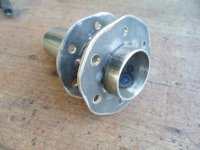
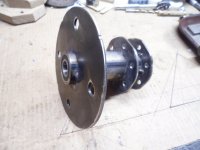
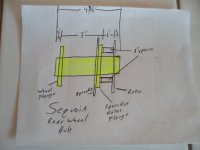
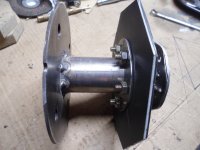
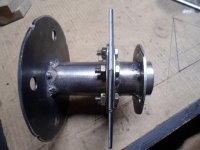
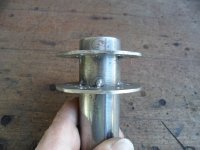
Ta work on the rear swing arm, I made up a "mock" rear hub
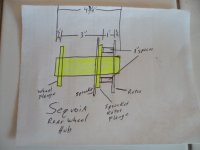
Rear hub diagram
SAM_1751 (2).JPG
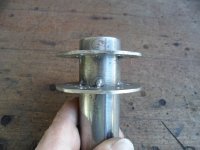
Started off with a 4 3/4" piece of 1 1/2" steel tube (as per the diagram)
SAM_1837 (1).JPG
Used a couple of pieces of 1" steel as the "spacer" to separate the rotor flange & the sprocket flange
...& used some 1/4" bolts ta bolt 'em together (ta hold everything together)
...& also, some welding magnets ta help hold the rotor flange, at the 1/2" mark (on the tube)
SAM_1843 (1).JPG
Just added a couple of "tacs"
...'cause, it's not really made ta be usable (it'll just be used for mockin' & proppin")
SAM_1844 (1).JPG
Another view
SAM_1845 (1).JPG
Then, added the wheel flange (using the same concept)
SAM_1849 (1).JPG
 
Last edited:

Functional Artist

Well-known member
Messages
5,303
Reaction score
2,744
Location
Toledo, Ohio
Hey T,
Ya need a better source for yer educational materials!
BS
I wish I had some of your skills
...but, I really like watching a "craftsman at work" (that B you) :2guns:

So, I figured that while I was makin' a mock rear hub, I would make it kinda like the original idea using (3) flanges
SAM_1578 (1).JPG
This is what I had in mind for a DIY split sprocket (just made up a plastic "mock" sprocket, for illustration purposes) :thumbsup:
...& a split bolting flange/ring (the real thing)
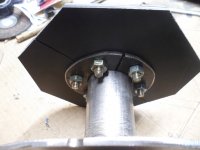
SAM_1860 (1).JPG
By only welding the sprocket & rotor flanges on the "inside" (in between the 1" area) the "flange "faces" would stay "clean' :sifone:
SAM_1844 (1).JPG
Then, the (2) halves of the split sprocket could be installed, onto the "outer face" of the sprocket (center) flange
SAM_1862 (1).JPG
The (2) halves of the bolting ring would help to align & secure the (2) halves of the sprocket :cheers2:
SAM_1864 (1).JPG
** Ideally, the flanges would be threaded (not using nuts & bolts, as shown)
SAM_1863 (1).JPG
 
Last edited:

Functional Artist

Well-known member
Messages
5,303
Reaction score
2,744
Location
Toledo, Ohio
OK, back to the swing arm (AKA trailing arm) :cheers2:

Reminder:
Drawing
SAM_1801 (2).JPG
Welding diagram (lower part of pic)
SAM_1802 (2).JPG
Maybe something like this
SAM_1852 (1).JPG
...& this
SAM_1854 (1).JPG
A 6" weldment bold should be adequate for a 4 3/4" hub (right)
SAM_1853 (1).JPG
Well, that would be a NO :furious2::mad2:
SAM_1855 (1).JPG
Hmmm....lets do the math :smartass:

So, we have a 6" bolt
...going thru a 3/16" plate
...& then, a ~7/8" space
...& then, another ~3/16" plate
...& then a 4 3/4" hub

WTF?...yup...Um...I mean nope...it don't seem ta add up too goodly :surrender:
...so, it looks like we probably gonna need a ~7" spindle/bolt
 

Master Hack

Well-known member
Messages
4,085
Reaction score
6,478
Location
Mountain top Labratory
l get what ya wanted to do, and mechanically it would be fine. It would be a nightmare to build. The most difficult would be to keep all those parts, straight, true and concentric. The 2 flange hubs were a bichhh! I wanted to keep runout .005 or less. Had success with that, but, Welding that together complicates all that. The doughnut provides 2 perfect mounting surfaces that cant get f'ed up, without some serious effort. That just leaves 1.
 

Master Hack

Well-known member
Messages
4,085
Reaction score
6,478
Location
Mountain top Labratory
5/8 bolt?

l'm ok with the split sprocket even, as long as the lD fits our requirement.
the doughnut makes the whole thing simple.
You'll get it when l start. I'll 'splain it all soon. I think you'll like it.
you'll be building your next two or three projects around this hub.
 

Functional Artist

Well-known member
Messages
5,303
Reaction score
2,744
Location
Toledo, Ohio
l get what ya wanted to do, and mechanically it would be fine. It would be a nightmare to build. The most difficult would be to keep all those parts, straight, true and concentric. The 2 flange hubs were a bichhh! I wanted to keep runout .005 or less. Had success with that, but, Welding that together complicates all that. The doughnut provides 2 perfect mounting surfaces that cant get f'ed up, without some serious effort. That just leaves 1.
Hey T,
I can't wait ta see what ya come up with. :popcorn:

I'm not questioning "your work" at all
...I'm tryin' ta learn more about this stuff, as I/we go :thumbsup:

But, I do have a couple of questions :cornut:

My !ARRIBA! kart
...had, factory made hubs (they are now on the Land Speeder)
...& the hubs didn't have any machining marks on the flange "faces"
SAM_1329 (1).JPG
1.) Any idea what "runout" tolerance most production shops would use, for the flanges on go kart hubs?
...& how they "get away" without "facing" the flanges?

2.) Any idea what technique they would/could use
...or how (method or jig) they use to weld the flanges on as "straight" as they do? :unsure:
 
Top