Remember trying to keep RPMs low and a fairly mild engine that will last.
Here is the cam I like.
Camshaft, 280 Series - (GX240s to GX390s)
Our Price: $109.99
http://www.nrracing.com/product-p/390cam-280.htm
Approx .280 lift and 220 duration (at .050). This is a nice cam that works well on both stock and modified motors. This cam produces lots of low end torque. One of the best all around cams we offer. HD springs required. Bored or Aftermarket carb needed.
TQ Grind - Serious Torque for Small Tracks 6000 max RPM. 9.0 to 1 compression or more, HD Springs Required.
Or maybe I like the Black Mamba Jr for gx390!
0.275" Lift, 230 degree duration, 104 LSA.
http://smallenginecams.com/
---------- Post added at 02:08 PM ---------- Previous post was at 02:02 PM ----------
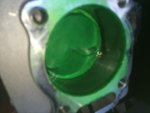
That paticular feature is so the "Venturi Effect" can be employed. Many beginning porters remove that...to the detriment of air flow.
Just one of the many mistakes the semi-informed make because they are not privy to the hidden secret information here.
BTW: I think it was Jim Carey that coined that "Venturi" connotation....it was one of his "Pet" things...IIRC.
I haven't yet got the math of the throat of the port. Geez.
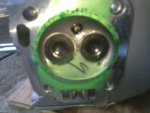
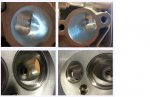
This was just the port opening and "runner?".
I was just about to re-read up on the optimized throat diameter.
I think it SHOULD BE MORE NARROW,
to speed up the air like a Pet Detective.
---------- Post added at 02:10 PM ---------- Previous post was at 02:08 PM ----------
https://www.youtube.com/watch?v=NarFUj80HfY
https://www.youtube.com/watch?v=lut9QPNAPhU
---------- Post added at 02:16 PM ---------- Previous post was at 02:10 PM ----------
That paticular feature is so the "Venturi Effect" can be employed. Many beginning porters remove that...to the detriment of air flow.
Just one of the many mistakes the semi-informed make because they are not privy to the hidden secret information here.
BTW: I think it was Jim Carey that coined that "Venturi" connotation....it was one of his "Pet" things...IIRC.
SEE It was the very next section.
"Calculating Optimum Port Area from Valve Size
The primary objective of all performance cylinder heads is to produce the maximum possible volumetric efficiency across the broadest possible range of engine speed. That’s why port and valve sizes are so critical and so easy to mess up without careful deliberation. The intake port crosssectional area (c/s) describes the smallest area of a port in a perpendicular plane to the flow upstream of the valve. There are two schools of thought on this. Depending on the cylinder head, the smallest cross section may actually be the venturi diameter or throat area directly above the valve seat. This is particularly true if you also consider the additional obstruction of the valve guide and valve stem. Others define cross-sectional area as the choke point farther upstream near the bump in the port wall adjacent to the pushrod. To determine this you measure the vertical and horizontal dimensions at that point and multiply to find the area."
---------- Post added at 02:29 PM ---------- Previous post was at 02:16 PM ----------
The throat (difficult to measure) my best guess is 1.185 sq inches +/- 0.125 square inches.
So If we use this number then....
1.185 sq inches / 4.25" = 0.279"
I still like my cam choices!
---------- Post added at 02:42 PM ---------- Previous post was at 02:29 PM ----------
"Head porters contend that the upstream cross-sectional area (in the port itself) should be 90 percent of the flow diameter of the intake valve for a race engine and 0.85 percent for a street engine. Some feel that 90 percent is good across the board. This is based on the valve’s flow diameter at the inner edge of the valve seat. It’s a reasonable assumption although the throat diameter directly above the valve seat may be even smaller and that is what the air actually sees. And it doesn’t account for the partial blockage caused by the valve guide and stem. For now however, we are simply relating port cross-sectional area in the port itself to the flow diameter at the valve seat.
For example, a 2.02-inch intake valve has a flow diameter of 1.717 inches if we’re going by the 85-percent rule."
My intake valve is 35mm.
35mm / 25.4mm/in = 1.38"
They say use 85 or 90.
I'll use 87.5.
1.38" *0.875 = 1.21" (87.5% Valve flow diameter)
1.21"/2 = 0.605" Radius
87.5% Valve Flow Area =
0.605" * 0.605" * 3.14159 =
1.150 sq inches
I measured 1.185 sq inches
= 3.14159 *r*r
r*r = 0.377
r = 0.614
Diam = 1.228"
1.228"/ 1.38" = 89% of Valve Diameter
SWEET!!
Everything looks really good on this engine so far. At least to me.
Good but very Broken!
---------- Post added at 02:49 PM ---------- Previous post was at 02:42 PM ----------
So what does this show me???????????????
Don't make anything much bigger!!!!!!!!!
Just clean it up!!!!!!!!!!
Then look at it after and wonder where all the material has gone!!!

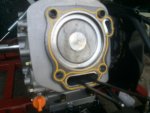 image.jpg194.2 KB · Views: 6