new to this

Status
Not open for further replies.

itsid

Moderator
Staff member
Messages
11,563
Reaction score
238
Location
Ruhrpott [Germany]
Is it possible the 1016 is 350w and the 1020 is 500w?
certainly not power, since my1020 range from 350W to 1000W
and my1016 range from 150W to 350W
but likely it's can size (short case, vs long case)
then ZY with bracket MY w/o..
maybe they just moved from MY names to ZY names for some other reason .. IDK
see here for example:
https://www.motiondynamics.com.au/united-my1016-350w-24v-dc-motor-with-11-tooth-chain-sprocket.html
(clearly states MY1016.. and ZY1016 on the label...)

too bad the unite website is no longer available:(
it was also misleading or plain wrong at times.. but it at least made
some of their naming system obvious (trailing Z for geared.. and ZX for planetary gearbox etc )
it was www.unitemotor.com (Zhejiang Unite Electric Motor Co Ltd)
red triangle UM logo

they themselves listed the my1020 to be available in 350W-750W
(while there clearly is a 1000W version and an 800W version)
so yeah grain of salt I guess ;)
here's an older list ..
http://web.archive.org/web/20050924003856/http://new.unitemotor.com:80/list.htm

Anyways, it's not really important what they call their motor,
as long as they list the mechanical power output instead of the thirst for electrical power and you pick the one that fits your needs ;)

geared or ungeared, long or short, with or without mounting bracket...
whatever suits you best :D

'sid
 

alim

New member
Messages
61
Reaction score
0
Is reverse important on a cart? Big jump in price from non-reverse controllers to reverse controllers.

Also, ned's sticky said the controllers must be run at their specified voltage. If I were to go with say a 24v motor, but I wanted to power it with a 20v lithium battery pack from a power tool, would that cause a problem with the controller?
 

itsid

Moderator
Staff member
Messages
11,563
Reaction score
238
Location
Ruhrpott [Germany]
yes, voltage is important, mainly because nearly all controllers have a so called undervoltage protection, the margin is relatively slim (within 10-15% of the nominal voltage)
soo for a 24V battery around 21Volts cutoff .. sometimes as little as 18V (for LiPos and deep cycle)

With a 20V batpack, that means there's not much juice you can make use of if any at all.
(keep in mind that a typical 12V battery holds 13.7Volts when fully charged)

The controller does not know what kind of battery is installed, and likely has a single setting (expensive ones have a programmable undervoltage protection limit, cheap ones don't)

reverse? nope.. I'd say none of the go karts on this site have reverse,
and just few of the mini buggies have.

So important.. nope.. convenient at times.. sure ;)

'sid
 

alim

New member
Messages
61
Reaction score
0
The plot thickens. I pulled the 24v motor out of the lawn mower today, set it up on a bench, set up a video cam, was going to run a few tests and upload the vid for you guys. I went to do the resistance test and I connected the leads on the multimeter to make sure I get a 0 reading - I didn't get a 0 reading, I got around 3 ohms! :confused:

Do I have a bad MM?
 

alim

New member
Messages
61
Reaction score
0
What would be a good choice of motor voltage rating if one wanted to build an electric kart that's powered by cordless tool batt packs? The batt packs are appealing because they're light, easy to use (no alligator clips or adapters or whatever, both for plugging in the kart and for charging), and ready available, if a little expensive.

The motors (in general) are 12v (too wimpy), 24v, 36v, 48v.

The batt packs (in general) are 12v, 14.4v, 18v, 20v, 40v.
 

Ebrownie

Member
Messages
582
Reaction score
7
Location
Western Montana
Your issue with those is that those cordless battery packs don't have near enough Ah to keep the motor going for very long. Most of them are around 3 Ah, correct? So with, say 3 of those cordless batteries, you only have 9 or so Ah, which is not enough if your motor is drawing a lot of power. I'm no expert, but a 36v 500w motor draws at least like 12 amps, right? I guess it depends how long you want the batteries to last, but 12v SLAs in like 12 or 18 Ah are pretty cheap.
 

alim

New member
Messages
61
Reaction score
0
SLAs are cheap yes, but also heavy and clunky to handle. Imagine using an electric kart similar to how you use a cordless power tool - when your batt goes low, throw it on the charger, grab a fresh one, and keep going. It's not like you're travelling long distances in a kart, usually just running around in the same area, so when things get sluggish you just go for a quick pit stop.
 

zogthegreat

New member
Messages
230
Reaction score
1
Location
Lake Wales FL/Montreal QC
You got any pics of this thing? How did you manage to cram all that on a Razor scooter? I'm looking at this pedal kart I got off kijiji wondering how the f--- I'm gonna fit a 24v 350w and 2 x 12ah!

Hi alim,

In reply to your question on the other thread, I used a really big hammer and a pry bar! ;)

You can see my build log here:

http://forum.modifiedelectricscooters.com/viewtopic.php?f=13&t=2192&p=17016#p16960

Although it seems that I didn't finish the build log and I can't find the pics of my final project. I mostly used hand tools for this project, along with a cheap arsed Chinese flux core mig welder that I got for $75.00 on fleabay. One quick note on the cheap'o welders, they are A/C output only. What this means is that you can't get as good of a weld as a DC welder, your welds won't penetrate as deeply as with a DC machine and no matter what you do, your welds will always look like crap. However, for projects like I do, this type of welder has been adequate and my welds have always been strong enough.

I had to make the battery box supports longer:

http://forum.modifiedelectricscooters.com/viewtopic.php?f=13&t=2192&start=50#p17817

and build a new battery box out of fiberglass. I originally had the motor mounted on the underside like this:


But I had problems with the motor scraping the ground so I had to mount it on the top side and remake the deck that you see in the build log.

The trick to doing a mod like your describing is to figure out what parts you want to use and then how to cram them all into the space that you have. Don't be afraid to cut, bend or weld. If you don't weld or you don't have access to welding gear, you can do a lot with grade 5 or 8 bolts and lock nuts.

The main things that you want to think about when placing you batteries is balancing the weight, and having your wiring as short as possible to help with voltage drop over long lines:

"Voltage drop describes how energy is supplied of a voltage source that is reduced as electric current moves through the passive elements (elements that do not supply voltage) of an electrical circuit. Voltage drops across internal resistances of the source, across conductors, across contacts, and across connectors are undesired as the supplied energy is lost (dissipated). Voltage drops across loads and across other active circuit elements are desired as the supplied energy performs useful work."

https://en.wikipedia.org/wiki/Voltage_drop


i.e, the shorter your wires, the better!

If you have any pictures of your project, it would help me and the other forum members with making suggestions on where to put the bits and pieces that you need for a project like this.

One thing to think about would be to run your 24v motor at 36v. Based on what I can find here:

http://manuals.homelite.com/system/files/4282/original/UT13122_039_eng.pdf?2017

Your motor spins at 3600 rpm without a load. The last part is important, because my experience with 24v motors is that they really suffer from a lack of torque. These motors are fairly robust and usually can handle 36v. Besides, if you fry the motor, it will give you and your sons a rebuild project to do!

I hope this helps.

zog
 

bob58o

SuckSqueezeBangBlow
Messages
9,646
Reaction score
1,826
Location
Chicago-town USA
What would be a good choice of motor voltage rating if one wanted to build an electric kart that's powered by cordless tool batt packs? The batt packs are appealing because they're light, easy to use (no alligator clips or adapters or whatever, both for plugging in the kart and for charging), and ready available, if a little expensive.

The motors (in general) are 12v (too wimpy), 24v, 36v, 48v.

The batt packs (in general) are 12v, 14.4v, 18v, 20v, 40v.

Monster Garage. They make a dragster with drill batteries.
https://www.youtube.com/watch?v=to90o173dCg
 

alim

New member
Messages
61
Reaction score
0
Ok, I bought a couple of resistors yesterday, 1 200ohm 2w and 1 270ohm 2w, so I can properly test my 24v lawn mower motor and make sure the results are accurate using the "voltage divider" method described by Sid earlier in this thread.

My multimeter isn't working properly so I will need to get another one. It reads the resistors I bought as 50ohm and 100ohm :(
 

alim

New member
Messages
61
Reaction score
0
The trick to doing a mod like your describing is to figure out what parts you want to use and then how to cram them all into the space that you have. Don't be afraid to cut, bend or weld. If you don't weld or you don't have access to welding gear, you can do a lot with grade 5 or 8 bolts and lock nuts.

I definitely don't weld, and don't really want to :) I guess if I could I probably wouldn't be working from the pedal cart as a starting point for the frame!

The main things that you want to think about when placing you batteries is balancing the weight, and having your wiring as short as possible to help with voltage drop over long lines:

"Voltage drop describes how energy is supplied of a voltage source that is reduced as electric current moves through the passive elements (elements that do not supply voltage) of an electrical circuit. Voltage drops across internal resistances of the source, across conductors, across contacts, and across connectors are undesired as the supplied energy is lost (dissipated). Voltage drops across loads and across other active circuit elements are desired as the supplied energy performs useful work."

https://en.wikipedia.org/wiki/Voltage_drop


i.e, the shorter your wires, the better!

Gotta balance the battery weight, and keep the leads nice and short, got it.

If you have any pictures of your project, it would help me and the other forum members with making suggestions on where to put the bits and pieces that you need for a project like this.

When it's time to start thinking about where all the parts are gonna go, I'll put up some pics for advice for sure.

One thing to think about would be to run your 24v motor at 36v. Based on what I can find here:

http://manuals.homelite.com/system/files/4282/original/UT13122_039_eng.pdf?2017

Your motor spins at 3600 rpm without a load. The last part is important, because my experience with 24v motors is that they really suffer from a lack of torque. These motors are fairly robust and usually can handle 36v. Besides, if you fry the motor, it will give you and your sons a rebuild project to do!

I was reading elsewhere on this forum that although it's possible to overvolt a motor, the extra power goes heat not motion. Kinda like my last marriage...
 

zogthegreat

New member
Messages
230
Reaction score
1
Location
Lake Wales FL/Montreal QC
I definitely don't weld, and don't really want to :) I guess if I could I probably wouldn't be working from the pedal cart as a starting point for the frame!

LOL, yeah well, I started on something similar and now.....!?!?

What you start with isn't important, your creativity is. Dream big when doing something like this, don't worry, reality will explain the parts that "aren't practical"!

I was reading elsewhere on this forum that although it's possible to overvolt a motor, the extra power goes heat not motion. Kinda like my last marriage...

Not exactly true, although you motor will run warmer/hotter depending on how many "extra" amps/volts you push through it. For example, I'm running a 36v motor on my "Beast" at 48v.


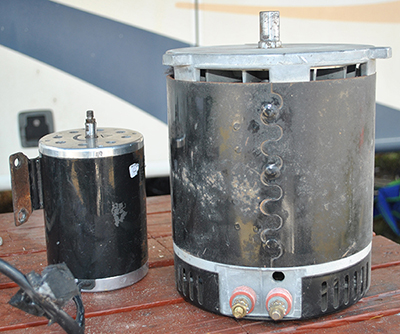
(My Imperial motor next to a Unite 1000w, 36v)

This has increased the rpm's from 2100 to around 2800 rpm. At 2100 rpm, I get around 13 mph top speed, (depending on batteries, road conditions etc). At 2800 rpm, my top speed goes up to 17 mph. Since I used an industrial motor with permanent magnets and an internal fan on the Beast, I'm not concerned about heat frying the motor, (some people have run motors like this at 72v with no problems). So don't be afraid of frying your motor. Worse case scenario is you fry what you have and you'll have to get a bigger motor.

And bigger is usually better when it comes to motors, right?

## EDIT ##

Also, those electric lawn mower motors are fairly robust, they are designed to be abused by people who probably will be doing as little maintenance as possible.
 

itsid

Moderator
Staff member
Messages
11,563
Reaction score
238
Location
Ruhrpott [Germany]
yes, but there are NO extra Amps.. just extra Volts...

Since we talk mainly about voltage specific wound motors
the power output does not increase by much (if at all)
All that increases is the power INPUT which mainly converts to heat..

it's not a question about frying the motor (you could, but as you said.. if you dare who cares)
it's about why would you drain your battery 30% faster when you have no noticable gain in power.

Some motors indeed increase their no load rpms when applied to a higher voltage, that's even very likely to happen...
then agin.. no load rpms are as telling as color ;)

'sid
 

alim

New member
Messages
61
Reaction score
0
Alright gang, replaced my multimeter today with a digital one (thank you kijiji)!

So I did two voltage divide tests just to be sure.

Test 1:
V at battery: 25.8 V = 25,800 mV
V at motor: 19.2 mV
V at resistor: 25.7 V = 25,700 mV
resistance of resistor: 264 ohms

19.2 * 264 / 25700 = .19723 is the resistance of the motor in ohms
24v (rated voltage of motor) / .19273 = 125A peak the motor can draw
24 * 125 = 3000w peak power draw

Test 2:
V at batt: 25.7 V = 25,700 mV
V at motor: 25.2 mV
V at resistor: 25.6 V = 25,600 mV
resistance of resistor: 196 ohms

25.2 * 196 / 25,600 = .19293 is the resistance of the motor in ohms
24v / .19293 = 124A peak the motor can draw
24 * 124 = 2976w peak power draw

So I did two tests, and they both tell me the motor has a peak power draw of ~3000w, which seems a little suspect (high) to me.
 

itsid

Moderator
Staff member
Messages
11,563
Reaction score
238
Location
Ruhrpott [Germany]
it is high indeed, but not outside of the range of some lawn mower motors

there was once a much searched for cordless mower that inside came with a 5kW motor
for ~60% of the price for the motor sold seperately... though still expensive,
you got a discount on the motor, a useable controlelr and a battery for free...
unfortunately that company went out of business (too slim of a margin I guess :D)

Anyways, 3kW electrical input power.. is indeed possible
although... that resistor you're using seems to be a little out of specs tbh..
30% difference... that's nowhere near a reliable reading, is it?

but then again, you have a 1Amp difference as a result, so even if we assume some ridicule misreadings (or rather inaccuracies made by various manufacturers [dmm, resistor etc..])
that motor should be able to draw about 100Amps peak at the very least (115 I'd guess).
(cold cranking amps let's say ;))
Now the resistance will slightly increase when the coils get warmed up, and so on and so forth,
but 75% of that can surely still be drawn with a hot motor;
makes at least 80Amps (rather 90 Amps tbh)
and assuming you have a motor with ~80% efficiency which is luckily quite common these days;
you'll end up with 1700 Watt of mechanical power
(as you've seen I rounded down massively along the way; to get you the lowest to be expected value)

That is quite an impressive motor tbh, good enough for an adult's kart;
for sure good enough for a kid's kart (maybe even for a small two seater...)

Assuming you have no misreadings, that's exactly the motor you'd want IMHO.
a lot of power (thus the chance of running it nice and cool for some heavy abuse by some kids)
with enough margin to speed the kart up as the kids grow
(and the occasional fun tearing up the backyard by the adult man who build the kart at full power :D:D)

:thumbsup:

So, next step determining the kind of controller needed.
brushed I assume (two wire motor)
>125Amps, and for sincere speed control, personally I'd dial towards a programmable controller,
that way you can determine the max rpms with a laptop (and a coded key later on)
safe for the kids, fun for dad :D

kelly has a 100Amp and a 200Amp controller, the first is too small so 200Amp it is:
http://kellycontroller.com/kds36200e200a24v-36v-mini-brushed-controller-p-276.html

that is the cheapest quality controller I know;
surely the best bang for the buck I know..
aaaand it's programmable :D

yes, it's way more expensive than those tiny pocket controllers for sure, but none of them can really handle 125Amps anyways AFAIK.. so there goes that
(quality 20A mosfet costs 7 bucks a piece, 200amps means ten of them.. 70 bucks in mosfets if you build your own controller... just saying)

Functional Artist has a kelly controller on one of his karts (he had on El Dingo ...it might be in El Moto now.. IDK tbh)
a bigger one, but not by much, ask him if he'd recommend it ;)

'sid

PS I'm actually really happy about that mower's motor power.. please post a pic of it,
(the mower and the motor ;))
 

alim

New member
Messages
61
Reaction score
0
that resistor you're using seems to be a little out of specs tbh.. 30% difference... that's nowhere near a reliable reading, is it?

Test 1 was done with a 270 ohm resistor.

270 ohm (rated) - 264 ohm (actual measured) = 7 ohms
7 / 270 = 2.6%

Test 2 was done with a 200 ohm resistor.

200 ohm (rated) - 196 ohm (actual measured) = 6 ohms
6 / 200 = 3%

Wow. So this thing is actually a pretty great little motor, that's awesome news!

I'm gonna have to start looking out for people giving away their 24v cordless mowers for cheap because the batteries are shot or something. Start harvesting these puppies.

So, next step determining the kind of controller needed.
brushed I assume (two wire motor)

Yes brushed motor.

>125Amps, and for sincere speed control, personally I'd dial towards a programmable controller,
that way you can determine the max rpms with a laptop (and a coded key later on)

Ahh, the catch. I can't just get a $10 controller off eBay, because my motor is too powerful! Well I haven't programmed stuff in a long time, but I do have the skills buried down deep somewhere, just have to brush off the dust and cobwebs.

kelly has a 100Amp and a 200Amp controller, the first is too small so 200Amp it is:
http://kellycontroller.com/kds36200e200a24v-36v-mini-brushed-controller-p-276.html

that is the cheapest quality controller I know;
surely the best bang for the buck I know..
aaaand it's programmable :D

Oh wow that thing is a LOT pricier than the cheapo eBay ones.

Also, will this be an issue:
"•Peak Current, 1 minute: 200A.
•Continuous current: 120A."

yes, it's way more expensive than those tiny pocket controllers for sure, but none of them can really handle 125Amps anyways AFAIK.. so there goes that
(quality 20A mosfet costs 7 bucks a piece, 200amps means ten of them.. 70 bucks in mosfets if you build your own controller... just saying)

Functional Artist has a kelly controller on one of his karts (he had on El Dingo ...it might be in El Moto now.. IDK tbh)
a bigger one, but not by much, ask him if he'd recommend it ;)

'sid

PS I'm actually really happy about that mower's motor power.. please post a pic of it,
(the mower and the motor ;))

Functional Artist, feel free to chime in with your comments on the Kelly controllers.

Thanks Sid! Here's some pics of the motor (next to a 9v batt for some perspective) and the mower.
 

Attachments

  • 20170916_222455[1].jpg
    20170916_222455[1].jpg
    153.9 KB · Views: 5
  • 20170916_222512[1].jpg
    20170916_222512[1].jpg
    141.1 KB · Views: 5
  • 20170916_222655[1].jpg
    20170916_222655[1].jpg
    138.9 KB · Views: 5
  • 20170916_222718[1].jpg
    20170916_222718[1].jpg
    252.3 KB · Views: 6

itsid

Moderator
Staff member
Messages
11,563
Reaction score
238
Location
Ruhrpott [Germany]
ahhh two different resistors.. much better! :D

yes, but for bench testing you can use the controller that's in the mower, it's likely throttled down,
to not drain the battery within just 5 minutes (12Ah.. 125 Amp...you get the idea)

maybe it can be messed with to gain the full motors potential, but I doubt it TBH.

have you restested the weed eater motor with the voltage divider?
maybe that reading was also a bit off
(the first on the mower was 300.. now it's 3kW... by that rate the 80W first reading of the weed eater might end up being 800 ;))
If it is, it's enough for a nice kids kart and you can get a cheap controller off ebay as well (sweet spot so to speak)

No, the controller is a rather perfect match,
a controller is a well, not a pump ;)
it allows up to 200Amps peak 120A continuous to be drawn (any more and it'll overheat [run dry])
the motor on the other side always draws the full amperage it can; (125Amps at first, warm maybe ~115)
and what the controller then does, is switch the powerline on and off according to the throttle position. (pulse width modulation) to limit the average power.

'sid
 

alim

New member
Messages
61
Reaction score
0
I measured the 18v weed-eater mower, it's coming up between 140w and 180w. That's a big to weak, yes?
 
Status
Not open for further replies.
Top