new to this

Status
Not open for further replies.

alim

New member
Messages
61
Reaction score
0
Hi all, brand new to the world of karting. I'm 42yo, have 8yo and 10yo sons. Would like to build simple (cheap) electric karts for them, electric because I know nothing about gas engines and I like the quiet and clean and not smelly/smoky aspect, and so would my neighbours.

I'm great with computers but not so great with building stuff, I don't have a 3d printer and I can't weld so I'm not going to be able to do much if any fabricating.

I am hoping to use stuff I already have starting with an 18v brush motor from a cordless electric weed-eater. Batteries would be SLAs, I researched how to "revive" them and I tried it and it worked, so I'm pretty stoked about that. I also have a 24v lawn mower and a 48v lawn mower, was hoping to start with the 18v just to get my feet wet.

I have read the stickys from Ned and the "essence" thread... this motor I have doesn't have any markings on it so I don't know the power, but it's probably not very much. I saw a vid on youtube where a guy put tape on the shaft, then let it hit his thumb while recording the sound, then loaded the sound recording into a audio software and used it to figure out the RPM - should I do that, would that help?

The other thing is the frame, since I have no welding/fabrication skills or tools, I would like to use a pedal cart and fit it with the electrics. Grabbed one off kijiji for $20.

So to recap: 18v motor, 24v SLA batt, pedal cart. Need controller, throttle (I think thumb throttle mounted on steering wheel), need to know sprocket details including how to mount them. Really hoping you fine folks can help me build this thing so it doesn't just burn up. Performance doesn't have to be the greatest! If this one goes well I will probably build a better one but to start because I have never done anything like this before I'm just looking for it to be cheap and to work.

Many thanks!
 

pRoFiT

Can't buy it?, build it!
Messages
1,151
Reaction score
60
Location
California
Electric and cheap is new to me :)

But if you want power wheels style speed then cheap maybe possible.

Itsid is our local electrical guy im sure he will chime in soon enough.

so you purchased a frame? have any pictures to post? would be good to see what you have already.

RPM of motor not always the biggest concern as you can change the gear ratio to match but voltage of motor, current draw? hopefully a DC motor. AC motors are hard to put in go karts. current draw helps calculate how much fun time you will get ;)

Location? where are you located? Will help if you need a place to buy things and to help with cost of things in your location. kijiji ? canadian?

Fabrication skills. you will at least need a drill to bolt things together. would help to have welder and angle grinder or saw, to fabricate mounts and brackets to hold motor in place?

Batteries. 24VDC SLA what is the mAH? so we can determine how long you will be able to drive.

Speed control.....im not too familiar with all the possible speed controls out there. need to know motor voltage rating first to match a controller with it.
 

itsid

Moderator
Staff member
Messages
11,563
Reaction score
238
Location
Ruhrpott [Germany]
first: I think the lawn mower is a better source than the weed eater.

1) it's likely a bit more powerfull (especially if it's the self propelled type)
2) if you have the mower, you have the controller, throttle and motor all at once ;)
(this might hold true for the weed eater as well)

First Power:
To find out about the motors power consumption,
you can fab a small voltage divider (basically all you need is a nicely sized resistor that's able to handle some power and a digital multimeter really..)
then test the motors internal resistance (will likely be too low to be read from the DMM directly) and you know what power it can draw.

typically it'll be around 90-150 Watts really;
which is enough for a kid's kick scooter.. and the so called power wheels.. might be just enough for a small pedal kart *shrugs* but IDK...

I'd rather test one of the mowers tbh they're more likely to have the power you'll need.

And again, if there was a small electronics box wired between the trigger and the motor.. you already have a controller matching the motor in question.
it'll not be perfect for an electric vehicle, but it'll do for getting your feet wet ;)

'sid
 

alim

New member
Messages
61
Reaction score
0
Electric and cheap is new to me :)

But if you want power wheels style speed then cheap maybe possible.

Itsid is our local electrical guy im sure he will chime in soon enough.

so you purchased a frame? have any pictures to post? would be good to see what you have already.

RPM of motor not always the biggest concern as you can change the gear ratio to match but voltage of motor, current draw? hopefully a DC motor. AC motors are hard to put in go karts. current draw helps calculate how much fun time you will get ;)

Location? where are you located? Will help if you need a place to buy things and to help with cost of things in your location. kijiji ? canadian?

Fabrication skills. you will at least need a drill to bolt things together. would help to have welder and angle grinder or saw, to fabricate mounts and brackets to hold motor in place?

Batteries. 24VDC SLA what is the mAH? so we can determine how long you will be able to drive.

Speed control.....im not too familiar with all the possible speed controls out there. need to know motor voltage rating first to match a controller with it.

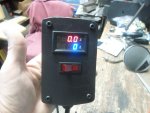
This is the pedal cart, with seat and cover removed to expose the "guts". Rear wheels are 10" diameter.

The weed-eater and lawn mower motors are all DC.

I am in Canada (London Ontario to be exact).

I have drill, and I can borrow a grinder as needed. Definitely no welder.

I have a couple of 12Ah 12v SLAs and a bunch of 7.2h SLAs.

Not sure what you meant by "motor voltage rating".

Thanks!

From my kids: :roflol::2guns::thumbsup:

Can't seem to post the pics, here's links to them:

https://drive.google.com/file/d/0B3m7W1PZjAykNnMxVW1jSXZhdWs/view?usp=sharing
https://drive.google.com/file/d/0B3m7W1PZjAykUHdjZEZubEVkUkk/view?usp=sharing


---------- Post added at 08:57 AM ---------- Previous post was at 08:43 AM ----------

first: I think the lawn mower is a better source than the weed eater.

1) it's likely a bit more powerfull (especially if it's the self propelled type)
2) if you have the mower, you have the controller, throttle and motor all at once ;)
(this might hold true for the weed eater as well)

First Power:
To find out about the motors power consumption,
you can fab a small voltage divider (basically all you need is a nicely sized resistor that's able to handle some power and a digital multimeter really..)
then test the motors internal resistance (will likely be too low to be read from the DMM directly) and you know what power it can draw.

typically it'll be around 90-150 Watts really;
which is enough for a kid's kick scooter.. and the so called power wheels.. might be just enough for a small pedal kart *shrugs* but IDK...

I'd rather test one of the mowers tbh they're more likely to have the power you'll need.

And again, if there was a small electronics box wired between the trigger and the motor.. you already have a controller matching the motor in question.
it'll not be perfect for an electric vehicle, but it'll do for getting your feet wet ;)

'sid

Ok, so it sounds like the first order of business is to measure the power of the motors, ya? I'll test all three of the motors I have. Is there a good how-to or youtube vid on how to do that?

Thanks!
 
Last edited:

itsid

Moderator
Staff member
Messages
11,563
Reaction score
238
Location
Ruhrpott [Germany]
IDK of a good how to tbh.
First let's make sure we need a voltage divider,
try to measure the motor resistance across it's terminals with the DMM.
if you get readings like 2Ohms or smaller you might want a voltage divider
since DMM mostly cannot read small resistances very precisely

Making a Voltage divider is easy:
get a good size resistor (I'd say 220 Ohms 2 or 3 Watts)
and a good power supply (one 12V SLA will do nicely)

get your multimeter and pen and paper.
now connect the resistor in series with the motor.
note down
1) the actual voltage directly across the battery poles.
2) the actual voltage directly on the motor terminals (should be low, read mV!)
3) the actual voltage directly on the resistor (as close to the bead as possible)

and finally
4) the actual resistance of the resistor (again as close to the bead as possible)

And disconnect the battery.

the rest is math:
raise all Volts to the same pwer of ten (ie multiply Volts by 1000 to get mV)
check that the volts do add up ( reading 2 + reading 3 = reading 1)
and if that's nice and close

And then just reading 2 * reading 4 / reading 3
will get you the resistance of the motor in Ohms.

divide the motor rated voltage by the resistance to get the peak amperage the motor can draw.

multiply Volts and Amps to get the peak power draw.
(I'd say it's safe to say that ~60% of that will be available as constant mechanical motor power maybe a bit more even)

'sid
 

alim

New member
Messages
61
Reaction score
0
try to measure the motor resistance across it's terminals with the DMM.
'sid

I have a multimeter, it's analog not digital. I know how to set it to measure resistance, that's easy enough. So then I touch the red probe to one terminal of the motor, and the black probe to the other terminal of the motor? Wouldn't I have to try and push some juice through it in order to measure it's resistance? Sorry for such basic questions :(
 

Functional Artist

Well-known member
Messages
5,281
Reaction score
2,720
Location
Toledo, Ohio
IDK of a good how to tbh.
First let's make sure we need a voltage divider,
try to measure the motor resistance across it's terminals with the DMM.
if you get readings like 2Ohms or smaller you might want a voltage divider
since DMM mostly cannot read small resistances very precisely

Making a Voltage divider is easy:
get a good size resistor (I'd say 220 Ohms 2 or 3 Watts)
and a good power supply (one 12V SLA will do nicely)

get your multimeter and pen and paper.
now connect the resistor in series with the motor.
note down
1) the actual voltage directly across the battery poles.
2) the actual voltage directly on the motor terminals (should be low, read mV!)
3) the actual voltage directly on the resistor (as close to the bead as possible)

and finally
4) the actual resistance of the resistor (again as close to the bead as possible)

And disconnect the battery.

the rest is math:
raise all Volts to the same pwer of ten (ie multiply Volts by 1000 to get mV)
check that the volts do add up ( reading 2 + reading 3 = reading 1)
and if that's nice and close

And then just reading 2 * reading 4 / reading 3
will get you the resistance of the motor in Ohms.

divide the motor rated voltage by the resistance to get the peak amperage the motor can draw.

multiply Volts and Amps to get the peak power draw.
(I'd say it's safe to say that ~60% of that will be available as constant mechanical motor power maybe a bit more even)

'sid

Hey Sid,

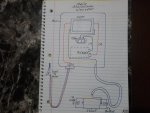
Would a simple (~$20.00) DIY meter be another/easier way for folks to find this type of data?
 

Attachments

  • SAM_4294.jpg
    SAM_4294.jpg
    218 KB · Views: 5
  • SAM_4290.jpg
    SAM_4290.jpg
    243.9 KB · Views: 10

alim

New member
Messages
61
Reaction score
0
Oh nice, just opened up my multimeter and there's a battery in there! And the fuse is blown. I'm gonna replace the fuse. Thanks guys!!
 

itsid

Moderator
Staff member
Messages
11,563
Reaction score
238
Location
Ruhrpott [Germany]
I have a multimeter, it's analog not digital. I know how to set it to measure resistance, that's easy enough. So then I touch the red probe to one terminal of the motor, and the black probe to the other terminal of the motor? Wouldn't I have to try and push some juice through it in order to measure it's resistance? Sorry for such basic questions :(

No resistance is a 'more or less' static value it changes with temperature, not with current flow (well current flow induces heat so add a grain of salt here ;))
but for a good guess, there's no need to fire it up really.
The multimeter provides a small voltage and current in order to test on it's own.

Ideally on a small motor that's already in a working (controlled) setup,
you can of course hit the "hot" terminals and measure the resistance for a more accurate (@ working temp) reading.

For a motor sitting on your bench.. a cold reading is good enough ;)

Hey Sid,

Would a simple (~$20.00) DIY meter be another/easier way for folks to find this type of data?

An Amp meter is not too good of an idea in some cases..
you can only measure up to the power source (if the batteries don't allow more than 20 Amps to be drawn, that's all you'll be able to read on a motor that's able to draw much more than that.)

And worse (at least for bench testing)
you'll have to push as much amperage through as possible,
that means a nearly stalling motor (mechanical resistance) and a crap ton of heat generated because of that.
While it's very well possible it cause a whole bunch of issues, most of them safety issues (I mean you wouldn't want your me0709 stalling near your face and breaking loose eventually would you?)

On a setup it's output is the "power needed" to push you along
not the power available
(again ideally you want it nearly stalling to get close to the limits)

Again you'd rather have a resistance measurement than current measurement.
(or in case of a voltage divider a voltage reading instead ;))

'sid

PS an Ohm-meter that's able to read very low resistances reliably is the best way...
but it'd do the exact same thing anyways (voltage divider + doing some math) internally
 

alim

New member
Messages
61
Reaction score
0
try to measure the motor resistance across it's terminals with the DMM.
if you get readings like 2Ohms or smaller you might want a voltage divider
since DMM mostly cannot read small resistances very precisely

'sid

Replaced fuse and battery in analog multi-meter, and was able to measure. The 18v weed-eater motor came in at 4ohms, the 24v lawn mower 8500ohms. How can they be SO different??

EDIT: I was highly suspicious of that 8500ohm measurement, I took it at the terminals where the battery connects to the mower. So instead I took the top off the mower and tested the motor directly - 2ohms! So first question is do I need to re-test with a voltage divider. And second question is why is the resistance so high when I measure where the battery hooks up, but so low when I measure directly at the motor?!

EDIT: I'm such a newb. I followed the wires around and realized that the switch, and possibly some circuitry, is between the battery and the motor. That would be why I get such a high measurement at the battery hook up terminals. Long story short: the 24v motor from the mower measure 2ohms. So do I need to re-test with a voltage divider?
 

itsid

Moderator
Staff member
Messages
11,563
Reaction score
238
Location
Ruhrpott [Germany]
4ohm? that's only 4.5Amps.. 80 watts peak power...
I doubt it'll be able to push your kids along on a pedal kart (well at fun speeds that is... slower than walking speeds.. maybe)

2Ohms is the lowest most multimeters are able to read
(and some default to two if the resistance is lower than that)
Personally I'd cross check with a voltage divider.

Although many cordless mowers these days use low power motors unfortunately,
300W (288) is a bit too low for my taste

Correct; 8.5kOhms at the battery is NOT the motor, you measure the controller,
which likely has a undervoltage protection to keep the battery from being drained to irrecoverable state.
So it needs at least 80% of the nominal voltage to even connect the motor when the trigger is pulled.
Thus with just the MM attached it reads a high resistance (maybe just enough to power a warning LED or something)

Anyways, yes to be sure I'd retest with a voltage divider if you want to be sure and do not have the motor specsheet handy
(frankly.. the motor should have a label.. googling the number should tell you what you need to know as well I guess.

'sid
 

alim

New member
Messages
61
Reaction score
0
4ohm? that's only 4.5Amps.. 80 watts peak power...
I doubt it'll be able to push your kids along on a pedal kart (well at fun speeds that is... slower than walking speeds.. maybe)

2Ohms is the lowest most multimeters are able to read
(and some default to two if the resistance is lower than that)
Personally I'd cross check with a voltage divider.

Although many cordless mowers these days use low power motors unfortunately,
300W (288) is a bit too low for my taste

Correct; 8.5kOhms at the battery is NOT the motor, you measure the controller,
which likely has a undervoltage protection to keep the battery from being drained to irrecoverable state.
So it needs at least 80% of the nominal voltage to even connect the motor when the trigger is pulled.
Thus with just the MM attached it reads a high resistance (maybe just enough to power a warning LED or something)

Anyways, yes to be sure I'd retest with a voltage divider if you want to be sure and do not have the motor specsheet handy
(frankly.. the motor should have a label.. googling the number should tell you what you need to know as well I guess.

'sid

Can you help me understand the calculations? How did you get 80W peak for the 18V weed-eater motor and 300W for the 24V lawn mower motor?

The weed-eater motor doesn't have any label on it, but the lawn mower motor does! I will see what info I can pull off it.

EDIT: Here's a pic off the 24v lawn mower motor. It says "YAT 8401-516201 11/03/02 24V"

https://drive.google.com/file/d/0B3m7W1PZjAykZUREZVdIazBmSFU/view?usp=sharing
 

bob58o

SuckSqueezeBangBlow
Messages
9,646
Reaction score
1,826
Location
Chicago-town USA
Ohm's Law.

V = volts (potential difference)
I = amps (current)
R = Ohms (Resistance)
P= watts (power)

V=IR
P=IV,

Combine the two...
V=IR and P=IV, then P=I(IR) so P=(I^2)R

4.5 amps
4 ohms

Power = amps x amps x ohms
Power = 4.5 x 4.5 x 4 =

Power = 81 watts

300 Watts at 24V?

Well P = IV
Power is 300 Watts
Voltage is 24 Volts

300 = I x 24
I = 300/24
I = 12.5 Amps.

V = IR
24 Volts = 12.5Amps x R
R = 24 volts / 12.5amps
R = 1.92 Ohms.

If I'm required to do multi-variable linear algebra or have to try to remember how to do matrices on a gokart forum, I AM OUT. LOL.

So many trees got wasted on Ohms Law Multi-variable Linear Algebra Problems.
Maybe I smoked too many trees and got wasted too often, so now I don't remember it. LOL
 

alim

New member
Messages
61
Reaction score
0
I see. So if the motor is rated at 18v, and measures a resistance of 4ohms, by V=IR we can calculate that max current draw would be 4.5A. So at 18v by P=IV we get 81 watts. And even if I were to run it at 24v (which I would) that would only bring it up to 108 watts and that's assuming the energy goes to motion not heat. So the weed-eater motor is out.

Anyone have an idea how to get the specs for the lawn-mower motor? Labelled "YAT 8401-516201 11/03/02 24V".
 

itsid

Moderator
Staff member
Messages
11,563
Reaction score
238
Location
Ruhrpott [Germany]
unfortunately that's nothing but a home depot partnumber for an
Earthwise model 602200 mower (the motor by sheer coincidence ;))
:(

So no, with that number there's not much we can do I'm afraid.
But the voltage divider can get you a closer reading.. and even if that's not different in the end,
250W is good enough for pushing a kid in a pedal kart;
350W would be better IMHO but it'd be alright.

Talking of which, check ebay to see what a my1020 motorset (some are listed with controller and throttle) would cost;
350W maybe even 500W should be good for still reasonably safe and fun for the kids.

Maybe that's easier for you and turning out to be cheaper than having to buy a new mower ;)

just saying ;)

'sid
 

alim

New member
Messages
61
Reaction score
0
I'll do the voltage divider thing, if for nothing else than to learn.

The 24v mower has been sitting in my garage collecting dust for 2 years+ so it would be great to take it apart, put a few parts to good use, and scrap the rest. Doesn't get any cheaper than that :)

BTW what is the difference between my1016, 1020 etc?

I'll post my findings soon.
 

alim

New member
Messages
61
Reaction score
0
I took the top off the 24v mower, removed the main leads to the motor, and re-tested. It's between 2.5 and 3 ohms. That's between 192 and 230 watts. Not enough.

I also hooked up a 24v SLA (reading at 26v before and after) to it, and it barely spun. I think there might be something wrong with the motor.

At the end of the day, even if there's nothing wrong with the motor, it's not going to be enough power for a cart.

I also have a dead 48v mower, I could test that, but honestly I don't know that I want to deal with that much battery. Karting around with 4 SLAs, that's a lotta weight! And charging them would be a pain too. I think 24v tops. I guess I'm off to eBay...
 

itsid

Moderator
Staff member
Messages
11,563
Reaction score
238
Location
Ruhrpott [Germany]
there is.. IIRC one comes with a mounting foot, the other without (just a round case)
but internally they're identical for all I know.

barely spinning and relatively high resistance.. that doesn't sound like a coincidence tbh.
check the brushes (if you don't have them accessibly from the outside of the can, you will need to remove the rear cap to get to them.
A brushed DC motor should spin when it gets the voltage needed (assuming it sees no mechanical load of course)
while you hold the motor in your hands, check the bearing (hopefully... if it's bushings check and reoil those ;)) to reduce self inflicted mechanical load.

post pics if you need us to judge...
BUT PLEASE turn on the lights this time that last pic you posted is like looking into the abyss.
I first thought it's not loading until I vaguely made out a red stripe.. didn't cared enough to adjust the brightness and contrast.

'sid
 

alim

New member
Messages
61
Reaction score
0
Is it possible the 1016 is 350w and the 1020 is 500w? That's what it looks like from a scan of eBay. They both come with mounting brackets.

I'll pull that 24v motor right out of the mower and mess with it some more. To do that, first I'll need to borrow an impact driver and get the mower blade off the shaft.

Thanks all, this forum is amazing. I'm getting pretty excited about this :)
 
Status
Not open for further replies.
Top