Hemi Build #3 -Boogie Woogie Woogie

Status
Not open for further replies.

bob58o

SuckSqueezeBangBlow
Messages
9,646
Reaction score
1,846
Location
Chicago-town USA
I played around for a lil bit today and I learned how to start this engine jetted as is (0.38mm Pilot Jet).

This worked repeatedly so I'm documenting my launch procedure.

-Mixture screw about all the way out (4+ turns, it is an air screw so I am allowing more air - leaning out the idle mixture).
-Idle Speed Screw all the way in.
-No Enrichment Circuit (no choke).
-Crank Starter Motor until it begins to run on its own (it begins as a really slow stumble)
-When it starts to run under its own power, SLOWLY blip the throttle a tiny bit (it will take off to about 4500 RPM, blip too aggressively and it will die).
-Back off the idle speed screw until I get desired idle RPM


Moral of the story - me thinks the idle jet is too big. Logic don't fail me now.
And don't try to tune a carb that isn't tightly clamped to the boot.

I have a video. I'm not sure if it captured the 6" blue flames that constantly shoot out the short exhaust.

The video also captured a glowing ember coming out the exhaust. Like a shooting star. I guess there is a reason spark arrestor mufflers exist.
https://www.youtube.com/watch?v=cUnsstYHGWg&feature=youtu.be
 

Attachments

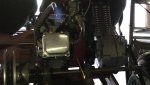
  • AA5DD93C-2CD6-4AF9-B705-2ED7B6285447.jpg
    AA5DD93C-2CD6-4AF9-B705-2ED7B6285447.jpg
    55.3 KB · Views: 8

bob58o

SuckSqueezeBangBlow
Messages
9,646
Reaction score
1,846
Location
Chicago-town USA
Today I tried a 0.35mm pilot jet.
Similar results to the 0.38mm pilot jet.

With the mixture screw about 3 turns out, I could start the engine with the idle speed turned down a bit. Instead of having it turned all the way in (giving a 4500 RPM idle), I could start the engine with the idle around 3300 RPM. Still no choke, Still started off as a slow stumble, and still required a small throttle blip to get it going. And seemed like less exhaust flames.

Progress (I think).

Tomorrow 0.32mm Pilot Jet.


After I find the jet I like for starting I'm 100% sure it will not be the jet the engine likes for idle to WOT launches. That would be too easy.

Other people might find attempted tuning like this frustrating.
So do I.
But I also love it.
The scientific process is awesome.
Observe, Hypothesize, Test, Get Results, Repeat...

The Hypothesize part is my favorite.
A useful hypothesis requires lots of GAB.
Most learning comes from the research required to make an intelligent hypothesis.

Am I getting flame thrower exhaust because I am using 100 octane and don't need it?
100 octane burns slower. Perhaps it doesn't complete the burn before the exhaust valve opens.

Am I getting flames out the exhaust because my timing is retarded from where it needs to be?
Start the burn sooner to get a more complete burn before the exhaust valve opens.

Am I getting exhaust flames because the cam profile opens the exhaust valve early?
Exhaust valve opening isn't one of the top three (of four) most important valve timing events, but if it opens too soon you will lose some torque.
Even with a short duration, advanced camshaft - I wouldn't expect the combustion to still be taking place when the exhaust valve opens.

Am I getting flames because the exhaust valve lash is still not correct and the valve isn't sealing correctly?
If the valve isn't sealing correctly, I suppose combustion will happen in the pipe too. I doubt the engine would run well with a valve allowing that much leakage.

I should probably use 93 octane to tune this engine if going to run 93 octane.
No point in deciding it likes x jetting and y timing on 100 octane if I'm going to run 93 octane. I was scared of knock at first, but think this should do fine on 93 octane.

I can probably advance timing more with 100 octane and make more power, but at 8 bucks per gallon - I don't want to.
 

TT540

Newb
Messages
347
Reaction score
6
Location
Huntsville, AL
See if you get the blue flame from a steady RPM. What i think is happening is When you lift off the gas, there can be unburnt fuel in the cylinders which doesn't have enough oxygen to burn completely because the throttle blade closed. Then as this fuel enters the hot exhaust it ignites and you can get flame. Also, there is some amount of valve overlap that has the exhaust valve open the same time as the intake. I think it is called reversion. Basically the exhaust flow out the tube will "pull" in the intake charge. And along with the piston traveling down will swirl the air and gas. This is true for automotive enginess not sure about single cylinder stuff. So do you get blue flame even cor a cold exhaust tube, and or steady RPM?

I need to understand more about these smaller carbs. I always thought that if you are above a certain RPM or if the throttle blade is open beyond a threshold amount, that the idle circuit is bypassed and you are on the main jet then. Are you saying the result is a combination of those two pilot and main?

Drop to 93 octane. And don't look back. Rethink it when you start doing full pulls later in life.

/gab
 

bob58o

SuckSqueezeBangBlow
Messages
9,646
Reaction score
1,846
Location
Chicago-town USA
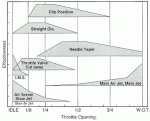
When I had the idle speed screw all the way in the RPMs were steady at around 4500 RPM. And with the steady RPMs, the flames were also steady. With the idle speed screw all the way in I'm not sure if it still operating off the idle circuit - or a combination of the idle circuit, slide cutaway, and needle. It won't be on the main jet unless you are about 3/4 throttle or more. So it isn't just main jet and idle jet. In between idle and 3/4 throttle, there is the slide cutaway, the needle diameter, the needle taper, and the needle height. Those things meter the fuel from 1/8 throttle to 3/4 throttle.

Since I don't have replacement needles, I tune the pilot jet for idle to about 1/8 throttle.
I tune the main jet for 3/4 to WOT.
I tune the needle clip position for 1/8 - 3/4 throttle.
The main jet has no effect on the A/F ratio unless you have the throttle open more than 50%. And little effect unless you have the throttle open 3/4 or more.
So you can see, that tuning the needle is the most important for a daily driver. Drag racing that sees nothing less than WOT probably don't care about tuning for idle and 25% throttle.
I, on the other hand, will probably spend 90% of my time between 1/8 and 3/4 throttle.


Reversion is when the you have a late closing intake valve. The piston moves down and the air starts to fill the cylinder. But intake valves don't close at BDC. They stay open past BDC. If at low RPMs, the intake charge doesn't have enough momentum to continue to fill the cylinder against the pressure of the rising piston - the intake charge will get pushed back into the manifold. That is reversion. At least as I know it. Ideally, you want to close the intake valve as soon as the intake charge doesn't have enough momentum to continue to fill the cylinder. Close it too soon and you are not filling the cylinder as much as you could. Hold it open too long and it will get pushed back into the intake manifold. Higher RPMs means you need to hold the intake open longer to allow the cylinder to fill. Lower RPMs mean you need to close the intake sooner to prevent reversion. At high RPM, the piston moves faster and leaves less time to fill the cylinder. At 3k RPM you might have "x" milliseconds for the charge to fill the cylinder as the piston moves from TDC to BDC. At 6k RPM, you will only have "x/2" milliseconds to fill the cylinder as the piston moves from TDC to BDC. Holding the intake open passed BDC on a high RPM engine gives the intake charge more TIME to fill the cylinder.

Exhaust gases leave the cylinder in one of two ways. First the exhaust valve opens when the piston is still going down in the cylinder. If the chamber wasn't pressurized from the combustion then the piston moving down would draw air in through the exhaust valve. This doesn't happen. There is pressure in the chamber and as soon as the valve opens, the gasses rush out the valve (despite the piston still moving down). This is called blow down.

Not all the gases leave in this fashion. Some of the exhaust is still chamber as the piston rounds BDC. The piston starts upward and the piston's upward motion pushes the remaining gas out of the exhaust valve.

Now before the piston reaches TDC during the exhaust stroke, the intake valve opens while exhaust gases still are escaping the exhaust valve. The air rushing out the exhaust valve leaves a low pressure area behind it. This low pressure area draws intake charge into the chamber (despite the piston moving up) This is scavenging. But it can also allow the intake charge to go straight out the exhaust if the cam profile doesn't match the operating RPM. You want to close the exhaust valve just before the fresh intake charge makes its way out the exhaust valve. The fresh intake charge gets trapped in the cylinder, then the piston moves down and the rest of the cylinder will continue to fill in regular fashion as the piston moves down towards bottom dead center.

After that the piston rounds BDC and we go back to the beginning where time the intake valve closing ABDC to allow filling from momentum, but preventing intake reversion.

I probably have some of that wrong. I didn't mention exhaust gas reversion. And I didn't mention how incomplete evacuation of exhaust gases will dilute the intake charge and cost you power.

Exhaust gas reversion is when the exhaust valve is held open too long and the downward motion of the piston pulls exhaust gases back into the cylinder during the overlap period of the intake stroke. Can't fill the chamber with fresh intake charge when exhaust gases are taking up the volume.
 

Attachments

  • calchart.gif
    calchart.gif
    14.4 KB · Views: 1

bob58o

SuckSqueezeBangBlow
Messages
9,646
Reaction score
1,846
Location
Chicago-town USA
Oh man I feel like I could write a book about the stuff I incompletely or incorrectly misunderstand. Imagine me trying to describe wave tuning and exhaust design theory. It would be 1,000,000 pages full of redundancies and 1,000,000,000 question marks. Probably a handful of ...'s and -'s. Those are how I get around the endless stream of run-on sentences.
 

bob58o

SuckSqueezeBangBlow
Messages
9,646
Reaction score
1,846
Location
Chicago-town USA
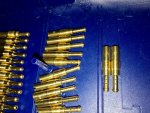
32 is my smallest Pilot jet.
Let's give it a shot.
I found a $7 12pc pilot jet kit that also has a 30 and 31.

Later on, the 420 gets a Tracheotomy
 

TT540

Newb
Messages
347
Reaction score
6
Location
Huntsville, AL
scavenging then. Perhaps that is the source of the blue flames. It is either that or unburnt fuel. Strange that unburnt fuel is combusting in a cold exhaust tube. It takes a LOT of heat to combust fuel without a spark. Google told me 1,100*F for 89 octane to combust on a heated pipe. options are:
1) exhaust valve not closing all the way.
2) unburnt fuel entering exhaust tube AND an ember from something that should not be embering.
3) Random fuel spark. but I think this is not likely as the engine would not continue running or run very poorly if missing alternating cycles.

Thanks for the explanation on slide carb fuel metering.

Are you trying to get the idle RPM lower? That would be my goal. To simplifying as much as possible.
 

bob58o

SuckSqueezeBangBlow
Messages
9,646
Reaction score
1,846
Location
Chicago-town USA
Are you trying to get the idle RPM lower? That would be my goal. To simplifying as much as possible.

First thing I'll check today is the spark plug.

As it is right now I wouldn't be able to start it up when it was mounted to a minibike or kart unless the clutch stall speed was 3600 or above.

I would blip the throttle to get it running and it would take off on me. I might use a TC set to engage at ~3600 RPM, but I feel I shouldn't have to band-aid an issue like that. These engines are designed to constantly run at 3600 RPM, so it wouldn't be a huge issue for me if I had a high idle speed.

If with the 0.32mm main jet I can get the engine started with the idle RPM screw turn down enough so that after I blip the throttle, the engine speed is around 2000 RPMs I'd be extremely happy. If I can get it below 2400 RPM, I'd be pleased. If under 2800 RPM, I guess I could accept that. Just seems strange that after it gets going it will idle at 1300 RPM, but I needed to turn the idle speed screw all the way in to start it.

I'm leaving the possibility open that starting with this manifold might just be difficult - and trying to jet for ease of starting might not be the same jetting for performance.

What I don't want is to have to turn a screw, set a parking brake, push the start button, blip the throttle, get off the bike, adjust the screw again, release the brake, then ride.

I'm hoping that leaning out the idle jet wil continue the trend I've seen. Small idle jet = less required idle speed to start = less flames out the exhaust. If the trend continues with the 32 but I'm not yet satisfied, I'll get the 30 and 31 jets.
 

bob58o

SuckSqueezeBangBlow
Messages
9,646
Reaction score
1,846
Location
Chicago-town USA
Let's get it started.
Apparently I like EDM again.
https://www.youtube.com/watch?v=tLp3KCqVAxw

---------- Post added at 01:20 PM ---------- Previous post was at 01:15 PM ----------

https://www.youtube.com/watch?v=XULRZHb7pnw&feature=youtu.be

---------- Post added at 01:21 PM ---------- Previous post was at 01:20 PM ----------

https://www.youtube.com/watch?v=4t4YiXWPBpo

---------- Post added at 01:25 PM ---------- Previous post was at 01:21 PM ----------

Turns out I just wasn't being delicate enough when tugging on the throttle cable.
I can have the idle speed turned down to where I want it and if careful with the throttle cable it'll start right up.
 

bob58o

SuckSqueezeBangBlow
Messages
9,646
Reaction score
1,846
Location
Chicago-town USA
So, operator error? :)
Let's call it Trial and Error.

The throttle window is a fine window for starting.

A bit too much throttle and we burn up upon re-entry.
A bit too little throttle and we skip off the atmosphere and into space for eternity.

---------- Post added at 04:10 PM ---------- Previous post was at 04:06 PM ----------

Now if I only purchased the correct length M8x1.25 bolts to install the manifold on the 420cc engine. Ugggh

I'm going to exchange them now.

30mm is too long.
25mm might work.
20mm should be right.
16mm might work.


20mm SS Socket Head Cap Screw M8x1.25
Tried some lock washers, but didn't fit. Washers prevented the screws from going in straight.
 

bob58o

SuckSqueezeBangBlow
Messages
9,646
Reaction score
1,846
Location
Chicago-town USA
Last Pilot Jet was 0.32mm.
New Jet is 0.30mm.

Area of orifice (0.32mm diameter) =
0.08042 sq mm

Area of orifice (0.30mm diameter) =
0.07069 sq mm

Percent Change =
[(0.08042 - 0.07069) / 0.08042 ] * 100 =
12.1%

The jet is less than .0008" smaller than the prior, but that is a 12.1% reduction in orifice area.
 

bob58o

SuckSqueezeBangBlow
Messages
9,646
Reaction score
1,846
Location
Chicago-town USA
A Perfect Circle (in a box)

Circles are funny like that.
Most amount of inside for the least amount of outside.

Oh you like fence problems? LOL

If you've only got 1000' of fence you can make a square that is is 250' x 250' and have an enclosed area of 62,500 sq ft.

Or

You can make it a circle with a diameter of 318.3' and have an enclosed area of 79,578 sq ft.

The square has 78.54% of the area of the circle having the same perimeter.

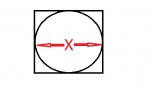
But if you had a square with L= 0.32mm it would obviously have more area than a circle inscribed in that square.

The square would have 0.1024 sq mm and the circle would have 0.08042 sq mm.

The circle has 78.54% of the area of the square it is inscribed in.

And since the area of a square with sides of length equal to x
= x^2

And the area of a circle with diameter equal to x = (Pi/4) * x^2

((Pi / 4 ) = 0.7854 There's that number again. Now you know where it comes from.)

Both the area of a circle and area of square are proportional to x^2, so changing a square with L=0.32 to a square with L=0.30 yields a 12.1% decrease in area
AND ALSO changing a circle with D=0.32 to a circle with D=0.30 yields the same 12.1% decrease in area.


This is why my sister can't pass a math class. She'll make a statement and then I'll go off on a tangent, confuse her, and frustrate the both of us.
 

Attachments

  • CIRCLE.jpg
    CIRCLE.jpg
    31 KB · Views: 0

bob58o

SuckSqueezeBangBlow
Messages
9,646
Reaction score
1,846
Location
Chicago-town USA
F:censored: Triangles.
Circles is where it's at.
So Perfect. So Symmetrical.

Not sure if you know this or not... Poboy invented the circle.
 
Status
Not open for further replies.
Top