Gearing Question

Status
Not open for further replies.

BobbyBlank

New member
Messages
10
Reaction score
0
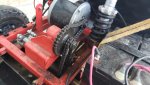
How would a person calculate the gear ratio when 4 sprockets are involved? My son's electric go kart is situated this way: motor shaft sprocket to jackshaft sprocket 1, then from jackshaft sprocket 2 to axle sprocket. Advantages or disadvantages to this setup?
 

Attachments

  • 20190703_155919.jpg
    20190703_155919.jpg
    297.6 KB · Views: 9

BobbyBlank

New member
Messages
10
Reaction score
0
This will help: https://affordablegokarts.com/pages/gear-ratio-calculator
That looks like one of those Razor drift karts, no?

I think it's actually a Razor "Dune Buggy", but not 100% certain.

---------- Post added at 05:26 PM ---------- Previous post was at 05:05 PM ----------

I think I see the use-case for such a gearing setup - space limitations? Instead of a 2, big vertical sprocket setup, it makes for a 4, small horizontal sprocket setup? Is this correct? I also noticed by switching the two jackshaft numbers, extreme ratio differences in opposite directions come about. Awesome...thanks for that link!
 

JTSpeedDemon

2019 Build Off Winner!
Messages
4,026
Reaction score
162
Location
Texas
I think it's actually a Razor "Dune Buggy", but not 100% certain.

---------- Post added at 05:26 PM ---------- Previous post was at 05:05 PM ----------

I think I see the use-case for such a gearing setup - space limitations? Instead of a 2, big vertical sprocket setup, it makes for a 4, small horizontal sprocket setup? Is this correct? I also noticed by switching the two jackshaft numbers, extreme ratio differences in opposite directions come about. Awesome...thanks for that link!

You are correct in both cases.
 

landuse

Moderator
Staff member
Messages
18,751
Reaction score
527
Location
Pietermaritzburg, South Africa
Ratio for a jackshaft is as follows.

JS in/engine sprocket * Axle sprocket/JS out

So if you has a 10T on the engine, a 20T on the JS in, a 10T on the JS out and 60T on the axle your ratio would be (20/10)*(60/10) = 2*6 = 12

So your ratio would be 12:1

You will have to count the teeth on your sprockets and do the maths. Even better, give us the sprocket counts and we can then verify your maths

---------- Post added at 08:21 AM ---------- Previous post was at 08:18 AM ----------

I think it's actually a Razor "Dune Buggy", but not 100% certain.

---------- Post added at 05:26 PM ---------- Previous post was at 05:05 PM ----------

I think I see the use-case for such a gearing setup - space limitations? Instead of a 2, big vertical sprocket setup, it makes for a 4, small horizontal sprocket setup? Is this correct? I also noticed by switching the two jackshaft numbers, extreme ratio differences in opposite directions come about. Awesome...thanks for that link!

Space limitations is the EXACT reason for this type of setup. You can get compund gear reduction without having a huge axle sprocket that will carve the ground up. Imagine wanting a 10:1 ratio. That means a 10T on the engine and 100T on the axle!!!! A 100T sprocket will more than likely be bigger than your rear tyres :D
 

BobbyBlank

New member
Messages
10
Reaction score
0
How does engine horsepower / sprocket size relationship factor in? Does having a huge sprocket turning a small sprocket require more hp to work efficiently as opposed to a large sprocket turning a smaller sprocket? I know in the rc world small driving large seems to be less stressful on electric motors. Does a similar rule apply here? Where can I find dangers/limitations/guidelines for proper gearing? I have so many questions, but don't know the search terms. Otherwise, I'd google it myself. If all those questions are annoying, I'll be happy with a few links and search ideas. Thanks again, gang!
 

cleatusj

New member
Messages
20
Reaction score
0
Location
Granbury, Texas
How does engine horsepower / sprocket size relationship factor in?

One of the best ways to understand is to get on a 10 speed bike and try taking off on each gear.

I know in the rc world small driving large seems to be less stressful on electric motors.

Applies to all motors, even human ones.
 

itsid

Moderator
Staff member
Messages
11,563
Reaction score
243
Location
Ruhrpott [Germany]
bicycles are the most confusing example one can think of really..

since the driver sprocket on a bike (pedals) is larger than the driven sprocket (wheel)
just because your legs can push a whole lot but cannot move very fast,
exactly opposite to an engine or motor which usually spin really quickly but do not have a lot of force.

and horsepower isn't really a factor AT ALL!

sticking with bicycles..
our typical gx200 (or clone) has roundabout 6.5hp and it's fair to say you'll have a hard time reaching that for more than a split second maybe.
it still couldn't move you on your bike if you're trying to 1:1 drive your bike crank with it.
since it only has a measly 12Nm of torque or thereabouts
and you can push at least ten times that easily.

the gx can spin 3600 rpms with ease.. you cannot turn your bike crank at anywhere near that speed even under no load at all.

So yeah... bike is a very bad example IMHO
since it obfuscates the facts
because of the extremely low speed high torque motor your legs act as.

you're right.. small driving large is always easier (requiring less torque) than the other way around.

'sid
 
Status
Not open for further replies.
Top