Functional Artist
Well-known member
Connector/Receptacle Housings
Now, lets discuss electrical connector housings
...their "basically" just insulators too.
(it's the box or container that holds & insulates the terminals, contacts/conductors or fuse from...everything)
The "housings" on most crimp-on terminals, connectors, receptacles, switches & even fuse holders have plastic "looking" housings
…& some are made out of rubber, but we'll cover that later.
Most housings are "usually" not just plain old plastic
...some of the white ones, like the Molex type, are actually nylon with a flammability rating of 94V-2 & an (operating) temperature range of -40* - +105*C.
https://www.molex.com/webdocs/datasheets/pdf/en-us/1501761020_CRIMP_HOUSINGS.pdf
But, some like the XT type connectors use what's referred to as high-temp nylon.
(makes sense, a higher amperage connector would need/use a higher temp rated housing)
https://www.sparkfun.com/products/10474
...& then, some housings like fuse holders & receptacles use (black) thermoplastic UL 94-V2 with the same (operating) temperature range of -40* - +105*C.
https://media.digikey.com/pdf/Data Sheets/Littelfuse PDFs/153 inline fuseholder.pdf
But, again many of these components don't have any type of "actual" ratings marks or labels.
Like, for example, your average fuse holder (round or blade)
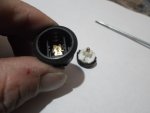
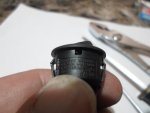
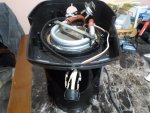
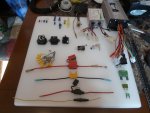
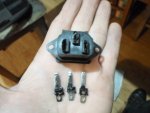
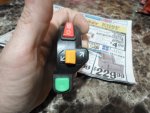
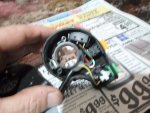
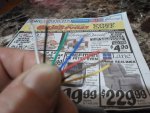
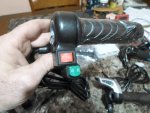
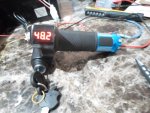
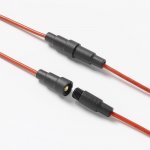
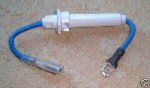
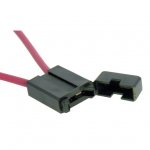
...like in pics #2, 3, 4 & 5 below. (their are no visible markings, of any kind)
So, then, were back to
...are there any indicators?
…& what do they tell us?
First, since they are all electrical components, are we "safe" to assume that they all would have at least a "standard" UL 94-V2 (-40* - +105*C) temperature rating?
...or how about the size of the contacts?
...or the size (gauge) of wire that is attached?
...or the size & type of fuse that it's designed to hold?
...any other clues, like look & feel or "quality/craftsmanship" of the component?
IMO
Yes, their are indicators.
...they don't tell us everything, but add more pieces to the puzzle.
It would make sense to make all electrical component housings meet the "standard" UL 94-V2 temperature rating.
As for the size of the contacts, if we compared them to the Namz & Molex connectors specs, ~2mm contacts = (up to ~10A) & ~4.5mm contacts = (up to) ~20A
The gauge of wire used tells us, 18-20g. is usually good for (up to) ~5A, 14-16g. is usually good (up to) 10A & 10-12g. is usually good (up to) 20A
The size of the fuse doesn't help much because most of them range anywhere from ~1A thru ~40A
Visual & physical quality
...do the terminals fit tightly?
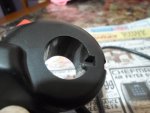
...is the housing molded cleanly or sloppily?
These are all indicators (& their may be more) as to the potential usability of a component.
Now, lets discuss electrical connector housings
...their "basically" just insulators too.
(it's the box or container that holds & insulates the terminals, contacts/conductors or fuse from...everything)
The "housings" on most crimp-on terminals, connectors, receptacles, switches & even fuse holders have plastic "looking" housings
…& some are made out of rubber, but we'll cover that later.
Most housings are "usually" not just plain old plastic
...some of the white ones, like the Molex type, are actually nylon with a flammability rating of 94V-2 & an (operating) temperature range of -40* - +105*C.
https://www.molex.com/webdocs/datasheets/pdf/en-us/1501761020_CRIMP_HOUSINGS.pdf
But, some like the XT type connectors use what's referred to as high-temp nylon.
(makes sense, a higher amperage connector would need/use a higher temp rated housing)
https://www.sparkfun.com/products/10474
...& then, some housings like fuse holders & receptacles use (black) thermoplastic UL 94-V2 with the same (operating) temperature range of -40* - +105*C.
https://media.digikey.com/pdf/Data Sheets/Littelfuse PDFs/153 inline fuseholder.pdf
But, again many of these components don't have any type of "actual" ratings marks or labels.
Like, for example, your average fuse holder (round or blade)
...like in pics #2, 3, 4 & 5 below. (their are no visible markings, of any kind)
So, then, were back to
...are there any indicators?
…& what do they tell us?
First, since they are all electrical components, are we "safe" to assume that they all would have at least a "standard" UL 94-V2 (-40* - +105*C) temperature rating?
...or how about the size of the contacts?
...or the size (gauge) of wire that is attached?
...or the size & type of fuse that it's designed to hold?
...any other clues, like look & feel or "quality/craftsmanship" of the component?
IMO
Yes, their are indicators.
...they don't tell us everything, but add more pieces to the puzzle.
It would make sense to make all electrical component housings meet the "standard" UL 94-V2 temperature rating.
As for the size of the contacts, if we compared them to the Namz & Molex connectors specs, ~2mm contacts = (up to ~10A) & ~4.5mm contacts = (up to) ~20A
The gauge of wire used tells us, 18-20g. is usually good for (up to) ~5A, 14-16g. is usually good (up to) 10A & 10-12g. is usually good (up to) 20A
The size of the fuse doesn't help much because most of them range anywhere from ~1A thru ~40A
Visual & physical quality
...do the terminals fit tightly?
...is the housing molded cleanly or sloppily?
These are all indicators (& their may be more) as to the potential usability of a component.
Attachments
-
 SAM_4170.JPG1.3 MB · Views: 0
 -
 Littelfuse_Fuse_Holder_150_Image_jpg.jpg69.3 KB · Views: 0
 -
 s-l1000.jpg16.7 KB · Views: 0
 -
 thLM4945WA.jpg6 KB · Views: 35
 -
 SZ2045ImageMain-515Wx515H.jpg31 KB · Views: 0


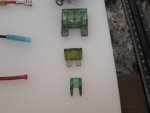
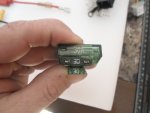
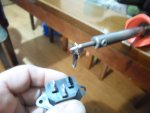
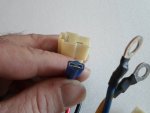
 (the conductor just slid right out)