Diamonite Electrathon America Racer

Functional Artist

Well-known member
Messages
5,296
Reaction score
2,739
Location
Toledo, Ohio
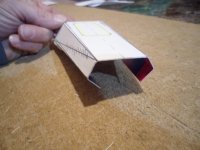
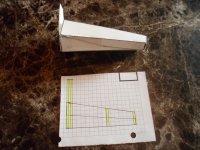
Time for some CAD (Cardboard Aided Design) :wai:

Maybe something like this
SAM_3982 (1).JPG
Front/nose
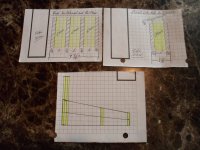
SAM_3989 (1).JPG
Rollbar
SAM_3995 (1).JPG
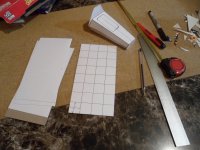
To keep the math simple I used a 1/12 scale...1" (in.) = 1' (ft.)

So, I started off by cutting a few pieces of (cereal box) cardboard into 4" x 8" rectangles
...to represent a 4" x 8" sheet of material ;)
SAM_4004 (1).JPG
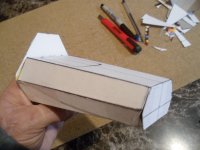
Maybe something like this :sifone:
SAM_3997 (1).JPG
 

Denny

Canned Monster
Messages
11,555
Reaction score
7,983
Location
Mayberry, Indiana
Something that makes me really nervous about the polycarbonate sheet is if it fractures in the case of an impact. A sharp shard could really F. U. your day. I’m going to keep my big mouth shut and see where this goes. Atleast fiberglass when it fractures usually results in a duller edge instead of a sharp knife.
 

Functional Artist

Well-known member
Messages
5,296
Reaction score
2,739
Location
Toledo, Ohio
Something that makes me really nervous about the polycarbonate sheet is if it fractures in the case of an impact. A sharp shard could really F. U. your day. I’m going to keep my big mouth shut and see where this goes. Atleast fiberglass when it fractures usually results in a duller edge instead of a sharp knife.
Hey Denny,

I've recently learned that plexiglass is acrylic & shatters
...Lexan is polycarbonate & doesn't

Check out this demo video
...Plexiglass (Acrylic) vs. Safety glass vs. Lexan (polycarbonate)

* Note the polycarbonate sheet was only 6mm (1/4")

** Now imagine a monocoque built out of that stuff :2guns:
 

Functional Artist

Well-known member
Messages
5,296
Reaction score
2,739
Location
Toledo, Ohio
Hey Denny,

The rule book agrees with you :cheers2:
...& prohibits the body of an EA racer to be made from material that shatters &/or produces sharp edges (like plexiglass)
...here is an excerpt from the EA rule book:

5 VEHICLE BODY
1. All vehicles must provide a body/chassis structure sufficient to protect the driver from impact from any side. A suitable structure or shell is required to provide a barrier between the driver and any contact with another vehicle or the ground.
2. This body or structure needs to protect the driver's legs, feet, and side up to shoulder
level protecting the rib cage from side impact.
3. The legs and feet must be enclosed to prevent them from leaving the vehicle in an accident and provide protection against a frontal impact.
4. If the chassis contains a structural shell sufficient to protect the driver, then any body provided need not be structural. However, under no circumstances is the body to be made of cardboard, paper or any material that becomes weak when wet. Materials that are brittle or produce sharp edges when broken (e.g. Plexiglas or brittle acrylic panels) are also not allowed.
5. A body is not required if the frame or chassis shell will prevent the driver's arms and legs from leaving the vehicle and prevent another vehicle's parts from entering the vehicle during an accident.
6. The vehicle must not have any sharp edges, corners or protrusions that could cause injury. Any questionable exposed portion of the vehicle should be cut off, rounded off or blunted
with durable padding.
7. The nose area must have a minimum radius of 3 inches (6-inch diameter) in at least one direction and not be dangerously pointed in the other direction.
8. The vehicle must have a fixed floor pan of solid-rigid material that prevents any part of the driver's body from contacting the ground.
 

Functional Artist

Well-known member
Messages
5,296
Reaction score
2,739
Location
Toledo, Ohio
I have seen lean windshields breeched by rocks on stock cars. It’s rare but it does happen. And there are sharp edges. Don’t want to see you hurt.
Hey Denny,

"Don’t want to see you hurt."

Me too...my friend...me too :cheers2:
...or me neither...my friend......me neither ;)

I've been doin' lots of research :popcorn:
...& this video has an interesting plexiglass vs. polycarbonate demonstration in it

* Notice the cold formed bend that he put into a piece of polycarbonate
...that looks about like the bends, I'ma lookin' ta do :thumbsup:
 

Functional Artist

Well-known member
Messages
5,296
Reaction score
2,739
Location
Toledo, Ohio
More research/info :thumbsup:

The last video showed how polycarbonate can be cold formed/bent
...this video shows how, for longer bends, polycarbonate sheets can also be formed, using heat :cheers2:
 

Functional Artist

Well-known member
Messages
5,296
Reaction score
2,739
Location
Toledo, Ohio
I have used lexan for years on stock and drag cars. I’m well aware of its capabilities and its shortcomings.
Hey Denny,

Well...this concept seems intriguing to me
...so, I'ma gonna experiment with it a bit :cornut:

So, I/we have the basic shape
...now, moving on to the bulkheads

How would ya make bulkheads outta plastic that would be strong enough?

Well, here's what I'ma thinkin' ;)
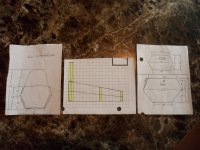
...in the drawin' the Nose bulkhead is highlighted in yellow (on right)
...the Dash/steering support (bulkhead) is in the middle
...the Rear bulkhead/rollbar would be in the rear (on left)
SAM_4007 (1).JPG
Um...OK...so, what do those lines (in yellow) actually represent? :unsure:

Well, I'ma thinkin'
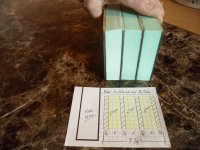
...for the roll bar we could try (4) ply's of 3/16" polycarbonate sheet with (3) layers of 1" foam (~3 3/4" thick)
...& for the center & front bulkheads maybe (2) ply's of 3/16" polycarbonate sheet with a 1" foam core (~1 3/8") :thumbsup:
SAM_4008 (1).JPG
Reminder of bulkhead's shapes & (rough) measurements
SAM_4009 (1).JPG
 

Functional Artist

Well-known member
Messages
5,296
Reaction score
2,739
Location
Toledo, Ohio
I would skip the foam core. But honestly I have no idea. You’re in unchartered territory there Magellan!
Hey Denny,

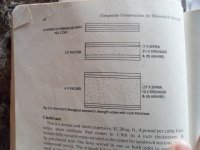
The foam core concept was illustrated in the Composite Homebuilt Aircraft book
SAM_3814 (1).JPG
They were referring to a couple of layers of fiberglass with a foam core in between
...&/so, I figured the concept would also apply to this situation
...especially if the foam is epoxied (glued) to the polycarbonate

I drew this up to help me "get a grip" of the concept, for this application ;)

Notice how (1) ply would (of course) be (1X) whatever the stiffness & strength of the material is
...& (2) ply's would (obviously) double the stiffness & strength specs
...but then, when a "foam core" is incorporated the numbers increase "jump" tremendously with a much smaller weight "penalty"

I'm thinkin' that a (1") foam core in between (2) pieces of 3/16" polycarbonate

TUFFAK GP Polycarbonate Sheet Specs
Tensile Strength- 9,500
Tensile Modulus- 340,000

Flexual Strength- 13,500
Flexual Modulus- 345,000

Compressive Strength- 12,500
Compressive Modulus- 345,000

https://plaskolite.com/docs/default-source/pds/PDS004_TUF_GP.pdf
SAM_4005 (1).JPG
I'ma thinkin' the resulting (3) layer "pieces" (front & mid bulkheads) should be
...IDK maybe ~10X stiffer
...& ~5X stronger
...than just a single piece of polycarbonate :thumbsup:
SAM_4012 (1).JPG
The rear bulkhead/rollbar needs to be MUCH stronger
...& so, for this critical piece of safety equipment, I was thinkin' ta triple up the foam cores
...& quadruple the plies of polycarbonate

These bulkheads should be really light
...but, "wickedly" strong :2guns:
SAM_4013 (1).JPG
 

Functional Artist

Well-known member
Messages
5,296
Reaction score
2,739
Location
Toledo, Ohio
I would think that the "shell" pieces and the core would absolutely need to be completely and thoroughly glued or adhered together for any of these stats to hold up.
Hey Ez,

I agree "especially if the foam is epoxied (glued) to the polycarbonate" in the bulkheads
...& am glad you brought it up
...so, I/we can delve into this a bit deeper :thumbsup:

First, for those who didn't read thru the TUFFAK polycarbonate fabrication Guide
...here are a few quotes, from that guide, on fastening this material together ;)

BONDING APPLICATIONS
A wide range of adhesives is available in the market. Polyurethane, epoxy, and silicone adhesives maybe used however, the choice of the right type of adhesive depends on the application and should be done carefully. Adhesion technology is a very technical field by its own. Apart from properties such as flexibility, mechanical strength, durability (indoor-outdoor) of the bond, the compatibility of the adhesive to TUFFAK polycarbonate must be assessed especially for solvent bonding.

Solvent bonding
Solvent bonding joins one plastic to itself or another type of plastic that dissolves in the same solvent. Typically, this process involves treating the bonding area with the minimum amount of solvent needed to soften the surfaces and then clamping the parts together until they bond Methylene chloride or ethylene dichloride bonds TUFFAK sheet to itself.
* Expect brittleness and reduced impact strength at the bonded joints.

Adhesive bonding
Adhesive bonding systems are among the most robust for joining plastic parts to parts made of the same plastic, different plastics or non-plastic materials. Generally, adhesives produce more consistent and predictable results in joints requiring strength and durability than other joining methods.

Consider the following when selecting an adhesive bonding material: » Chemical compatibility with TUFFAK sheet » Flexibility or rigidity requirements » Load bearing force » Environmental condition and temperature requirements » Aesthetics.

General characterizations of different adhesive systems: » In general, urethane and epoxy adhesives impart excellent bond strength.

The design of the adhesive joint has an influence on the final strength of the bond. Joints should be designed in a way that transform tensile or compressive stress to shear stress. The larger the bonding area, the stronger the bonding. Butt joints can form weak bonding joint. Overlapping sheets or adding a strip of polycarbonate along the joint line improves the bonding strength of the joint.

MECHANICAL FASTENING
Mechanical fasteners
Due to their low cost and reliability, screws, bolts, and rivets are common joining methods. Common practices and selection criteria are discussed within this section.

Common head styles of screws and bolts Pay special attention to the fastener’s head. Use bolt and screw heads that have a flat underside, called “pan” or “round” head. This bolt design imparts lower compressive stresses on the material. Conical heads, called flat or oval heads, produce undesirable tensile and hoop stresses and should be avoided.

Fastening with self-tapping screws Use thread-cutting screws, which cut away material from a pre-drilled hole to form a mating thread and result in better long-term performance. Note the radial and hoop stresses imparted to the part by thread-cutting screws are lower after installation vs. thread-forming screws. Typically, thread-cuttin screws are classified as ANSI BT (Type 25), ANSI T (Type 23) Thread-cutting screws may not be appropriate in all applications and environments. Cracks around the screw hole may form under conditions where the polycarbonate expands and contracts due to temperature variations.

Fastening with rivets
Rivets offer a low-cost and simple hardware solution for static parts. Aluminum rivets are preferred over harder materials. Select rivets with large flat heads and three times the shank diameter Use of washers on the flared end are helpful in distributing loads, but be careful not to over-tighten as it can result in compressive stress and damage to the plastic.

Use flat aluminum or hard plastic washers under nuts and fastener heads to evenly distribute the applied force. Their ability to resist over-compression helps to prevent localized stressing of the joining part. Ensure there is sufficient distance between the edge of the fastener’s hole and the part’s edge: at minimum, two-times the diameter, and twice the part’s thickness.
Note: Slotted holes require more edge clearance.
https://plaskolite.com/docs/default-source/fab/fab015_tuf_en.pdf


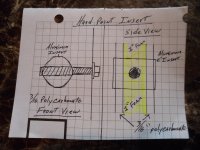
Beyond simply bonding, I'm thinkin' I can incorporate another type of fastener, to help "hold" everything together

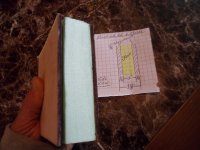
I'm not sure what they are called (help me out here)
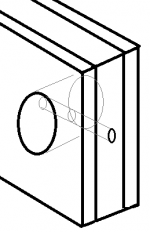
...but, they are simply a (~1") round piece of metal (steel or aluminum) that is about as long as the material is thick
...with a threaded hole thru the side
...that can be inserted into a round hole
...kinda like what they use to assemble "particle board furniture"
SAM_4010 (1).JPG
 

Whitetrashrocker

Inmate #952016
Messages
4,532
Reaction score
3,532
Location
Southern New Mexico
Just throwing this in the mix.
We use Omega-bond on our buggies for side and roof panels. It's aluminum sided foam core sign material. It's pretty tough and light. Comes in pre painted colors and easy to bend, shape and cut.
 

Functional Artist

Well-known member
Messages
5,296
Reaction score
2,739
Location
Toledo, Ohio
I would look into a panel bonding adhesive such as that used to bond on new steel parts to cars. Then skip the mechanical part.

Hey Denny,

Appreciate all of the "input
...but/again, from the fabrication guide, for this specific material :thumbsup:

In general, urethane and epoxy adhesives impart excellent bond strength.

The design of the adhesive joint has an influence on the final strength of the bond. Joints should be designed in a way that transform tensile or compressive stress to shear stress. The larger the bonding area, the stronger the bonding. Butt joints can form weak bonding joint. Overlapping sheets or adding a strip of polycarbonate along the joint line improves the bonding strength of the joint.


So,
1.) I personally don't 100% "trust" adhesive "bonds" connections or joints...alone
...& usually try to incorporate a mechanical "bond" into the mix ;)
* As an additional bonus, the (2) "bonds" accentuate each other & double up the strength too :2guns:

2.) Where a bulkhead would intersect/connect with the "outer skin" would be a Butt joint
...& (from above)
Butt joints can form weak bonding joint.
...so, IMO a mechanical "back up" would be called for...in this situation

3.) Since I will be the "Test Dummy" testing this experimental monocoque racer
...I don't want it "fall apart" (around me) from the "stresses of the track"
...or disintegrate "if" I was to run into something :ack2:
 
Top