Hey Denny,
I'm just about done "jabbering" about the front
...then, we'll move on to the rest of the body

I guess, I've been trying to keep these concepts as simple as possible to help folks/students understand how knowledge of how some things "work" can & quite often does, "relate" to how other things "work"

Another quick "story"
I have memories of me & a buddy carrying 4' x 8' sheets of plywood, on a windy day
...& that "if" we kept it nice-n-level, while carrying it, the wind didn't seem to affect it very much
But, "if" we accidentally tilted the front of the board upward (into the wind)
...the wind would try to push or pick up the front upwards (lift)
&
Then, "if" we tilted the front of the board downwards
...the wind would push downward on the board (downforce)
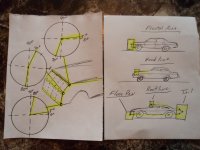
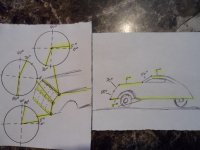
The second drawing shows sheets of plywood with a 60* "break" & a 45* "break"
The top image, shows what it would "look like" "if" the front 2' of the board was "tilted" downward
...& the remaining 6' was still level or "flat"
The middle image shows what it would "look like" "if" the front 4' of the board was "tilted" downward
...& the remaining 4' was still level or "flat"
The bottom image shows what it would "look like" "if" the front 6' of the board was "tilted" downward
...& the remaining 2' was still level or "flat"
Now, imagine how much more "area" the wind would have to "push down" on the boards, with the longer part (6') tilted downward
...& also, how much "more" push down would happen by the board with the 45*

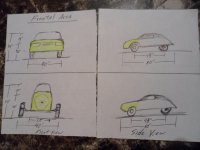
Then, to help show how this info applies to the body of a race car
1.) there are surfaces of a car that are relatively wide/flat, just like a sheet of plywood
So, it seems to reason that some of the same effects, should apply to some surfaces of a car

(to varying degrees, of course, depending on angle & surface area)


 ) that I've been using this empirical concept...like literally...forever

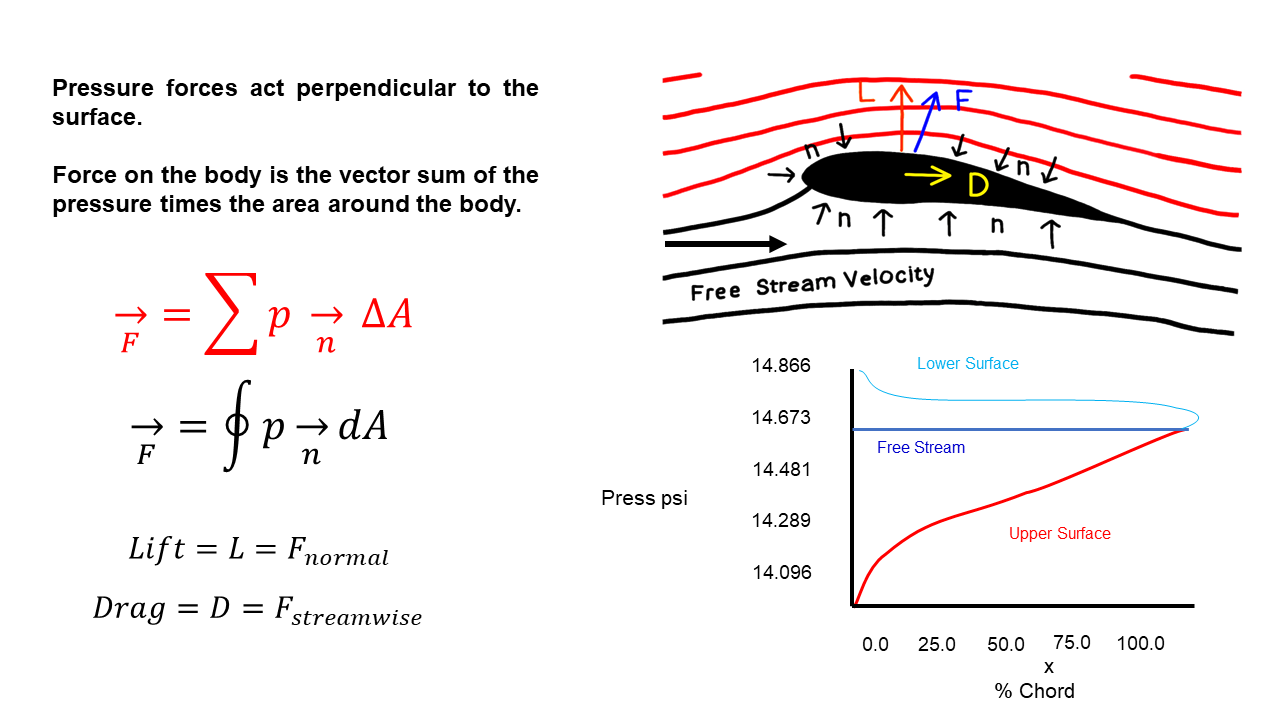
 www1.grc.nasa.gov