Diamonite Electrathon America Racer

Functional Artist

Well-known member
Messages
5,292
Reaction score
2,739
Location
Toledo, Ohio
I forgot to mention, that I didn't coat the rear ~20% of the side pieces of MDF
...& the formica too
...so, they wouldn't "stick" down/together (yet)

After "triple checking" that the formica would "lay down" properly
...I coated the rear ~20%, let it dry properly
...& then, adhesivised (fancier technical word) 'em "in place" ;)

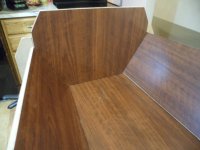
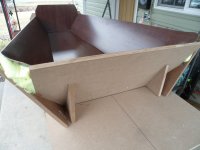
Then, I used a trim router to trim any excess material off of the pieces
...& after a bit of assembly, Jualla! :sifone:
SAM_4110 (1).JPG
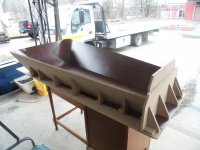
I noticed that 60* seemed to be a re-occurring theme
...as the rear panel & the sides seemed to be "best" when "set" at ~60*
...&/so, all of those "braces" are simply cut at 60*
SAM_4111 (1).JPG
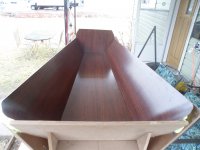
View from the back
SAM_4112 (1).JPG
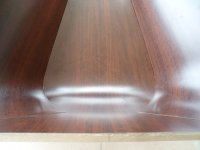
* Notice how those nice-n-smooth rear "transitions" seemed to "lay down" pretty good(ly) :bannana:
SAM_4113 (1).JPG
There are/were a couple of "hollow areas" behind/where the formica curves up from the floor to the back
...& also, behind/where the sides curve to the back

So, to strengthen/stiffen &/or solidify these areas, I "filled 'em up" with some spray foam
SAM_4116 (1).JPG
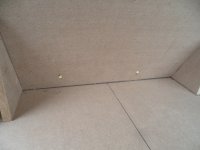
* Also, had to drill a couple of "access holes" on the lower rear, to facilitate "filling" this area
SAM_4117 (1).JPG
 

Master Hack

Well-known member
Messages
4,065
Reaction score
6,465
Location
Mountain top Labratory
A lighter color wood like, ahhh i dunno, a light colored wood would be faster. Nice work despite the color!

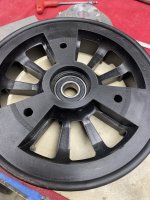
Now I'm faced with a dilemma on these hubs.
I'm trying to make this stuff run true when I "ran"into this problem.

Video linky

Runout is all over the place! That is the wheel itself.

I was able to get it down to .015. Still unacceptable for a brake rotor.
A revisit to the drawing board might be in order.


IMG_4769.JPG
 
Last edited:

Functional Artist

Well-known member
Messages
5,292
Reaction score
2,739
Location
Toledo, Ohio
Hey T,

Hmmm...interesting...
...that's the rim edge/tire bead area?

How "true" is the rim (in the center) after turning?
...& how "true" does the rotor (itself) "run"?

Maybe...just thinkin' out loud...if the rotor runs "true" enough
...the brakes should still function properly
&
Maybe...I dunno...the (flexible rubber & full of air) tire would help "smooth out" the warpage of the rim
...before it gets to the ground?

* I don't remember...did you check...the run out of those white, steel stamped rims
...when you made the hubs for the Sequoia racer?
 

Master Hack

Well-known member
Messages
4,065
Reaction score
6,465
Location
Mountain top Labratory
Hmmm...interesting...
...that's the rim edge/tire bead area? yes

How "true" is the rim (in the center) after turning? .015
...& how "true" does the rotor (itself) "run"? didn't bother checking

Maybe...just thinkin' out loud...if the rotor runs "true" enough
...the brakes should still function properly. l think l have a fix
&
Maybe...I dunno...the (flexible rubber & full of air) tire would help "smooth out" the warpage of the rim
...before it gets to the ground? Apperantly all that runout is not a problem for a tire. It looks like crap, but if the tire runs out in the axial direction, who cares?

* I don't remember...did you check...the run out of those white, steel stamped rims
...when you made the hubs for the Sequoia racer No, the brake rotor mounted to the hub, not the wheel.
I think i'll try surfacing the rotor mounting surface while it is bolted to the wheel.
If l can get the assembly trued up, then the individual pieces don't matter.
you probably will have indicate and shim it in its final assembly.
The bolt holes in the wheel are purdy loose.

When are ya needin this stuff again?
 

Functional Artist

Well-known member
Messages
5,292
Reaction score
2,739
Location
Toledo, Ohio
Hey T,

* I don't remember...did you check...the run out of those white, steel stamped rims
...when you made the hubs for the Sequoia racer No, the brake rotor mounted to the hub, not the wheel.

Yup, your right (what was I thinkin'?) :unsure:

I was just thinkin' that those stamped wheels probably aren't very "true" either
...probably NOT a HUGE concern for places making/selling generic "go kart" parts :huh:

When are ya needin this stuff again?
Well...it's early March right now
...& I'm going to start building/creating the monocoque...As Soon
As Possible
...so, let's say...maybe...by May :cheers2:
 

Master Hack

Well-known member
Messages
4,065
Reaction score
6,465
Location
Mountain top Labratory
After looking at a coupla other wheels 'round here, that appears about average.
The high end of average, but still average. Wheels must have a .100 " tolerance?
"Normal" people wouldn't care about that runout, or even think to check it.
It goes without saying we ain't normal.
Runout in the radial direction could be a problem, however.
Da***t, now l gotta check that.

May? Shyt! I can stall a few more weeks....
 

Functional Artist

Well-known member
Messages
5,292
Reaction score
2,739
Location
Toledo, Ohio
I'm going to start building/creating the monocoque...As Soon As Possible
Here is some (good/great) research info I came across
...& would like to share

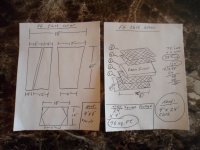
Initial planning/detail notes
Left illustration shows the required pieces
...& dimensions for a/each "layer" of fiberglass
* Basically 48" x 72" (or 4' x 6') per layer

Right illustration shows potential "layering" of F/G cloth
...& some of the "math" involved

So, for (4) layers of (4' x 5') fiberglass cloth it looks like it would require (at least)
...a 4' x 24' roll (or ~96 sq. ft) of F/G cloth
SAM_4128 (1).JPG
 

Functional Artist

Well-known member
Messages
5,292
Reaction score
2,739
Location
Toledo, Ohio
More good/great (next step) info (same guy) :cheers2:

After watching several videos (& some contemplation) I'm thinkin' about using some
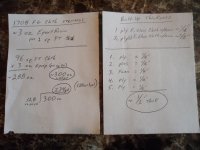
...1708 (bi-axial) fiberglass cloth (with Epoxy resin)
&
As seen in the last pic, it looks like we will need ~96 sq. ft of f/g cloth :huh:

So, according to info in/from that last video
...1708 f/glass cloth should require
...~3oz of Epoxy resin, per square foot (of cloth)

More Initial planning/detail notes
Left illustration shows, the "math" required to find about how much resin we will need for this part of the project
...so, it looks like we will need (at least) ~2 1/2 gallons of resin for 96 sq. ft. of f/g cloth

Right illustration shows (roughly) about how thick this monocoque should end up being probably
...~1/4" thick "if" just (4) layers of 1708 f/g cloth (are used)
......& maybe ~1/2" (if a 1/4" foam core is incorporated) :thumbsup:
SAM_4129 (1).JPG
 

Bansil

Painter of gnomes....
Messages
1,414
Reaction score
1,108
Location
Mnts of the farthest NE TN you can go
On your lay up schedule.

Make sure to take into account mounting areas for attaching mounts..

Fiberglass with no voids will not compress or Crack, ask the millions of high performance OB users.

Make mounts thicker, feather them out, to spread load.

Fully wetted out and no air bubble.....
 

Master Hack

Well-known member
Messages
4,065
Reaction score
6,465
Location
Mountain top Labratory
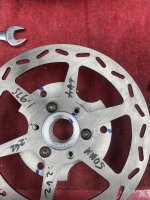
Redrilled and resurfaced the hub and got the runout down to .020. Like B4 the rotor is thin enough that runout can be adjusted by the 6 bolts. Not much sense in me screwing with it when its gotta come apart.
You can have all that fun on final assembly.

ACEA2F80-6187-4105-9D10-B5D2A7E87ED3.jpeg


Here at MTL Skunkworks division we take "speed holes to the next level!


IMG_4778.JPG
 

Functional Artist

Well-known member
Messages
5,292
Reaction score
2,739
Location
Toledo, Ohio
Hey T,

Bite marks...really LOL :ROFLMAO:

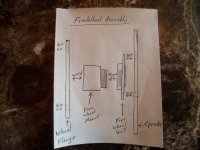
Here is a reminder (drawing) of the rear freewheel unit

It just needs a wheel flange welded to the freewheel mount
...& the sprocket needs to be mounted to the freewheel unit (itself)

* The whole unit "floats" over the axle
...just like those "bad azz" aluminum hubs you made :2guns:
SAM_3954 (1).JPG
This video shows the freewheel "in action" @ ~5:00
 
Last edited:

Functional Artist

Well-known member
Messages
5,292
Reaction score
2,739
Location
Toledo, Ohio
Now, how ta make the beforementioned creation
...but, full size
...& outta what???:popcorn:

Well, it'sa still WINTER here in Toledo
...but, Ima gettin'a a bit antsy (technical term) ta make some REAL progress on this monocoque project

So, after a bit of contemplation (thinkin')
...I'ma thinkin'...maybe...WOOD

I've been thinking about "imagination"
...& "how" I/you/we &/or folks in general "come up" with ...stuff :idea2:
...& found some interesting info...:popcorn:

So, I thought...I'd...share:sifone:

"Imagination is the production of sensations, feelings and thoughts informing oneself. These experiences can be re-creations of past experiences, such as vivid memories with imagined changes, or completely invented and possibly fantastic scenes. Imagination helps apply knowledge to solve problems and is fundamental to integrating experience and the learning process.

Imagination is the process of developing theories and ideas based on the functioning of the mind through a creative division. Drawing from actual perceptions, imagination employs intricate conditional processes that engage both semantic and episodic memory to generate new or refined ideas. This part of the mind helps develop better and easier ways to accomplish tasks, whether old or new.

A way to train imagination is by listening to and practicing storytelling (narrative), wherein imagination is expressed through stories and writings such as fairy tales, fantasies, and science fiction. When children develop their imagination, they often exercise it through pretend play. They use role-playing to act out what they have imagined, and followingly, they play on by acting as if their make-believe scenarios are actual reality.

Etymology
The English word "imagination" originates from the Latin term "imaginatio," which is the standard Latin translation of the Greek term "phantasia." The Latin term also translates to "mental image" or "fancy." The use of the word "imagination" in English can be traced back to the mid-14th century, referring to a faculty of the mind that forms and manipulates images.

Definition
In modern philosophical understanding, imagination is commonly seen as a faculty for creating mental images and for making non-rational, associative transitions among these images.

The psychological view of imagination relates this concept to a cognate term, "mental imagery," which denotes the process of reviving in the mind recollections of objects previously given in sense perception.

Ancient
Ancient Greek philosophers conceived imagination, or "phantasia," as working with "pictures" in the sense of mental images. Aristotle, in his work De Anima, identified imagination as a faculty that enables an image to occur within us,[18][19] a definition associating imagination with a broad range of activities involved in thoughts, dreams, and memories.

Middle Ages
In the Middle Ages, the concept of imagination encompassed domains such as religion, literature, artwork, and notably, poetry. Men of science often recognized poets as "imaginative," viewing imagination as the mental faculty that specifically permitted poetry writing. This association, they suggested, lies in the capacity of imagination for image-making and image-forming, which results in a sense of "visualizing" with "the inner eye."

Medieval theories of faculty psychology posited imagination as a faculty of the internal senses (alongside memory and common sense): imagination receives mental images from memory or perception, organizes them, and transmits them to the reasoning faculties, providing the intellect with sense data. In this way, it enables the reshaping of images from sense perception (even in the absence of perception, such as in dreams), performing a filtering function of reality.

Although not attributed the capacity for creations, imagination was thought to combine images received from memory or perception in creative ways, allowing for the invention of novel concepts or expressions. For example, it could fuse images of "gold" and "mountain" to produce the idea of a "golden mountain."

In medieval artistic works, imagination served the role of combining images of perceivable things to portray legendary, mysterious, or extraordinary creatures. This can be seen in the depiction of a Mongolian in the Grandes Chroniques de France(1241), as well as in the portrayal of angels, demons, hell, and the apocalypse in Christian religious paintings.

Renaissance/Early Modern
The Renaissance saw the revival of classical texts and the celebration for men's dignity, yet scholars of the time did not significantly contribute to the conceptual understanding of "imagination." Marsilio Ficino, for example, did not regard artistic creations such as painting, sculpture and poetry as privileged forms of human creativity, nor did he attribute creativity to the faculty of imagination. Instead, Ficino posited that imagination could be the vehicle through which divine intervention transmits insights in the form of images, which ultimately facilitates the creation of art.
Nevertheless, the groundwork laid by humanists made it easier for later thinkers to develop the connection between imagination and creativity. Early modern philosophers began to consider imagination as a trait or ability that an individual could possess.

This type of wit was thought to be typically found in individuals for whom imagination was the most prominent component of their "ingenium" (Spanish: ingenio; term meaning close to "intellect").

Early modern philosophers also started to acknowledge imagination as an active, cognitive faculty, although it was principally seen as a mediator between sense perception (Latin: sensus) and pure understanding (Latin: intellectio pura).

...but wait...there's more
 

Functional Artist

Well-known member
Messages
5,292
Reaction score
2,739
Location
Toledo, Ohio
Enlightenment
By the Age of Enlightenment, philosophical discussions frequently linked the power of imagination with creativity, particularly in aesthetics. William Duff was among the first to identify imagination as a quality of genius, distinguishing it from talent by emphasizing that only genius is characterized by creative innovation.

Immanuel Kant, in his Critique of Pure Reason (German: Kritik der reinen Vernunft), viewed imagination (German: Einbildungskraft) as a faculty of intuition, capable of making "presentations," i.e., sensible representations of objects that are not directly present. Kant distinguished two forms of imagination: productive and reproductive. Productive imagination functions as the original source of the presentation of an object, thus preceding experience; while reproductive imagination generates presentations derived from past experiences, recalling empirical intuitions it previously had. Kant's treatise linked imagination to cognition, perception, aesthetic judgement, artistic creation, and morality.

The Kantian idea prepared the way for Fichte, Schelling and the Romantics to transform the philosophical understanding of it into an authentic creative force, associated with genius, inventive activity, and freedom.

Albert Einstein famously said: "Imagination... is more important than knowledge. Knowledge is limited. Imagination encircles the world."

Nikola Tesla described imagination as: "When I get an idea I start at once building it up in my imagination. I change the construction, make improvements and operate the device in my mind. It is absolutely immaterial to me whether I run my turbine in thought or test it in my shop. I even note if it is out of balance. There is no difference whatever, the results are the same. In this way I am able to rapidly develop and perfect a conception without touching anything."

The phenomenology of imagination is discussed in The Imaginary: A Phenomenological Psychology of the Imagination (French: L'Imaginaire: Psychologie phénoménologique de l'imagination), also published under the title The Psychology of the Imagination, a 1940 book by Jean-Paul Sartre. In this book, Sartre propounded his concept of imagination, with imaginary objects being "melanges of past impressions and recent knowledge," and discussed what the existence of imagination shows about the nature of human consciousness. Based on Sartre's work, subsequent thinkers extended this idea into the realm of sociology, proposing ideas such as imaginary and the ontology of imagination."

Excerpt from & for more info...https://en.wikipedia.org/wiki/Imagination#Etymology
 
Top