Boma 60V 2,000W brushless motor

Status
Not open for further replies.

sikbrik

New member
Messages
131
Reaction score
0
Location
Greater Harrisburg PA area
FYI, the BOMA 60v 2000w setup I got from AlphaWheels does NOT come with the #35 sprocket. No biggie...just FYI so people can plan for it.

Maybe it's something I needed to specifically inquire about
 

Quinc

Member
Messages
236
Reaction score
1
FYI, the BOMA 60v 2000w setup I got from AlphaWheels does NOT come with the #35 sprocket. No biggie...just FYI so people can plan for it.

Maybe it's something I needed to specifically inquire about

How much does it weigh?
 

Functional Artist

Well-known member
Messages
5,651
Reaction score
3,289
Location
Toledo, Ohio
I have been doin some more research & testin' on these controllers :thumbsup:

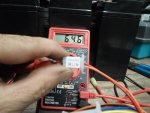
Installed some red & black 10g.wires to the battery connector plug, connected up (5) 12VDC SLA batteries (total pack voltage ~64.5VDC) via (thru) 50A circuit breaker & then, started testin' wires.

Controller Off
All plugs showed 0 VDC, except the on/off plug (labeled "electric lock") & the charge port plug (they both showed pack voltage)

Controller On
With the controller switched on, the Battery Indicator plug showed pack voltage (of course) but, also
...the Indicator Light plug
...the Brake Light (lever) plug
…& the Brake Light plug, all showed pack voltage (~64.5VDC)

To my surprise, when I tested the other control circuits, the Reverse plug (labeled Astern) showed 4.6VDC & the 3-speed plug showed 5VDC/0 VDC/ 5VDC (about the same as the throttle)

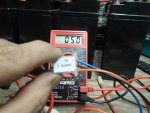
* I even did an amp draw test on the "Electric Lock" circuit, just to see what was flowing thru it.
At first nothing was showing on the meter (must be below .2A) so, I changed the setting to 200mA & then, got a reading of 14.5mA :2guns:
 

Attachments

  • SAM_3360.JPG
    SAM_3360.JPG
    1.3 MB · Views: 1
  • SAM_3361.JPG
    SAM_3361.JPG
    1.3 MB · Views: 2
  • SAM_3363.JPG
    SAM_3363.JPG
    1.3 MB · Views: 2
  • SAM_3365.JPG
    SAM_3365.JPG
    1.3 MB · Views: 2
  • SAM_3380.JPG
    SAM_3380.JPG
    1.3 MB · Views: 1
  • SAM_3374.JPG
    SAM_3374.JPG
    1.3 MB · Views: 1
  • SAM_3371.JPG
    SAM_3371.JPG
    1.2 MB · Views: 1
  • SAM_3370.JPG
    SAM_3370.JPG
    1.2 MB · Views: 1
  • SAM_3372.JPG
    SAM_3372.JPG
    1.3 MB · Views: 1
  • SAM_3381.JPG
    SAM_3381.JPG
    1.3 MB · Views: 1

Functional Artist

Well-known member
Messages
5,651
Reaction score
3,289
Location
Toledo, Ohio
Now, with that info we begin to establish some "safe" operating parameters.

This speed controller has (12) sets of wires that we can probably break down into (5) categories.
(as per their voltage &/or amperage requirements)

1.) Battery/Power - 60VDC 50A - 100A yes (this circuit MUST be protected with a HD fuse)
2.) Motor/Traction - 60VDC 50A - 100A no (a fuse is not needed)
3.) Charging - 60VDC 5A - 10A yes (use a fuse)
4.) Lighting - 60VDC 5A - 10A yes (use a fuse)
5.) Controls - (see below)
a.) lock, brake lever & battery indicator 60VDC no (fuse needed)
b.) throttle, reverse & 3-speed 5VDC no (fuse needed)
c.) motor (hall) 5VDC no (fuse needed)
 

Functional Artist

Well-known member
Messages
5,651
Reaction score
3,289
Location
Toledo, Ohio
So, (to help clarify) to properly choose components for a given system, it's best to first research & confirm the "actual" specs of the particular system your working with.
...& then, apply that info to any potential/proposed components you may want to use for controlling or protecting all of the individual systems.

Mainly:
Voltage
(max potential voltage of the battery pack)
...& (if its used for AC or DC)

Use
(signal or load)

Size
(motor-wattage/max amp rating)
...& (conductors-wires/cables)


Then, along with all of that info, maybe we can apply some different lenses (filters) to help narrow the choices even further.

Like:
Safety
Voltage: for a 60VDC system, add a 10% safety margin so, 72VDC would be the target.
Amperage: this motor/controller is listed as 35A max current, plus a 10% margin = (38.5A) so, ~40A would be the target.

Efficiency
if a ~40A is called for, using a 100A component is "overkill", usually more expensive & in most cases will not protect the system/circuit any better. (& sometimes worse, by not being "sensitive" enough)

Reliability
keep in mind what the components actual use will be, like for a horn button ("usually" seldom used) as opposed to an on/off switch (could be used several times daily).

Alternatives
repurposing components (requires extensive thought, research & (if possible) testing to confirm fit, compatibility & overall usefulness)
 

Quinc

Member
Messages
236
Reaction score
1
You can adjust this controllers amperage above the default 40a?


Now, with that info we begin to establish some "safe" operating parameters.

This speed controller has (12) sets of wires that we can probably break down into (5) categories.
(as per their voltage &/or amperage requirements)

1.) Battery/Power - 60VDC 50A - 100A yes (this circuit MUST be protected with a HD fuse)
2.) Motor/Traction - 60VDC 50A - 100A
 

Functional Artist

Well-known member
Messages
5,651
Reaction score
3,289
Location
Toledo, Ohio
You can adjust this controllers amperage above the default 40a?

No, I don't think so. :ack2:

The way I understand, the fuse/circuit breaker amperage rating needs to be sized a bit bigger than the controllers max amperage rating.

If some one was to use, lets say a 30A fuse on this controller, it should "pop" as soon as the fuses "ceiling" is reached (probably ~10% above the listed rating) in an effort to protect the system.

I probably shoulda just said, 60VDC 50A :2guns:

* I've been diggin' deep into 60VDC stuff
...more to come :cheers2:
 

Functional Artist

Well-known member
Messages
5,651
Reaction score
3,289
Location
Toledo, Ohio
Miguel from Alfa Wheels sent me/us some data on these Boma motors direct from the factory. :2guns:

I cant seem to get 'em to up load right. :ack2:

If someone could post 'em properly & maybe decipher what they mean, it would be most appreciated. :thumbsup:
 

Attachments

  • archive.zip
    69.6 KB · Views: 5
  • BM1024-48V1500W CURVE.pdf
    24.9 KB · Views: 2
  • BM1024-48V1500W-DATA.pdf
    24.7 KB · Views: 4
  • BM1024-60V2000W CURVE.pdf
    24.9 KB · Views: 5
Last edited by a moderator:

p0440

New member
Messages
24
Reaction score
0
I think this is what they're saying..

Miguel from Alfa Wheels sent me/us some data on these Boma motors direct from the factory. :2guns:

I cant seem to get 'em to up load right. :ack2:

If someone could post 'em properly & maybe decipher what they mean, it would be most appreciated. :thumbsup:
 

Attachments

  • Untitled-1.jpg
    Untitled-1.jpg
    425.1 KB · Views: 11

sikbrik

New member
Messages
131
Reaction score
0
Location
Greater Harrisburg PA area
I'm not expecting this thing to replace the power density of the race engine it's replacing but it's crazy that the torque rating isn't too far off.


sikbrik

New member
Messages
131
Reaction score
0
Location
Greater Harrisburg PA area
For those of you running this motor, did you mount it for one specific rotation/direction vs the other for any reason?

I'm asking since it offers the unique opportunity to run "full speed" in either direction. This gives me the option to move the sprocket inboard, where a 4 stroke would run it, or leave it out board in the 2 stroke position.

Also interesting, the factory two stroke mount had 2 outer holes which lined up exactly with the outer mounting holes of this motor...it just simplifies the adapter plate I'll need to build so thank heavens for small metric blessings.

The same matching hole scenario applies on the inner side, if I end up mounting in that direction...the adapter plate will actually work either way.


Quinc

Member
Messages
236
Reaction score
1
I have found with my industrial motors that are bi-directional; that one way is always smoother with less resistance. Once you have it on the cart push the cart with the motor on both ways and see if one way is easier to push then the other.
 

sikbrik

New member
Messages
131
Reaction score
0
Location
Greater Harrisburg PA area
Okay, next crazy question...

Let's say the 2k watt BOMA isn't enough and I want to run a second one. (bear with me). ...do I run a second controller and chain and sprocket? Other option is 2nd motor/controller with single chain/sprocket, mounted inline. Is there one which should be avoided?

The other question is, there's now a really affordable 2500w setup available for about the same price. If I run duals, should they be matched, 2000w each? Or is it okay to run a 2000 watt and 2500 motor on the same live axle?

Mods/FunctionalArtist, please move this if it's too far off topic.

---------- Post added at 08:15 PM ---------- Previous post was at 08:13 PM ----------

For what it's worth, I watched FunctionalArtist's double trouble vids, which sort of kicked off the idea.
 

Quinc

Member
Messages
236
Reaction score
1
Okay, next crazy question...

Let's say the 2k watt BOMA isn't enough and I want to run a second one. (bear with me). ...do I run a second controller and chain and sprocket? Other option is 2nd motor/controller with single chain/sprocket, mounted inline. Is there one which should be avoided?

The other question is, there's now a really affordable 2500w setup available for about the same price. If I run duals, should they be matched, 2000w each? Or is it okay to run a 2000 watt and 2500 motor on the same live axle?

Mods/FunctionalArtist, please move this if it's too far off topic.

---------- Post added at 08:15 PM ---------- Previous post was at 08:13 PM ----------

For what it's worth, I watched FunctionalArtist's double trouble vids, which sort of kicked off the idea.

I would run both motors inline like this:
https://www.youtube.com/watch?v=P9b6UdxyRHM

As long as both motors are running at the same rpms they should be fine to mix.
 
Status
Not open for further replies.
Top