Baja 200 Upgrades

panchothedog

Well-known member
Messages
2,788
Reaction score
3,739
Honestly if you use a grade 8 or stainless steel fine thread 1/4" X 28 as compared to a standard hardware store bolt it will cut its own thread. Chinese aluminum is pretty soft. I have done this successfully on at least 8 builds. Run the bolt in all the way, back it out, add the thread locker and retighten. No mess involved that you get when running in a tap. Don't have to wash the metal chips out of the block.
 

joshw0000

Well-known member
Messages
304
Reaction score
346
Honestly if you use a grade 8 or stainless steel fine thread 1/4" X 28 as compared to a standard hardware store bolt it will cut its own thread. Chinese aluminum is pretty soft. I have done this successfully on at least 8 builds. Run the bolt in all the way, back it out, add the thread locker and retighten. No mess involved that you get when running in a tap. Don't have to wash the metal chips out of the block.
That's for the top 2 holes (1/4 x 28), right? What length do you use? Some builds I've seen look like the bolt is sticking pretty far into the engine.

The sensor hole is a larger bolt, right? The last Red Beard video I saw, he threaded that hole but not the others.
 
Last edited:

joshw0000

Well-known member
Messages
304
Reaction score
346
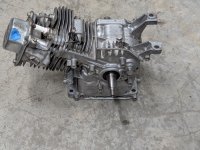
Finally snuck out for a little shop therapy. I taped the side hole and used a 7/16x20 bolt. I tried putting 1/4x28 bolts in the governor holes but they felt too small. So I taped both of those holes for 5/16x28 bolts. I've squirted most of a can of brake cleaner in it to get the shavings out. Then I switched to cheap oil (dump some in, spin it, swish it to all sides, dump, and repeat). I think it's ready to seal back up now.

PXL_20251210_005745883.jpg
 

joshw0000

Well-known member
Messages
304
Reaction score
346
Your so close....
A billit rod and a cam are there just waiting to be changed.
No billet parts in my near future. At best, just cheap aluminum ones. Keep in mind, this is just my first real build. If this doesn't blow up, I'll go further on the next one.

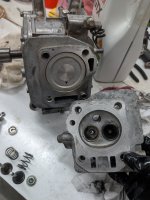
Cleaned some things up.

PXL_20251210_021927440.jpg

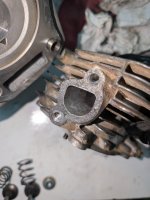
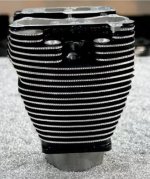
My attempt at polishing the the exhaust port. I'm to wimpy to do any porting on this build.

PXL_20251210_022027995.jpg
 

joshw0000

Well-known member
Messages
304
Reaction score
346
Arrrggghhh. You need to mill the head now! Its right there in your hand. Take the dremel to it and hog out those ports.

Just do it the first time!

Lol.
Yea I know, lol. I almost did it, but decided against it. I just picture when it's all back together not being able to get it to crank or run right and that's one less thing to question when I'm troubleshooting. If this ends well, my next build will be bigger.

Got the 18# springs in and set the valve lash to 003-004. It's ready for the flywheel, carb, and exhaust.
 

Hellion

Moderator
Messages
8,474
Reaction score
3,588
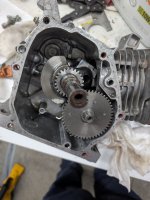
I’m catching up on this thread but I love how the governor was removed, only by its own volition it appears. By that I mean it looks like it exploded and the previous owner shrugged and left the remnants of the gear on the shaft.
On a governor delete, I usually leave the governor gear shaft intact (to keep it simple, stupid) and just remove the gear because it is simply a press-on fit (but hard to get to if you have 800lbs gorilla hands).

“your going" to make the Grammar Polices head explode.
I vote to add Denny’s submission to the bad grammar thread… 👮‍♂️🚔 (and yours too, Ezcome).

I've squirted most of a can of brake cleaner in it to get the shavings out. Then I switched to cheap oil (dump some in, spin it, swish it to all sides, dump, and repeat). I think it's ready to seal back up now.

You can use compressed air to blow out the shavings (or swarf as it is called), assuming you have a compressor. But it is best to do all your machining and cleaning first, then wash the block in hot soapy water and let it dry with the assistance of compressed air. Yes I said soapy H2O.

I don’t know why you used oil as a solvent or cleaning agent, it’s too thick. If you want, you can pre-lube by adding oil to the crank, con rod and camshaft bearings (or just dribble some fresh oil on all the moving parts) but the best thing to use is assembly lube because it is tacky.

Before you button everything up, use a fresh scotchbrite pad or maybe some medium/fine steel wool (manually or with a rotary tool) to clean both mating surfaces of the sump cover and the cylinder head. If you’re extra talented you can use a single edge razor blade or a gasket scraper (dedicated tool for the purpose). The steel wool will create its own shavings/debris so do it first and then wash the block last. The preceding process ensures the gaskets can do their job and seal properly.
 

joshw0000

Well-known member
Messages
304
Reaction score
346
I’m catching up on this thread but I love how the governor was removed, only by its own volition it appears. By that I mean it looks like it exploded and the previous owner shrugged and left the remnants of the gear on the shaft.
On a governor delete, I usually leave the governor gear shaft intact (to keep it simple, stupid) and just remove the gear because it is simply a press-on fit (but hard to get to if you have 800lbs gorilla hands).


I vote to add Denny’s submission to the bad grammar thread… 👮‍♂️🚔 (and yours too, Ezcome).


You can use compressed air to blow out the shavings (or swarf as it is called), assuming you have a compressor. But it is best to do all your machining and cleaning first, then wash the block in hot soapy water and let it dry with the assistance of compressed air. Yes I said soapy H2O.

I don’t know why you used oil as a solvent or cleaning agent, it’s too thick. If you want, you can pre-lube by adding oil to the crank, con rod and camshaft bearings (or just dribble some fresh oil on all the moving parts) but the best thing to use is assembly lube because it is tacky.

Before you button everything up, use a fresh scotchbrite pad or maybe some medium/fine steel wool (manually or with a rotary tool) to clean both mating surfaces of the sump cover and the cylinder head. If you’re extra talented you can use a single edge razor blade or a gasket scraper (dedicated tool for the purpose). The steel wool will create its own shavings/debris so do it first and then wash the block last. The preceding process ensures the gaskets can do their job and seal properly.
I caught most of the savings with a shop vac and by adding towels inside the motor while I taped. Then I sprayed brake cleaner inside as I turned the shaft. It would puddle at the bottom of the engines with any shavings it caught and I would dump / wipe it out. I then started pouring a small amount of oil on the moving parts (again while turning the shaft) and dumping anything that collected at the bottom. I feel like I got more out with oil since the shavings stuck to it better. I dumped the engine at least 10 times between the 2 fluids so hopefully I got it all out. I'll run 10w30 for one heat cycle when I first start it and swap with 10w30 full synthetic so if I did miss anything, hopefully that'll get it.

I've already buttoned up the front casing / cylinder/ valve. I did use a razor blade, putty knife, wire brush, and towel with brake cleaner to get the old gaskets off. I didn't even think about using steel wool. I have a half pack of ultra fine that I could've used (mixed with WD40 is the best method to tackle surface rust that I've found). I think I'll use it to help clean the exterior of the engine more. Does it matter? No, but I've done this much so it might as well look good.
 

joshw0000

Well-known member
Messages
304
Reaction score
346
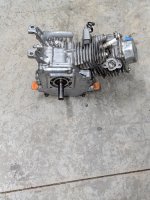
I decided to clean it up some on my break. The steel wool worked good but my Temu handheld steamer worked better. Next time, I'll use that to clean the inside as well.

It's still a turd, just less dirty. It's mint if you squint.

PXL_20251210_180836262.jpgPXL_20251210_180847531.jpg
 
Top