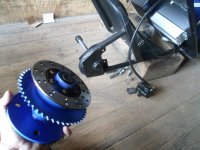
Sequoia Electrathon Racer

Functional Artist

Well-known member
Messages
5,320
Reaction score
2,782
Location
Toledo, Ohio
Oh no! That IS unfortunate!
Waiting on the full report!
Hey T,

Yup, I agree

I dunno...it looks like maybe a few different things "ganged up" on this motor/controller :huh:
Weight?
GR?
Spring sag/rolling resistance?

For comparison: :thumbsup:
My Atom kart (mini-Aerial Atom) 2018
https://www.diygokarts.com/community/threads/building-a-go-kart-size-aerial-atom.40167/
...is a heavy beast (IMO)
...& even has an extra wheel
&
It has the same 60V 2,000W motor & controller (bought at the same time)
...running about the same GR (Atom has 10T drive & 54T driven = 5.4:1) & (Sequoia has 10T drive & 50T driven = 5:1)
...& both were tested with the same battery pack (custom made 60V 16S Lithium)

This is the type of performance I was expecting :auto:
 

Master Hack

Well-known member
Messages
4,106
Reaction score
6,508
Location
Mountain top Labratory
That purdy much sucks...
l know how dissapointing that is. My last electric kart project ended in a similar fashion.
l learned a lot about components and component placement.
l put the controller box thingy under the "dashboard". it worked purdy good until it didn't, at which point the control box thingy got so hot it started raining molten solder and hot components down on my leg. It took a couple of weeks for the burns to heal.
Did l mention that was my last electric project?
 
Last edited:

Functional Artist

Well-known member
Messages
5,320
Reaction score
2,782
Location
Toledo, Ohio
I got out a couple of karts over the weekend
...& did some comparin' :cheers2:
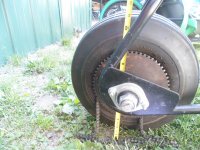
SAM_2806 (1).JPG
The mini-Slingshot has (60T ~7" sprocket (6:1 GR) on a ~13" wheel)

* Notice that the driven sprocket is ~50% of the size of the wheel?
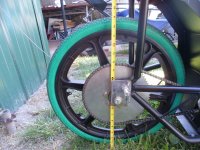
SAM_2809 (1).JPG
Polaris has (72 T ~9" sprocket (7.2:1 GR) on a ~20" wheel)

* Notice the driven sprocket is also ~50% of the size of the wheel?
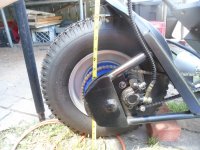
SAM_2810.JPG
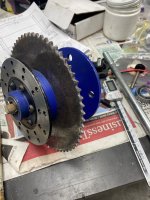
Sequoia has (48T ~5" sprocket (4.8:1 GR) on a ~16" wheel)

* Notice the driven sprocket is ~30% of the size of the wheel? :ack2:
SAM_2811.JPG
So, yea! I'ma thinkin' that I got a bit too aggressive with the ~5:1 GR (50T driven sprocket...after double checkin' it is actually a 48T)

Ta "back 'er down a bit" I found (& ordered) a 60T sprocket from BMI karts for ~$10.00
...which will give us a 6:1 GR ;)
https://www.bmikarts.com/Sprocket-35-60T-No-Bolt-Holes_p_11973.html

Sprocket #35 60T (No Bolt Holes)​

Product Specs:
  • Chain Pitch: #35
  • Teeth: 60
  • Bore: 1-1/2"
  • Can be used on a multitude of projects
  • Sprockets have surface rust from storage
Also, I have to deal with the front suspension "sag" issue
...which leads to the front wheels "toeing outwards"
...which then, dramatically increases the rolling resistance :mad2:

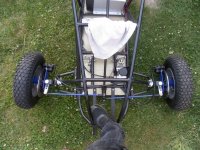
Pre-weighting the front of the kart with my foot, ta demonstrate how the wheels "splay" outwards
SAM_2827 (1).JPG
 

ezcome-ezgo

G'me sumthin to write on
Messages
5,903
Reaction score
2,864
Location
Atlanta, GA
I’m the they who calls it bump stear
You invented that term? Oddly "stear" is a combining form of a word meaning related to or derived from stearic acid. One small error in spelling has led to cataclysmic failure of the human condition. You were not the first, you will not be the last.

One hits a bump and the mechanism moves in a way that affects steering geometry. In centuries from now this will be referred to as "bumpster".
 

Functional Artist

Well-known member
Messages
5,320
Reaction score
2,782
Location
Toledo, Ohio
That purdy much sucks...
l know how dissapointing that is. My last electric kart project ended in a similar fashion.
l learned a lot about components and component placement.
l put the controller box thingy under the "dashboard". it worked purdy good until it didn't, at which point the control box thingy got so hot it started raining molten solder and hot components down on my leg. It took a couple of weeks for the burns to heal.
Did l mention that was my last electric project?
Hey T,

Tell us more about your electric kart project, I'm very interested in mini-EV successes & failures
...to "see" what works
...& what don't
...to try-n-get a better understanding about why ;)

They call that bump steer don't they? Who the heck is "they"?
Hey Ez,

Yup,
...but, in this instance, when the suspension "sags" it's even worse
...'cause the bump steering doesn't "come & go"

When the front wheels start "toeing" outwards, it gets continually worse
...'cause as the kart travels, the front wheels "continue" to creep "outwards"
...& they suck the suspension down even lower
...making the problem continually wors(er)

IMO the suspension in a performance or race car shouldn't really "travel" very much
...or be "stiff" (like in a Corvette, where the ride isn't super smooth but, they "hug" the road) :auto:
...& only or mainly to help absorb road irregularities, which should help keep the wheels "planted" on the road & not bouncing around

So, Ima thinkin' we'sa be need'in some stiffer shocks :thumbsup:

The "they" are those who know :p

It’s me, I’m the they who calls it bump stear. Mostly found in ford twin I beam suspensions.
Hey Denny,

Your preferred pronoun is "they"
...& you now "identify" as a group? :ROFLMAO:
&
Ya, kinda "stepped" into "it" with that one :eek:
 

Functional Artist

Well-known member
Messages
5,320
Reaction score
2,782
Location
Toledo, Ohio
Emperical engineering at its finest!
Hey T,

Never heard of it
...so, I had ta look it up :thumbsup:

Here is some info for those who didn't bother ta look it up :cheers2:

For an experienced practitioner, empirical design means drawing on personal experience with building structures to be able to determine approximate size and configuration for the next project.

Often, in senior engineers, the accumulation of experience makes a practitioner capable of intelligent empirical decisions in the preliminary layout and sizing of a building project.

The word ‘empirical’ derives from the Greek word for ‘experience.’ Empirical design, as applied to the structural design of buildings, is the application of proven sizes, proportions, materials, and assemblies. The basis of empirical design is previous experience, without regard for any systematic theory.

There are two primary benefits to the application of empirical design. The first, is the ability to make expedient decisions on layout and sizing (and to communicate these decisions to the rest of the design team) prior to undertaking a detailed structural design.

The second, in the area of historic preservation, is that by understanding the method by which most historic buildings were designed, it becomes less necessary to impose a modern structural outlook on these structures in order to trust their safety.

Buildings have been designed and built by empirical design for most of the history of building, up to the nineteenth century, when some rational forms of design began to appear.

The temples of ancient Greece and Rome were built according to proportioning rules that defined the size of all of the elements on the basis of the column diameter. (In an Ionic temple, the columns are spaced 2 column diameters apart, the architrave has a depth of 1/12 of the column height, the frieze ¾ the height of the architrave, etc.)

Other monumental buildings, such as the Pantheon, the Colosseum, or the Constantinian basilica of St. Peter’s, were worked out according to similar proportional rules.


So, basically
Empirical (engineering) design, as applied to the structural design of buildings, is the application of proven sizes, proportions, materials, and assemblies. The basis of empirical design is previous experience, without regard for any systematic theory.

Yup, I guess I'm guilty of doin' that :2guns:
 
Top