Frederic's Backbone Kart

Status
Not open for further replies.

frederic

The Junk Man
Messages
385
Reaction score
1
Location
New Jersey
Boring Bar

The best way to think of a boring bar is as a cutter extension.

When boring a hole with a lathe cutter, once you reach the depth of the exposed part of the cutter, the toolpost and holder will slam into the work. If you need to bore a hole that's deeper than that distance, you can use a boring bar which simply relocates the cutter from the toolpost to the end of the boring bar.

The longer the boring bar, the deeper the hole you can bore. This video is less than 2 minutes.

http://www.youtube.com/watch?v=VXQXy7wcWos

What is the difference between drilling and boring?

Drilling is a way to make a new hole with low accuracy.
Boring, is a highly accurate way to enlarge an existing hole.


Here are some other interesting tidbits about drilling.

1. Drilling does not produce round holes. They are "slightly" triangular due to the spiral action of the cutting edge at the end of the bits. More often than not, the bit "walks" not only when you start the hole, but as you get further down. The deeper the hole the less likely it will be straight. If the bit is dill you can often see how crooked the hole is without magnification.

2. For the same reason, the finished surface inside the hole is rarely smooth and often galled, scraped, and gouged.

3. Drill bits that are Ti coated are often preferred because the chips don't stick therefore the bit doesn't get clogged up. They also don't tarnish and rust the way uncoated bits often do.

The Ti coating is paint - and eventually it wears off and then the final diameter of the drill bit is 0.007" smaller than it started out when you bought it.

Enjoy!
 

jorge0136

New member
Messages
108
Reaction score
0
That's why I measure, and measure, and measure, just to be sure.
Sounds like a mantra my father drilled into my head. Probably imprinted on my DNA somewhere.

I live in Washington state. There is a guy here that worked for Boeing up in Seattle and was selling a cabinet of his tools in a garage sale. I picked up a whole variety of high quality dial indicators, micrometers, drill bushings etc..... Very pleased with that whole arrangement. There are tools in that cabinet I will don't think I will ever use. If I ever get the chance to though it will be the perfect tool for the job. I think a lot of those tools will come in handy when I get a lathe/mill. I don't imagine myself getting a new machine so I will have the same accuracy problems you have.

Between all these gears/transmissions I can turn material to silky smooth or cut threads as large as 1 TPI and as small as 100 TPI.
Being able to thread things smoothly would be a huggge plus. I need to start saving my pennies again. You may have already anwsered this, how big is your lathe? Thanks for explaining how the acme screw works.

It is, however around here in the NY/NJ area that's about the going rate for custom work. Paying for 3-4 hours of labor is cheaper than buying a $3500 machine, especially if the job is a one-off or such a low production part that the purchase of the machine isn't justified.
$3500 is only about 50 hours on the machine. Just enough for me to justify buying my own machine and spending 5 times the amount of time to do half the job they would do in a pro shop. :)
It's all in the experience right? Granted I might still need to pay a shop for things where a few thousandths count, as You said.

Since my friend's foundry is "only" for aluminum, he uses an iron crucible which to be honest I'm not sure where it came from. It's about a foot and a half in diameter at the top, about two feet deep, and rounded like a ball on the bottom. Basically his furnace cooks the aluminum the same way you'd cook a stew on a stove, then the whole furnace is on a stand that allows the furnace to rotate, and that's how pours are done.

The whole thing, stand and all, is about 4' high. It runs on acetelyne and oxygen just like a welding/cutting torch.

I am going to making mine out of a old beer keg with a kind of fire cement plastered inside. Fueled by waste oil such as motor oil, frying oil etc.... Probably won't get as hot as the acetelyne/oxy furnace though. Mine won't rotate, although it's worth thinking about.

Fantastic work on the second video! Explains my questions precisely.

Drilling is a way to make a new hole with low accuracy.
Boring, is a highly accurate way to enlarge an existing hole.

Makes sense now. Makes me want to be able to use a boring bar more often. I'll have to make do with a drill bit. I can make reasonably accurate holes with the drill bushings I have. However it sounds as though the boring bar is still the way to go. You can only use a drill bit on a mill correct? You can't spin the piece and have a stationary cutter like a boring bar. Is this why you used the lathe for the accuracy?

Are you going to be using a locking collar to hold the axle in the bearing? Any progress on the rest of the suspension? Thanks again for documenting all this, hope it isn't making the work too slow.
 

frederic

The Junk Man
Messages
385
Reaction score
1
Location
New Jersey
Some additional pictures.

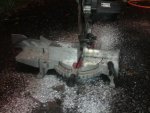
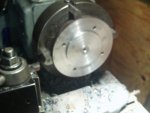
Pic 1: I ordered the aluminum blocks to be a certain size because they'd fit in the mower rims, mostly because they have a sleeve that sticks out quite a bit so the blocks didn't have to go that far in. With the new 4-bolt rims this changes and the aluminum blocks need to go in, almost flush with the rim. So, I had to shorten the blocks, and I used a miter saw for this with a c6 carbide blade. C6 carbide is typically what end mills are made of, so it cuts aluminum just fine as you can see from the chips all over the ground.

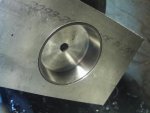
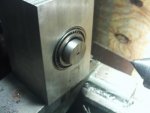
Pic 2- the start of the necessary pocket for the bearing cup. The bearing cup is a tapered, hardened steel ring that the tapered bearing rides in. This is the preferred arrangement when the structure is a softer material like aluminum, brass, copper, and so on. Hardened steel rollers riding directly on aluminum surfaces will chew it up quickly. This tapered ring prevents that. However, to fit tightly, it needs to be a precise cut.

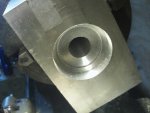
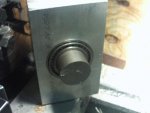
Pic 3 - Finished pocket.

Pic 4 - Finished pocket with tapered cup installed.

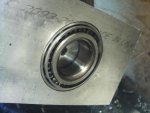
Pic 5 - Now with the tapered roller bearing. Notice the roller bearing sticks out. This extension into open space ensures that the back of the wheel plate (drilled and tapped for studs and lugnuts) will not rub on the aluminum block. Since all the rollers are below the surface, eerything is "cool" as far as the bearing is concerned.

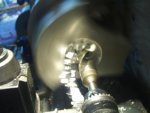
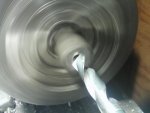
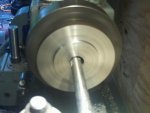
Pic 6 - to bore out the hole that the axle stub will pass through, I will use my boring bar because I don't have any drill bits above one inch. However, a boring bar cannot start a hole so I had to drill it out and I used a 1" bit just to minimize the wear on the boring bar's cutter. Seemingly I need to reorder these cutters because this is my last one and I had to sharpen it quite a bit.

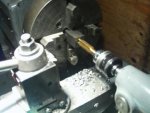
Pic 7 - Boring bar about to bite into the chunk of aluminum. With the cutter as short as it is (due to many sharpenings), I could only take off about 0.030" each pass, so I ended up spending most of the afternoon boring out the two axle holes - one in each rear spindle. This is where an automatic lathe comes in handy... set it... power up the headstock, engage gearing, and sit back with a soda and a magazine and wait until the squeeking stops.
 

Attachments

  • elec-truck-082.JPG
    elec-truck-082.JPG
    46.1 KB · Views: 15
  • elec-truck-084.JPG
    elec-truck-084.JPG
    23.4 KB · Views: 13
  • elec-truck-085.JPG
    elec-truck-085.JPG
    32 KB · Views: 11
  • elec-truck-086.JPG
    elec-truck-086.JPG
    34.1 KB · Views: 12
  • elec-truck-087.JPG
    elec-truck-087.JPG
    37.2 KB · Views: 15
  • elec-truck-089.JPG
    elec-truck-089.JPG
    32.2 KB · Views: 13
  • elec-truck-088.JPG
    elec-truck-088.JPG
    31 KB · Views: 12

frederic

The Junk Man
Messages
385
Reaction score
1
Location
New Jersey
While the lathe was cutting out the many, many passes for the axle tubes in the rear spindles, I got bored reading magazines so I started on the front spindles.

Pic 1: the top of the spindle is just a 1" x 1/2" x 3" piece of bar stock which I drilled a 37/64" hole then followed with a tap. This tapped hole is for the bolt that goes through the upper rod end of the upper a-arm. These parts together form a crude yet strong ball joint.

Pic 2: The body of the spindle is 1" square bar stock and again, a 37/64" hole needed to be drilled for the lower bolt, and tapped to 5/8".

Note: While this seemed "easy" there was some engineering in that the depth of the drilled hole followed by the tap, allows the bolt I'll be using to go all the way in, with the very last 1.5 threads it engages being incompletely cut. This results in spindle itself acting as a lock nut. This piece of bar stock is actually tool steel so the locknut "feature" is reusable as long as I don't use grade 5 or higher bolts.

Pic 3: The hole needs to be tapped, so I started the tapping process on the lathe without the lathe being powered. What I do is insert a homemade tool into the back of the headstock and it engages a large tang that's there and allows me to turn the headstock (and in turn the chuck and the material in the chuck) by hand with decent leverage. While I'm ratcheting the chuck around, I'm also cranking the tailstock which pushes the tap forward. The tailstock is not clamped down tightly but just enough that it doesn't wiggle. When the cutters on the tap engage the aluminum, I ratchet another 1/4" turn then undo the drill chuck in the tailstock, then release the work from the chuck and put it in the vice as you can see in Pic 4.

Since I used a drill chuck in the tailstock to drill the hole, if I remove that and chuck the tap I am assured the tap will perfectly align with the hole, thus guarrenteeing I can start the tapping process with the tap "dead nuts" straight in all directions.

I don't know about you but I can never start taps accurately by hand. I used to have a tapping head but the clutch wore out and I can't tighten it any further for it to be useful, so I have to replace that at some point. It was a nice unit too whereas it would drive the tap into the material until a certain amount of required force was reached and it would shift into reverse and back the tap out automatically. This allows you to use a powered machine to tap holes while guarrenteeing the taps never bite so much that they break.

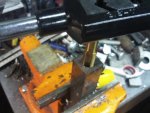
Pic 4 - Hand tapping the bottom ball joint hole (which is just a bolt going through the lower rod-end).
 

Attachments

  • elec-truck-095.JPG
    elec-truck-095.JPG
    42.2 KB · Views: 11
  • elec-truck-096.JPG
    elec-truck-096.JPG
    29.1 KB · Views: 11
  • elec-truck-097.JPG
    elec-truck-097.JPG
    38.6 KB · Views: 13
  • elec-truck-099.JPG
    elec-truck-099.JPG
    45.6 KB · Views: 14

frederic

The Junk Man
Messages
385
Reaction score
1
Location
New Jersey
don't think I will ever use. If I ever get the chance to though it will be the perfect tool for the job. I think a lot of those tools will come in handy when I get a lathe/mill.

That is the best way to buy tool(ing). I picked up a cigar box of small lathe cutters for $5 a few years ago and it was a great find not only because it was cheap but also because they were pre-ground for a variety of very specific purposes, which alleviated me from having to master that craft. I personally think the hardest part of using a lathe is making the right cutters. Certainly you can buy thread-cutting cutters and the like, but making them yourself saves tremendous dollars because you just buy tool steel bars and hack out what you want.

I don't imagine myself getting a new machine so I will have the same accuracy problems you have.

It's only a problem if you're unaware of it and don't pay attention. This is where the dial indicators come in real handy.

Even with the wear and inaccuracy my lathe has, I am comfortable enough with it's operation that I can compensate for it enough to still machine things to about 1/1000" if I have to. Most of what I do never needs to be that precise.

Being able to thread things smoothly would be a huggge plus. I need to start saving my pennies again. You may have already anwsered this, how big is your lathe? Thanks for explaining how the acme screw works.

My lathe is a 12x24 unit, meaning that I can chuck something up to 12" diameter and up to 24" long. The bed is much longer but part of the bed on the left is taken up by the headstock and some of the bed on the right is taken up by the tailstock.

I also have a second tailstock for it which is a "turret tailstock", and that's for mass production of parts. Instead of one MT2 (morse taper 2) socket that's extendable via a crank, the turrent is octagon shaped and has eight such sockets. I can insert different tools into each of the eight sockets, then rotate the tailstock to whichever tool I need to present to the material. So with my machining of the rear spindles, I could have put the live center in position one, a center drill in a chuck in position two, a 37/64" drill bit in a chuck in position three, and so on and significantly reduce the time it takes to set up the tooling each time. I had it on the lathe for the longest time and used it quite a bit until recently where I needed to machine a 24" long axle shaft and the turret tailstock is much longer than the "ordinary" one so I swapped them out. Swapping them is a pain in the butt because the turrent tailstock has to be realigned every time, where as the ordinary tailstock just bolts onto the bed and self-aligns.

$3500 is only about 50 hours on the machine. Just enough for me to justify buying my own machine and spending 5 times the amount of time to do half the job they would do in a pro shop. :)

yes, that's one way of looking at it and that's how I ended up with a lathe and a vertical mill. There are some steps in things I make that requires a machine I do not have, and that I'll send out. Like surface grinding, I don't own the machine so the once in a blue moon where I need something surface ground to a thou or better I'll farm that out. I probably farm a job like that out once every few years, so buying a big-arse machine and having it take up valuable space is not worth it to me.

It's all in the experience right? Granted I might still need to pay a shop for things where a few thousandths count, as You said.

Experience does count, absolutely, but one thing many amatuer machinists forget is how important the math is. For example, you know that the radius of a circle is half the diameter. Almost everyone knows that. However if you're not paying attention, and you need to enlarge a bore exactly 1/100th of an inch, you'd be very tempted to move the dial exactly one line, which is 1/100th of an inch.

Except, since you're machining a bore, you're actually cutting off 2/100th of an inch.

While this seems like an incredibly stupid mistake, I cannot count the number of times I've borked that completely. It's very, very easy to do.

One thing you may notice in the video (I did mention it) is that I always cut away from the chuck if possible. Why? Because exactly once, just before the cutter that was skimming down a long shaft, the phone rang and in telling that person I'd get back to them in about 10 minutes, the lathe cutter went all the way to the chuck, hit the jaws, and broke off in a way that it ended up embedded in the tool holder. I didn't care about the cutter as it was about $6 worth of tool steel, but losing a $60 Aloris tool holder sucked and the $180 piece of aluminum that was chucked was also toast. And, things like this are easy to do. That's one of the reasons why I cut as slow as I do. It gives me the opportunity to correct mistakes before the mistake ruins a lot of stuff.

I am going to making mine out of a old beer keg with a kind of fire cement plastered inside. Fueled by waste oil such as motor oil, frying oil etc.... Probably won't get as hot as the acetelyne/oxy furnace though. Mine won't rotate, although it's worth thinking about.

The rotation thing makes it easier to pour as it's on a stand therefore no tongs are necessary. The ace/oxy fuel system I thought was gross overkill, but then again my buddy was comfortable machining all the jets and whatnot and the end result is that it melts large quantities of aluminum fairly fast, which lowers the overall cost in fueling. Obviously if it can melt a crucible of aluminum in 20 - 45 minutes that's more economical than if it has to run for hours.


Fantastic work on the second video! Explains my questions precisely.

Thanks!


akes sense now. Makes me want to be able to use a boring bar more often. I'll have to make do with a drill bit. I can make reasonably accurate holes with the drill bushings I have.

Just remember that twist drill bits do not make round holes, but round-like triangles. We're talking small tolerances here, in the "few thou" range. But sometimes, this makes a huge difference between junk and quality. It all depends what you are making.

A boring bar gives a very precise finish, especially when the work moves quickly and the cutter moves slowly. The finish is even better when cut wet, which I rarely do unless I'm machining tool steel or something harder.

You can only use a drill bit on a mill correct?

Um, no, you can use them on a lathe, I do it all the time. There's two ways of doing it that I know of. One is to buy a chuck for your tailstock, which replaces your live center. Chuck the work into the lathe's chuck, then drill the hole. It's backwards in a sense because the bit is stationary and the work rotates.

Another method is to buy a drill chuck on a tool holder, and use it with your tool post. Then you'll have to align it to center every time but when you need to drill off-center holes in precise locations, you can do that. An example of this would be drilling stud holes in a wheel plate for a hub. The four or five bolts that the rim bolts to are off center. So you'd move your lathe's crossslide then drill, using the accuracy of the lathe dials to precisely place that hole. The lathe's chuck of course isn't rotating and should be locked, as you're using it more like a rotary table.

Does that make sense?

You can't spin the piece and have a stationary cutter like a boring bar. Is this why you used the lathe for the accuracy?

This is how a milling machine operates - the work is stationary and the boring bar rotates in the work to make the hole. The difference is the boring bar is called a boring head, and is shaped a little differently and maybe has some additional features other than 'stiff' and 'cutter goes here'.

Are you going to be using a locking collar to hold the axle in the bearing?

The axle will fit snugly in the bearing, and the axle will be located left to right by the things attached to it. The wheel plate which will have the wheel studs inserted will be welded to the axle, so the outer bearing will be held in place. On the inside, there will be a larger diameter collar attached which will hold the inner bearing in place (adjustable tension of course) as well as provide a mount for a CV or a U-joint depending how that all works out. I'm still mulling that detail in my head, but yes, the tapered bearings will be locked in place with adjustable tension the old fashioned way - castle nut and cotter pin, more than likely.

Any progress on the rest of the suspension?

I added two posts this evening with pictures so that's the progress that's been made.


Thanks again for documening all this, hope it isn't making the work too slow.

Sure, happy to help and share knowledge. It did slow me down a bit though not so much while machining, but mostly I lost machine time after my son goes to bed as I was monkeying with the video. Seemed my software didn't like my camera's .mov format at first, and I had to tweak something to make it work.

It's cool though, I was happy to do so.
 

frederic

The Junk Man
Messages
385
Reaction score
1
Location
New Jersey
BTW, I meant to mention, you can also do the reverse with lathes and drill bits. If you get a drill chuck that fits into your lathe's headstock, you can bore holes in your work that's clamped to your x-y table.

The only drawback is that the movement of the crossslide is much less than the typical milling machine, but if your project is small you can do this with fantastic results.

I may not have mentioned this earlier (I thought I had?), but I machined adapters to insert into my headstock which allow me to put anything that's morse taper 2 (MT2) right into headstock. I have a full set of used MT2 collets, the drill chuck you see in the above pictures and the first video, and quite a few MT2 shanked end mills with two, four and six flutes. I made another "thing" that replaces my Aloris tool post and it's just a big plate with some t-slots bored down the length, allowing me to clamp work and drill holes, mill slots, and things of that nature. It worked fine even with it's limitations, but once I got the mill those parts went into a box, sealed, and into the attic. The milling machine makes live much easier in this regard.
 

frederic

The Junk Man
Messages
385
Reaction score
1
Location
New Jersey
Started machining one of the rear axle stubs today. It was coming out nice until a chip got wedged between the cutter and the axle, while I was standing outside the garage on the phone. I have to turn it quite a bit more so I'm hoping enough has to come off where that gouge will disappear. It's not where either bearing will go so it's really not a big deal if it doesn't, but I prefer things to come out correct and precise. Or at least some reasonably facimile of correct and precise lol.

Finished the upright portion of the front spindles, however the bound right up on the rod ends while turning. It looked right in my design however it seems I didn't pivot the rod ends in the drawing when playing with the various angles, so I have a binding issue.

I solved it somewhat by cutting back the top extension piece to the upper rod end about 5/8" of an inch, and redrilling for the bolt. That helped a lot but isn't quite what I wanted. It seems to only effect full-droop which is unlikely to be a common occurance while driving around.
 

frederic

The Junk Man
Messages
385
Reaction score
1
Location
New Jersey
Rear Axles: These are the axle "sections" that will pass through the rear spindles and the two tapered bearings. One end is left unmachined at an approximate 1.500" diameter and will be welded to the wheel flanges once they are done. The remainder of the axle section was turned down to 1.499", 0.001" smaller diameter than the ID of the tapered bearings in the rear spindles.

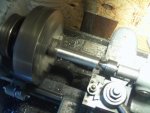
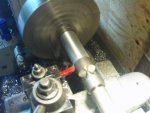
Pic1: Turning the axle shaft from the chuck out.
Pic2: Same process, just further along and much closer to the targeted 1.499" diameter.

I also finished up the front spindles, as it gave me something to do while the lathe chugged along cutting the axle shaft. I had the cross-slide moving very slowly to ensure that the cuts are smooth and the shaft comes out ungouged. I had a little problem with this early on. Anyway, front spindles:

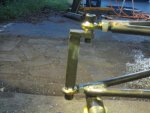
Pic 3: The front spindles completed - before I realized I had too much angle in the design leaving the upper and lower rod ends little room to swivel with the suspension in full droop or fully compressed. This prevents the spindle from rotating on it's axis (kingpin inclination angle) which in turn would prevent steering under some circumstances. I had to change the design.

Pic 4: Drilled and tapped new 5/8" holes in the new position, and before installation onto the chassis I hacked off the outer, unused hole and rounded the end the best I could in less than a minute.

Pic 5: The front spindles are instaled, and the angle is actually better than I had before. It actually "looks" right to the eye and I can articulate the suspension the full seven inches without the spindles binding.

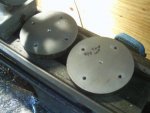
I started making the rear wheel flanges (or hubs as I call them) which starts off as an approximate 6" diameter, 3/4" thick disk which I need to find center and drill/bore for the axle stub I'm making in the first few pictures. I also have to drill out the 4x110mm bolt circle and since I own a rotary table this is really easy work.

First, I center the rotary table to the spindle of the milling machine. I made a jig for this which is just a R8 collet-shaped shaft that goes into the collet holder of the spindle and is tightened, and the end sticking out is a thousandths of an inch smaller than the hole in the center of the rotary table. I move the x-y table around until I can fully sink that jig into the center of the rotary table. Once I can, I have found center. The edge of the jig is slightly rounded to make finding center a little easier.

Pic ... um ... 6 and 7: With the rotary table centered, and center found on the metal chunk that will be the wheel flange, I line everything up and clamp using the standard t-slot type clamps as you can see in Pic 6. I then drill the hole with a center drill, but only part way so I can use the angled edge of the hole to slip on my lathe's tailstock, so I can align this disk to my lathe true and center.

Once that's done, I crank the X-axis of the x-y table over 55mm, then start another hole with a center drill that will be one of the wheel stud holes. I then crank the rotary table until it's in a position of 90.00 degrees, and drill another hole. That's wheel stud two. I continue this until all four wheel stud holes are drilled and ready for tapping as is displayed in Pic 7.

Where did the "move over 55mm" come from? The bolt circle of the wheels I'm using for this project is 4x110mm, which means four bolts on a 110mm bolt circle. Half of 110mm is 55mm.

It's that easy.
 

Attachments

  • elec-truck-107.JPG
    elec-truck-107.JPG
    44.7 KB · Views: 17
  • elec-truck-104.JPG
    elec-truck-104.JPG
    46.9 KB · Views: 10
  • elec-truck-100.JPG
    elec-truck-100.JPG
    42.7 KB · Views: 10
  • elec-truck-110.JPG
    elec-truck-110.JPG
    41 KB · Views: 10
  • elec-truck-101.JPG
    elec-truck-101.JPG
    39.3 KB · Views: 7
  • elec-truck-108.JPG
    elec-truck-108.JPG
    45.2 KB · Views: 7
  • elec-truck-109.JPG
    elec-truck-109.JPG
    36.6 KB · Views: 11

frederic

The Junk Man
Messages
385
Reaction score
1
Location
New Jersey
Rotary Table Video. Freshly made.

http://www.youtube.com/watch?v=invK9F7HQYM

If my son stays in the bed (sigh) I'll get some more time in the garage and hopefully finish one axle stub and from there things will start to look like the finished product. Piles of "stuff" isn't much fun.

Still waiting for the front tapered bearings and cups... only been 7 business days... it's a shame because I could have finished the front spindles, hubs and wheel plates by now. I just don't want to machine the parts until I have the bearings in the shop just in case the website measurements are off a little. I've had that happen before and it's no fun machining parts for bearings that simply fall off because of a typo on a web page lol.
 

jorge0136

New member
Messages
108
Reaction score
0
Wow that rotary table is the way to do that! I was figuring that it sounded like a lot of math to do it otherwise.

Experience does count, absolutely, but one thing many amatuer machinists forget is how important the math is. For example, you know that the radius of a circle is half the diameter. Almost everyone knows that. However if you're not paying attention, and you need to enlarge a bore exactly 1/100th of an inch, you'd be very tempted to move the dial exactly one line, which is 1/100th of an inch.

Except, since you're machining a bore, you're actually cutting off 2/100th of an inch.

While this seems like an incredibly stupid mistake, I cannot count the number of times I've borked that completely. It's very, very easy to do.

One thing you may notice in the video (I did mention it) is that I always cut away from the chuck if possible. Why? Because exactly once, just before the cutter that was skimming down a long shaft, the phone rang and in telling that person I'd get back to them in about 10 minutes, the lathe cutter went all the way to the chuck, hit the jaws, and broke off in a way that it ended up embedded in the tool holder. I didn't care about the cutter as it was about $6 worth of tool steel, but losing a $60 Aloris tool holder sucked and the $180 piece of aluminum that was chucked was also toast. And, things like this are easy to do. That's one of the reasons why I cut as slow as I do. It gives me the opportunity to correct mistakes before the mistake ruins a lot of stuff.

What you are talking about right here is what I would mess up on something like a hub without the right tooling. I am actually fairly good at math on a simply theoretical level. However in real life applications I seem to just mix it up just enough to make things not work the way they were designed. Practice makes perfect however.

Um, no, you can use them on a lathe, I do it all the time. There's two ways of doing it that I know of. One is to buy a chuck for your tailstock, which replaces your live center. Chuck the work into the lathe's chuck, then drill the hole. It's backwards in a sense because the bit is stationary and the work rotates.

Another method is to buy a drill chuck on a tool holder, and use it with your tool post. Then you'll have to align it to center every time but when you need to drill off-center holes in precise locations, you can do that. An example of this would be drilling stud holes in a wheel plate for a hub. The four or five bolts that the rim bolts to are off center. So you'd move your lathe's crossslide then drill, using the accuracy of the lathe dials to precisely place that hole. The lathe's chuck of course isn't rotating and should be locked, as you're using it more like a rotary table.

Does that make sense?

Yes it does. I have really seen these machines in person just understood their workings through reading. It helped tremendously to see your videos, I am starting to get my head around how most of it works.

This is how a milling machine operates - the work is stationary and the boring bar rotates in the work to make the hole. The difference is the boring bar is called a boring head, and is shaped a little differently and maybe has some additional features other than 'stiff' and 'cutter goes here'.

How is the boring head different?

BTW, I meant to mention, you can also do the reverse with lathes and drill bits. If you get a drill chuck that fits into your lathe's headstock, you can bore holes in your work that's clamped to your x-y table.

The only drawback is that the movement of the crossslide is much less than the typical milling machine, but if your project is small you can do this with fantastic results.
From what I am reading it sounds as though a lathe should first on the shopping list as I can manage to do things on a lathe that I could do a milling machine, more than vice versa.

Started machining one of the rear axle stubs today. It was coming out nice until a chip got wedged between the cutter and the axle, while I was standing outside the garage on the phone.

Were you trying cut it too quickly?

Finished the upright portion of the front spindles, however the bound right up on the rod ends while turning. It looked right in my design however it seems I didn't pivot the rod ends in the drawing when playing with the various angles, so I have a binding issue.

I solved it somewhat by cutting back the top extension piece to the upper rod end about 5/8" of an inch, and redrilling for the bolt. That helped a lot but isn't quite what I wanted. It seems to only effect full-droop which is unlikely to be a common occurance while driving around.
Is the steering all redesigned/fixed now? I saw you redrilled a hole further down, did it fix the king pin inclination?

I don't know about you but I can never start taps accurately by hand. I used to have a tapping head but the clutch wore out and I can't tighten it any further for it to be useful, so I have to replace that at some point. It was a nice unit too whereas it would drive the tap into the material until a certain amount of required force was reached and it would shift into reverse and back the tap out automatically. This allows you to use a powered machine to tap holes while guaranteeing the taps never bite so much that they break.

I have only tried to tap by machine once and I snapped the tap in seconds. I should have backed it out from the sound of it. By hand I think I am getting fairly good at getting it all aligned. I just have to triple check that everything is level/square. That clutch sounds super handy. I like your solution of getting the tap started.

My lathe is a 12x24 unit, meaning that I can chuck something up to 12" diameter and up to 24" long. The bed is much longer but part of the bed on the left is taken up by the headstock and some of the bed on the right is taken up by the tailstock.
That is the size lathe that I am looking to get, maybe a slightly longer bed. Do you find you wish you had more room very often?

You have been very busy out in the garage from the look of it. The new movie was fantastic as usual. Very well documented. Do you have your shocks yet?
 

frederic

The Junk Man
Messages
385
Reaction score
1
Location
New Jersey
Wow that rotary table is the way to do that! I was figuring that it sounded like a lot of math to do it otherwise.

There are several methods of making wheel plates. A rotary table on a mill is probably the easiest way and the one I showed here.

You can also drill through the center of the wheel and bolt it down to the x-y table through the center, then mark off all the bolts on the bolt circle using a protractor and a straight edge.

Another way is to measure the circumference of your lathe chuck and print out equadistant lines, 360 of them, which are all the degrees in a circle. Rotate to appropriate positons, then move the lathe's crossslide over 1/2 the bolt circle, and mark or drill or whatever, depending what tools you have available for your tool post. I made one toolpost block that I can shove a hardened steel rod with a point through it (it's a tight fit) and tap the back of the rod sticking out the other end specifically for this purpose. It worked great in the past but now I have the rotary table I don't bother with it and gave it to a friend of mine to play with.

You can actually mark the whole thing up using a pencil, protractor and straight edge and center punch where you want to drill. I've done that too.

Since you said you're good with math on a theoretical level I'm sure all of these methods make sense to you.

mix it up just enough to make things not work the way they were designed. Practice makes perfect however.

that's why I draw everything out in Visio or some other 2d cad program, so I can print out copies and actually look at what I'm trying to make. Certainly I have the car visualized in a completed state in my mind (and I'm good at this!) but the paper diagrams really help.

tremendously to see your videos, I am starting to get my head around how most of it works.

Glad to help.

How is the boring head different?

Boring Bar and Holder:

http://www.dragonworks.info/Metalworking/quick%20change%20toolpost/quick%20change%20toolpost%20pictures/boring%20bar%20.jpg[img]

Boring head:

[img]http://www.finelinehair.com/home/boring_head_2_inch_lathe_1.jpg


You can use either cutting tool (boring bar or boring head) in either machine, but it's more common to use boring bars in lathes and boring heads in milling machines.

Lathes rotate the material and the cutter does not rotate, and milling machines are the opposite - the cutter rotates but the material does not. At least in the simplist of configurations.

Lathes have more cutting distance in the "depth" dimension than in the x/y dimenisons. My crossslide can only move across the width of the bed 12.100 inches. I can adjust the machine to move the cutter the length of the bed an entire 36 inches if I were to remove the tailstock and the chuck. With both installed, the maximum distance the cutter can move is 24.100 inches.

The milling machine is different - the depth is the smallest dimension - 6" of travel though i can raise or lower the headstock to increase the space underneath, the spindle itself (and the cutter) will only move 6" by the cranks.

Milling machines have much more travel in the x and y dimensions - 9" for Y and I think 42" for width. Maybe it's 39", I forget. It's an inch short of however long a big-block ford head measures out to be ;-)

Since I don't own a boring head, I've used boring bars in my mill in the past with good results. It's the same principle in a sense, except sideways. The mill I have is a vertical machine, and the lathe is horizontal.

Way back in the day when American made iron machines were the ONLY thing one could buy, milling machines were horizontal just like a lathe. Unlike a lathe, the work didn't spin and the cutter did.

From what I am reading it sounds as though a lathe should first on the shopping list as I can manage to do things on a lathe that I could do a milling machine, more than vice versa.

If you have both machines you have almost endless capability. It all depends on what you're making. If you're machining mostly round parts (bushings, bearings, axles, hubs, etc) then you'd probably get more use out of a lathe but if you're going to make parts that aren't entirely round, a mill will serve you better.

And, if you're clever, you can adapt either machine to do *some* work of the other. Before I bought my milling machine I used to do lightweight, small parts requiring a mill in the lathe. I'd clamp the work to the crossslide with an adapter I made, and chuck the cutter in the headstock in place of the chuck.

Were you trying cut it too quickly?

The scoring came from an incorrectly ground cutter that I made quickly. I didn't have enough chip relief space off to the side so chips were getting caught between the miniscule open area next to the cutting edge and the material, gouging the material as it spun. I corrected this by rounding the cutting edge and grinding a minute slot across the top so chips would "break away" and be pushed off the back side of the cutter.

Is the steering all redesigned/fixed now? I saw you redrilled a hole further down, did it fix the king pin inclination?

I wanted more kinpin inclination than I have now, but it was more important that the suspension can articulate at or close to the design. An off-road vehicle of any kind with about an inch of suspension travel is a worthless effort. Shortening the top solved the problem, with moving the upper rod-ends out "a hair" as well.

clutch sounds super handy. I like your solution of getting the tap started.

I only start larger taps with the machines. Anything 1/4" or smaller I start by hand. I used to have a tapping stand that would basically extend the tap's shaft about six inches through two rigidly located bearings, however I couldn't find it in time. It's a hand cranked tool that basically just ensures the tap goes in straight.

That is the size lathe that I am looking to get, maybe a slightly longer bed. Do you find you wish you had more room very often?

As long as the material is less than a 1.75" diameter it can extend through the chuck and the headstock, sticking out the left side, so I can machine longer parts than the lathe's capability with this diameter restriction. Obviously once I machine the first two feet I need to slide the material through the tailstock, and that's done by removing the tailstock and installing a steady rest. A steady rest is essentially a rigid ring with three arms with bearings on the end to support the diameter of the material in the center. I made my own, and it works "OK". There's no fine adjustment so I do have some issues aligning it at times.

What would have been better for me is more diameter capability, i.e. the first measurement, simply because I do a lot of automotive work and turning down brake drums and rotors requires more than 12" diameter capability. At least the vehicles I drive... Crown Victoria, F350 crewcab, etc. I have to take these items out to a local gas station and have them cut them for me. Cheap enough.

You have been very busy out in the garage from the look of it. The new movie was fantastic as usual. Very well documented. Do you have your shocks yet?

Thanks, I enjoy this kind of work far more than cleaning gutters (for example).

The shocks have not officially been acquired, but it looks as though I'll be getting a set of four air shocks which on a vehicle of this weight (or lack thereof) can also be used at air springs. I'm waiting for a friend to agree with the trade we started negotiation and we're good to go. If not, I'll have to investigate a source for cheap motorcycle coil-overs or something along those lines.

I debated doing the corvette setup... a transverse leaf spring front and back.
 

frederic

The Junk Man
Messages
385
Reaction score
1
Location
New Jersey
8/28/2009 - more progress on the rear spindles/axles/wheel plates.

Pic 1: The outside of the rear spindle (facing the wheel), with the unmachined portion of the axle protruding through the tapered bearing. This unmachined area will be welded to the wheelplate once I bore the center of the wheelplate out to the appropriate diameter.

Pic 2: The inside of the rear spindle (facing the differential and half-shafts) also poking through a tapered bearing. This end will be threaded so a castle nut can be used to retain the shaft and bearings in place with the appropriate tension, and a bolt-on u-joint holder (or something like that) will be machined to graft onto the little stub. I'm still engineering this because I haven't had a chance to go to the local family owned auto parts store and ask them to pull out their entire castle nut collection as well as a pile of small u-joints. They're good that way, they like me enough to pull out 100's of items for me to look at, measure, and so forth knowing I'm going to spend $10 tops and buy two.

Pic 3: I'm machining down the first wheel plate so that it's flat and actually round, with a protruding center hub that's 3.5" diameter - the same diameter as the hole in the wheels. The purpose in doing this is so the wheels ride on the hub and the studs only have to hold the wheel flat on the wheelplate. The machined hub supports all the weight of the vehicle, and the studs do not.

Pic 4: the face of the first wheelflange is complete.
 

Attachments

  • elec-truck-116.JPG
    elec-truck-116.JPG
    30.2 KB · Views: 5
  • elec-truck-115.JPG
    elec-truck-115.JPG
    29.8 KB · Views: 3
  • elec-truck-114.JPG
    elec-truck-114.JPG
    29.3 KB · Views: 4
  • elec-truck-113.JPG
    elec-truck-113.JPG
    28.2 KB · Views: 3

frederic

The Junk Man
Messages
385
Reaction score
1
Location
New Jersey
One rear spindle is almost done. I have yet to mll out the pockets where the rear a-arms will attach because I haven't made them as of yet.

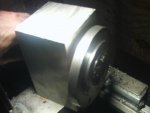
Pic 1: Boring out the center so the unmachined area of the axle I machined in previous pictures will fit tightly. This will hopefully allow me to get the shaft and the wheel flange very close to perpendicular.

Pic 2: I removed the wheel flange then chucked the axle in it's place, then tapped the wheel over the axle stub (the unmachined area), and it fight nice and tight but I couldn't get it to remain perpendicular so no matter what I do I'm going to have to skim it. This is why I bought 3/4" thick pieces when I only needed 1/2" thick pieces. I allowed plenty of "waste" in case I had to true things up after welding. Anyway, the wheel plate is now welded to the shaft.

Pic 3: As you can see only the axle is gripped by the chuck, allowing me to machine the front face, the perimeter edge, and the back face as necessary.

Pic 4: The tapered bearings and cups are installed into the aluminum block, the axle and welded wheel flange is pushed through, and viola, rear spindle capable of handling about 4500 lbs of weight each. Overkill? Yes, one would think so but if you drive directly into a tree at full throttle, it won't break.

In theory ;-)

I guess since the front wheel bearings have not arrived as of yet I guess I'll start machining the other rear spindle tonight. If the bearings had arrived I'd have machined all four axle stubs rather than change the way the chuck jaws are so many times per day, but such is life.

The rear a-arms are actually not going to be a-arms, but rather h-arms, and more like a triangle with the top cut off. This saves costs by reducing the number of rod ends that will be used back there to zero. Of course the pieces I make will need to be drilled for zerk fittings and greased regularly.

I didn't machine the slagged area where the welds are only because it's quite bumpy and I didn't want to shave off the now hardened steel with the smallish lathe cutters that I have because they'd break. Since this pokes through the wheel it's really just a cosmetic issue and I've decided at least for now, to leave it alone. I may hand-grind the beads after I'm done most of the machinining but for now it's staying "as is".
 

Attachments

  • elec-truck-118.JPG
    elec-truck-118.JPG
    31.3 KB · Views: 4
  • elec-truck-119.JPG
    elec-truck-119.JPG
    34.1 KB · Views: 6
  • elec-truck-120.JPG
    elec-truck-120.JPG
    34.3 KB · Views: 3
  • elec-truck-121.JPG
    elec-truck-121.JPG
    25.7 KB · Views: 5

jr dragster T

New member
Messages
3,966
Reaction score
7
Location
Cold place
I noticed you where drilling the wheel hubs free hand in the drill press. One time I had to drill out a wheel hub and the drill locked up into the hub and whipped it around the room. Pretty scary.
 

frederic

The Junk Man
Messages
385
Reaction score
1
Location
New Jersey
Yeah, that's a habit I should get out of. I've had things like that happen to me also and even with ER visits and scars, I still do it.
 

frederic

The Junk Man
Messages
385
Reaction score
1
Location
New Jersey
Another short (6m) video illustrating how the rear spindle, axle, wheel flange (hub) fit together and some of the machining and welding involved.

http://www.youtube.com/watch?v=FwptpVcNarM

I have to admit I'm enjoying creating time-lapse videography. I am not enjoying narrating however, I sound like such a dork. None-the-less, they are overall fun to do.
 

jorge0136

New member
Messages
108
Reaction score
0
You can actually mark the whole thing up using a pencil, protractor and straight edge and center punch where you want to drill. I've done that too.

I imagine this is how I would go about doing things. Your rotary table would much more accurate and easy to use. I could also see myself using the doing the compass of sorts on the chuck when I get a lathe.

that's why I draw everything out in Visio or some other 2d cad program, so I can print out copies and actually look at what I'm trying to make. Certainly I have the car visualized in a completed state in my mind (and I'm good at this!) but the paper diagrams really help.

I have been thinking of using something like visio to mock up my parts. I have been drafting things on graph paper to scale thus far. Takes far too long and my drafting skills leave a lot to wanted. Is visio worth the price tag?

You can use either cutting tool (boring bar or boring head) in either machine, but it's more common to use boring bars in lathes and boring heads in milling machines.

Thanks for educating me on something again. :)
And, if you're clever, you can adapt either machine to do *some* work of the other. Before I bought my milling machine I used to do lightweight, small parts requiring a mill in the lathe. I'd clamp the work to the crossslide with an adapter I made, and chuck the cutter in the headstock in place of the chuck.

I can see that happening when I get one or the other tool. We will have to see which comes first. I am in the midst of trying to sell my pops ancient truck project we have given up on to give us more room in the garage. After that more tools can go in.

The scoring came from an incorrectly ground cutter that I made quickly. I didn't have enough chip relief space off to the side so chips were getting caught between the miniscule open area next to the cutting edge and the material, gouging the material as it spun.
You grind your own cutters? How do you do that with any accuracy? How do you sharpen said cutters? Sounds like something worth trying out.

Thanks, I enjoy this kind of work far more than cleaning gutters (for example).
Quite possibly my least favorite chore. I understand where you are coming from completely.

I debated doing the corvette setup... a transverse leaf spring front and back.

I had been thinking that leaf springs might be a fun suspension to try on a kart. What design did you have in mind?

I haven't had a chance to go to the local family owned auto parts store and ask them to pull out their entire castle nut collection as well as a pile of small u-joints. They're good that way, they like me enough to pull out 100's of items for me to look at, measure, and so forth knowing I'm going to spend $10 tops and buy two.

I have a similar shop here in Washington that not only lets me poke through their parts but will help me engineer stuff in there store with them. Gotta love the old mom and pop type businesses.

I removed the wheel flange then chucked the axle in it's place, then tapped the wheel over the axle stub (the unmachined area), and it fight nice and tight but I couldn't get it to remain perpendicular so no matter what I do I'm going to have to skim it. This is why I bought 3/4" thick pieces when I only needed 1/2" thick pieces. I allowed plenty of "waste" in case I had to true things up after welding. Anyway, the wheel plate is now welded to the shaft.
Aren't you so glad you planned ahead? I would not have ever planned that far ahead I don't think. I am liking the looks of the hubs. Look like the whole thing will in fact be overkill and just run right on over the tree.

The time lapse video is perfect. Gives me an idea of whats going on without making me watch every chip fly off. I like your design of having the studs only hold the wheel to the hub and not the weight of the wheel. Very clever plan there. How big are the wheels you ended up going with?

Your narration is fine by the way. Not a James Earl Jones performance but it works just fine.

I guess since the front wheel bearings have not arrived as of yet I guess I'll start machining the other rear spindle tonight. If the bearings had arrived I'd have machined all four axle stubs rather than change the way the chuck jaws are so many times per day, but such is life.

Eventually they will come, in the main time keep spinning that wrench to get the jaws out. Even with time lapse I can imagine how tired you are of moving those jaws back and forth.

Excellent craftsmanship as always and thanks for answering my questions.
 

frederic

The Junk Man
Messages
385
Reaction score
1
Location
New Jersey
I have been thinking of using something like visio to mock up my parts. I have been drafting things on graph paper to scale thus far. Takes far too long and my drafting skills leave a lot to wanted. Is visio worth the price tag?

Visio is a 2D drawing package, most known for it's "drag and drop" capability using what they call "stencils". If you're designing a floorplan, you select the three or four stencils relating to floorplans then drag walls, bathtubs, outlets, sinks, sofas and whatnot into your diagram and you've created an accurate floorplan.

I've been using Visio since it came out (in the windows 3.1 days) to draw and manage network diagrams. It's very, very good in this regard, and with the last version Microsoft added significant features for mechanical and architectural engineers though I sitll wouldn't consider it a CAD program like AutoCAD or any of the other ones.

If you can use it for more than drawing kart parts, then it might be worth the over $300 price tag but if not, you might be better suited with something else.

When I had my homemade CNC plasma cutting machine going I struggled with Visio's inability to *accurate* convert from its proprietary format to AutoCAD's DXF format and in turn, convert the DXF format to what is called G-Code. The CNC plasma cutter kept undercutting every dimension about a hair less than 1% (0.79 to be precise), and while for some things that doesn't really matter for other things this is awful. I had to scale the drawing to 100.79% before exporting to DXF in order to get it right. I know for certain it was Visio and not the DXF to G-Code converter or the machine itself because if I created the same drawing in Autocad the cuts were 'spot on'.

I haven't used the cnc plasma cutter in years so Visio still works for me. Once I get around to finishing up converting my milling machine to CNC, I'll be revisiting the drawing sofware issue myself because making parts that are always undersized from the design does not work.

You grind your own cutters? How do you do that with any accuracy? How do you sharpen said cutters? Sounds like something worth trying out.

For cutters that will be cutting flat surfaces on the lathe I make my own without any issues. It's just grinding bevels and such and that can be done freehand using the grinder's little "table" in front of each wheel for positioning.

Grinding single-edge gear cutters or thread cutters requires a lot more precising, and I cheat and chuck the tool steel in my toolmaker's vice on the milling machine and angle that more precisely with a protractor, then make the cuts using a carbide cutter in a collet.

I had been thinking that leaf springs might be a fun suspension to try on a kart. What design did you have in mind?

Simple transverse leafs much like the corvette old and new. The suspension is bascially an unequal length arm type suspension but instead of coilovers a leaf spring is laid across the width of the chassis, tied to the lower a-arms and clamped to the backbone, and that's it.

My other unresolved option is a set of four air-shocks. Still waiting to hear if my buddy is willing to trade.

Aren't you so glad you planned ahead? I would not have ever planned that far ahead I don't think. I am liking the looks of the hubs. Look like the whole thing will in fact be overkill and just run right on over the tree.

Always.

The rear suspension bits are larger than what most road-worthy vehicles of today would be using for parts.

I like your design of having the studs only hold the wheel to the hub and not the weight of the wheel. Very clever plan there.

This is how real cars/trucks work, and where I got the idea from.

How big are the wheels you ended up going with?

The rims are 8x7 with a 4x110mm bolt circle and a 3.500" center hole, the tires are 18x9.50x8. I got them on ebay for $120 or so as a set of four including shipping. I expected a 4 on 4 or a 4 on 4.5 bolt circle however they're replacement rear tires/wheels for chinese-made ATV's so I should have expected the metric bolt circle.

Excellent craftsmanship as always and thanks for answering my questions.

Thank you very much! I think my thread bored many people however... lol
 

Attachments

  • transverseleafspring.jpg
    transverseleafspring.jpg
    26.6 KB · Views: 26

frederic

The Junk Man
Messages
385
Reaction score
1
Location
New Jersey
Finished up the axle/wheel flange for the other side. Did an experiment where I welded the flange to the shaft first, then machined them as one unit. I can't say it's better or worse, just another way of doing things.

Unfortunately, during the last skim of the axle, taking off the last 0.003" the stupid thing released from the chuck and bounced out getting caught and dinging the perimeter of the wheel flange pretty good. While that terminated the existance of a perfectly good cutter, all is not lost because I hadn't shaved down the diameter of the wheel flange so the part itself is still usable.

It seems when I chucked it I left one jaw loose and after hours of skimming back and forth it worked free. Seemingly it worked loose just before it popped out because the turnings I did on the axle are round and dead center.

I was standing a few feet away and wow, it was loud!

This is called a "machine crash".
 

freakboy

the names 'mater
Messages
3,961
Reaction score
2
Location
hick town
You should add a note infront of the machine that says MAKE SURE ALL JAWS ARE TIGHT i forget stupid things like this all the time on stuff. i forgot to tighten the bolts on my kart seat before. we all make mistakes!
 
Status
Not open for further replies.
Top