Viper Off Road Build

Status
Not open for further replies.

andrewmacc

Canadian Wonderboy
Messages
66
Reaction score
1
Location
Surrey BC Canada
Looks a little cold, need to turn up the heat and down the feed.
Is that 120v or 220v?

You can tell it's 120v because of the severe cold lap on almost all the joints. I was gonna keep my big yap shut because I know that not everybody appreciates that kind of criticism, but the welds holding the tube onto the bracketside of the A-arm are very concerning.
The welds holding the bolt onto the spindle are even moreso. I am intensely skeptical of 120v welders for this very reason.. after a lot of hours under the hood burning 1/16" wire at over 300 amps, 120v welders require certain prep-work to even remotely guarantee proper penetration into the joint. Fusion is not necessarily penetration, and well, vice versa.

A hot root bead followed by appropriately placed cap passes would have been much more preferable than a wide (and thereby ineffective) weave bead, when you are using equipment that is inadequately rated for the weldment material.

As well, the reinforcement tube of the A-arm should have been placed further up on the tube to prevent bending. IMO, the HAZ of the weld is going to make the tube more susceptible to bending after the weld joint now, nearer to the spindle, where it will see the largest moment of bend stress.

Also, in terms of suspension design, parallel A-arms are not the most effective. The upper arm should decline downward at an angle greater than the lower A-arm. But that's a whole 'nother ballgame of discussion!

Sorry dude, not bashing, you're building a wicked project and can't wait to see how it turns out, just don't want it falling apart on you when you need the strength the most!
 

gjpgonzo

New member
Messages
109
Reaction score
0
Location
Boston Area
You can tell it's 120v because of the severe cold lap on almost all the joints. I was gonna keep my big yap shut because I know that not everybody appreciates that kind of criticism, but the welds holding the tube onto the bracketside of the A-arm are very concerning.
The welds holding the bolt onto the spindle are even moreso. I am intensely skeptical of 120v welders for this very reason.. after a lot of hours under the hood burning 1/16" wire at over 300 amps, 120v welders require certain prep-work to even remotely guarantee proper penetration into the joint. Fusion is not necessarily penetration, and well, vice versa.

A hot root bead followed by appropriately placed cap passes would have been much more preferable than a wide (and thereby ineffective) weave bead, when you are using equipment that is inadequately rated for the weldment material.

As well, the reinforcement tube of the A-arm should have been placed further up on the tube to prevent bending. IMO, the HAZ of the weld is going to make the tube more susceptible to bending after the weld joint now, nearer to the spindle, where it will see the largest moment of bend stress.

Also, in terms of suspension design, parallel A-arms are not the most effective. The upper arm should decline downward at an angle greater than the lower A-arm. But that's a whole 'nother ballgame of discussion!

Sorry dude, not bashing, you're building a wicked project and can't wait to see how it turns out, just don't want it falling apart on you when you need the strength the most!

I don't mind the constructive critisism but in the future if you see something of concern please post a pic of what it should look like, or something you have done and how you did it.

As far as ther welds although I am a beginner I know the welds are very strong, I lay down a good weld where I can see the two pieces meltning together, then I make second and third passes for added strength. I think that that is what is making the welds look a little cold to you.

If that a arm bends after the weld I will be shocked, I can't imagine that amount of force that it would take to do that, but we will see, after all I expect to learn allot from the mistakes/ miss calculations from this very first build. Plus if I have to redo some things after running it a few times, I will do that.

Thank you all for your comments and concerns.
 

OzFab

Well-known member
Messages
15,615
Reaction score
69
Location
Warwick Qld, Australia
You obviously realise that welding is all about penetration, that's good but, you mentioned

I lay down a good weld where I can see the two pieces meltning together, then I make second and third passes for added strength.

My question is did the second & third passes penetrate as well as or better than the first? They won't add much strength if it's all just sitting on top...
 

gjpgonzo

New member
Messages
109
Reaction score
0
Location
Boston Area
You obviously realise that welding is all about penetration, that's good but, you mentioned


My question is did the second & third passes penetrate as well as or better than the first? They won't add much strength if it's all just sitting on top...

Second yes, third maybe not so much:rolleyes:
 

andrewmacc

Canadian Wonderboy
Messages
66
Reaction score
1
Location
Surrey BC Canada
I don't mind the constructive critisism but in the future if you see something of concern please post a pic of what it should look like, or something you have done and how you did it.

As far as ther welds although I am a beginner I know the welds are very strong, I lay down a good weld where I can see the two pieces meltning together, then I make second and third passes for added strength. I think that that is what is making the welds look a little cold to you.

If that a arm bends after the weld I will be shocked, I can't imagine that amount of force that it would take to do that, but we will see, after all I expect to learn allot from the mistakes/ miss calculations from this very first build. Plus if I have to redo some things after running it a few times, I will do that.

Thank you all for your comments and concerns.

I'll not trash up your thread after this, I'd like to see you continue to post evidence of your progress! :cheers2:

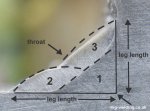
I have attached files at the bottom, as you have requested, that outline the appropriate weld fillet profile in a root or single bead, as well as the fillet profile for a correctly performed multipass weld (or as we called them in the shop for a weld requiring one root and two caps, a "two-show", whereas a "three-show" actually consists of 6 welds.. happens a lot when you're welding 2" AR plate).

Seeing the two pieces melt together is not indicative of penetration. It is indicative of fusion, and even then, a weld can fuse into both parent material only a few molecules deep and still be considered a "weld" as it has atomically bonded the filler wire with the parent material. Although fusion is technically the determining factor of weld strength, which is why the WPS (weld procedure specification) calls out to fulfill a specific fillet size, not penetration depth, it is nonetheless equally as important to have penetration - also called "depth of fusion".

This is why it is a better idea to perform the welds with one pass directly into the root, and two cap passes with 50% overlap over the root, in the case of either requiring a larger fillet profile, or using equipment inadequately rated for the material that cannot achieve sufficient depth of fusion.

Cheers! And carry on, I like the overall design! :thumbsup:
 

Attachments

  • fig5.4%2880%25%29.jpg
    fig5.4%2880%25%29.jpg
    106.7 KB · Views: 20
  • fillet-diagram-large.jpg
    fillet-diagram-large.jpg
    170.4 KB · Views: 13

gjpgonzo

New member
Messages
109
Reaction score
0
Location
Boston Area
I'll not trash up your thread after this, I'd like to see you continue to post evidence of your progress! :cheers2:

I have attached files at the bottom, as you have requested, that outline the appropriate weld fillet profile in a root or single bead, as well as the fillet profile for a correctly performed multipass weld (or as we called them in the shop for a weld requiring one root and two caps, a "two-show", whereas a "three-show" actually consists of 6 welds.. happens a lot when you're welding 2" AR plate).

Seeing the two pieces melt together is not indicative of penetration. It is indicative of fusion, and even then, a weld can fuse into both parent material only a few molecules deep and still be considered a "weld" as it has atomically bonded the filler wire with the parent material. Although fusion is technically the determining factor of weld strength, which is why the WPS (weld procedure specification) calls out to fulfill a specific fillet size, not penetration depth, it is nonetheless equally as important to have penetration - also called "depth of fusion".

This is why it is a better idea to perform the welds with one pass directly into the root, and two cap passes with 50% overlap over the root, in the case of either requiring a larger fillet profile, or using equipment inadequately rated for the material that cannot achieve sufficient depth of fusion.

Cheers! And carry on, I like the overall design! :thumbsup:

thank you, now can see what I am striving to do. I will keep trying to get better and better:wai:

I guess time will tell if my welds hold up, so far all of my break tests have held up nice! (and almost destroyed my vice)
 

gjpgonzo

New member
Messages
109
Reaction score
0
Location
Boston Area
Shock Mounts

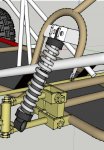
Any objections for mounting the shock like this? I did not like the original plans, as it showed the shock mounts at 90 degrees to each other, this way the shock is free to move on the same axis.
Let me know. TY
 

Attachments

  • Shock Mount.JPG
    Shock Mount.JPG
    66.9 KB · Views: 12

exenos

Project Nut
Messages
1,217
Reaction score
0
Location
Ontario, Canada
The shock mounting bolt is supported on both sides of it. AFAIK the viper plans call for it to be supported only from one side. Its really not all that important because I cant see this kart going airborne too often, just a good design practice.
 

gjpgonzo

New member
Messages
109
Reaction score
0
Location
Boston Area
The shock mounting bolt is supported on both sides of it. AFAIK the viper plans call for it to be supported only from one side. Its really not all that important because I cant see this kart going airborne too often, just a good design practice.

Yes, I was kind of uncomfortable with that too, if you have any ideas of how I could mount it differently I will do it, otherwise I’ll just mount it as I have shown.:thumbsup:
 

exenos

Project Nut
Messages
1,217
Reaction score
0
Location
Ontario, Canada
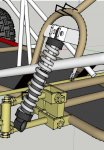
How about moving the upper shock mount to the loop and mount the shock on top of the upper arm?
 

Attachments

  • Shock Mount.JPG
    Shock Mount.JPG
    104.1 KB · Views: 5

exenos

Project Nut
Messages
1,217
Reaction score
0
Location
Ontario, Canada
Exactly like that. You may need to change the height of the upper shock mount if you have already bought your shocks. It might seem counter intuitive placing the shock on the top arm but it really doesn't make a difference until you get into the extreme high performance world.
 

gjpgonzo

New member
Messages
109
Reaction score
0
Location
Boston Area
Exactly like that. You may need to change the height of the upper shock mount if you have already bought your shocks. It might seem counter intuitive placing the shock on the top arm but it really doesn't make a difference until you get into the extreme high performance world.

I'll mock it up tonight and see I get the warm and fuzy's about it. there is one other advantage of doing that....I could put the control arms in front without the shocks in the way. Thoughts?
 

andrewmacc

Canadian Wonderboy
Messages
66
Reaction score
1
Location
Surrey BC Canada
Any objections for mounting the shock like this? I did not like the original plans, as it showed the shock mounts at 90 degrees to each other, this way the shock is free to move on the same axis.
Let me know. TY

Just for the record, shock mount orientation SHOULD be 90 degrees from each other. Typically, but not always, the axle-side mount is parallel to the axle, and the frame-side is perpendicular (or differently termed, parallel to the body from front to back). This orientation prevents binding in either axis. Mounting them in a similar orientation will increase binding on the other axis.

This is not necessarily a hard and fast rule, as there are many off-road trucks (the world that I come from) with large amounts of articulation that mount their shocks/coilovers in an identical orientation, but they typically have misalignment spacers that allow them to achieve a wider mounting width and more joint articulation in the spherical rod ends that prevent them from binding.

Double shear is good practice for making brackets with large equipment - think about it this way, would you ever consider mounting control arms with only one tab holding them on? :cheers2:
 

exenos

Project Nut
Messages
1,217
Reaction score
0
Location
Ontario, Canada
Any chance you could dig up a few pics/builds that use shocks or coil overs with the mounts perpendicular to each other? I've never saw any mounted that way except for in the plans for this kart. Your explanation somewhat makes sense but it just seems that it would cause more binding than it would prevent in anything over short-mid travel situations.
 

gjpgonzo

New member
Messages
109
Reaction score
0
Location
Boston Area
Bearings

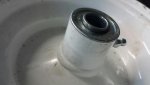
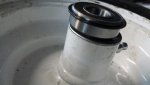
OK I got the new bearings, now the question is…id they send me the right ones?
If they are how doI install them, they don’t have a flange like the existing ones, does the ring come off or do I use that as the flange?

Also on the original bearing the center is raised helping it not to bind when tightened, but the new one is not like that, how can I tighten it down without it binding?
 

Attachments

  • Bearing1.jpg
    Bearing1.jpg
    36.5 KB · Views: 5
  • Bearing2.jpg
    Bearing2.jpg
    42.7 KB · Views: 8

mckutzy

Well-known member
Messages
8,353
Reaction score
108
Location
bc, canada
IF the hub doesnt have a seat for the bearing to sit, then keep the snapring. that will hold the bearing.
As far as the nut on the end. Just tighten it to it is just about to touch the race, oh there should be a washer in there too. make sure it isnt as big as the out side of the bearing.

Take out the grease nipple aswell, dont need to regrease these ones.
 

KartFab

Active member
Messages
3,381
Reaction score
57
Location
Dallas, TX
Cut a piece of 5/8" ID pipe. Cut it just slightly longer than needed then insert between bearings. You can wrench it down hard and not get binding this way. You shouldn't wrench it down though. The pipe over the spindle just adds a little more support so a bearing won't pop out when driving (that has happened to me before).
 
Status
Not open for further replies.
Top