Torque, HP, RPM, Weight, Top Speed Calc

Status
Not open for further replies.

bob58o

SuckSqueezeBangBlow
Messages
9,646
Reaction score
1,830
Location
Chicago-town USA
Since top speed calculators ignore HP and weight, how do thy factor in?

Im guessing use a torque / HP vs RPM graph to show at what rpm rotational force (and hence acceleration) fall off along with equations for motion:

Torque = moment of inertia * angular acceleration
or linear
Force = Mass * linear acceleration

Eventually at high enough rpm, torque falls low enough where it cant accelerate the mass any faster?

My question is:
Will weight and HP ultimately limit RMP to a safe level of operation, or is it just as bad for an engine to be run at wide open throttle for extended time even if the load is keeping the RPM low.

Sorry as Im brand new to this stuff, but want to understand
 

Poboy kartman

Senior Moments Member
Messages
12,461
Reaction score
62
Location
White Settlement Texas
Since top speed calculators ignore HP and weight, how do thy factor in?

Im guessing use a torque / HP vs RPM graph to show at what rpm rotational force (and hence acceleration) fall off along with equations for motion:

Torque = moment of inertia * angular acceleration
or linear
Force = Mass * linear acceleration

Eventually at high enough rpm, torque falls low enough where it cant accelerate the mass any faster?

My question is:
Will weight and HP ultimately limit RMP to a safe level of operation, or is it just as bad for an engine to be run at wide open throttle for extended time even if the load is keeping the RPM low.

Sorry as Im brand new to this stuff, but want to understand

Well....yes, to a degree. Eventually, every engine will reach a point to where the factors of weight and resistance are met and the vehicle can no longer accelerate.

But it's not because of lack of torque. If this were the case, all engines would stop accelerating once they reached 5,252 rpm. We all know this is not the case. But...at 5,252 rpm torque begins to fall off while hp continues to climb.

As far as running wide open...an engine is always more vulnerable at top rpm...(why you must upgrade parts to run higher rpms.)

Given load as a limiting factor to rpms...yes, the engine will survive longer, but sooner or later, the engine is going to overcome that limitation...(if it has to go downhill to do it)....so, at the end of the day, the engine itself can only limit rpms.

The speed calculator is only a rough guide to be used more as a reference to how gearing affects speed and an approximate guide...(there's no substitute for common sense...and it would be much more difficult to include every factor that could influence outcome.)

As far as engine longevity, again, there are no absolutes, only percentages....and luck of the draw...while failure can be predicted fairly reliably, non-failure cannot.
 

bob58o

SuckSqueezeBangBlow
Messages
9,646
Reaction score
1,830
Location
Chicago-town USA
Well....yes, to a degree. Eventually, every engine will reach a point to where the factors of weight and resistance are met and the vehicle can no longer accelerate.

But it's not because of lack of torque. If this were the case, all engines would stop accelerating once they reached 5,252 rpm. We all know this is not the case. But...at 5,252 rpm torque begins to fall off while hp continues to climb.

As far as running wide open...an engine is always more vulnerable at top rpm...(why you must upgrade parts to run higher rpms.)

Given load as a limiting factor to rpms...yes, the engine will survive longer, but sooner or later, the engine is going to overcome that limitation...(if it has to go downhill to do it)....so, at the end of the day, the engine itself can only limit rpms.

The speed calculator is only a rough guide to be used more as a reference to how gearing affects speed and an approximate guide...(there's no substitute for common sense...and it would be much more difficult to include every factor that could influence outcome.)

As far as engine longevity, again, there are no absolutes, only percentages....and luck of the draw...while failure can be predicted fairly reliably, non-failure cannot.

Thank you

YD3203-ish Predator 212 Stage 1 Kit
18.5" Tires, 30 Series torque converter, 60T axle sprocket (10,9, and 8T options for TC)
(Same stock gearing, slightly smaller than stock tires).

I've heard valve float will occur at 5200 rpm so I picked there as reference
5200 rpm at the crank with that set up and a 10T on the TC should be 48mph. If I don't get to 48mph (probably wont), should I assume I am not reaching 5200 rpm and weight is limiting me (is this wasted power potential?).
So Then try 9T on the TC, 5200 rpm should be 43 mph. (Plenty fast with better power) Again if I don't hit 43mph, should I assume I'm not hitting 5200 rpm (again wasted power potential??) and I should drop another tooth on the TC.
8T on the TC would give 38 mph at 5200rpm. (Still pretty fast for this thing, still more power). If I don't get to 38mph, I can put the smaller tires on which should put me at 33mph at 5200 rpm with the 8T. (Kinda slow as they are supposed to do around 30mph stock/goverened with 10T and 20" wheels)

Does this make sense??
To shoot for 5200 rpm in this sort of fashion, at least until I get the cam, rod, and wheel so I can put my springs in
 
Last edited:

Toycrusher

New member
Messages
168
Reaction score
0
Location
Deep Deep South Texas
(I didn't double check your calculations)

Based on your theoretical rpm x gearing top speed calculations, yes, if you didn't reach theoretical speed, it's because of friction losses.

Weight technically affects friction, not speed. Wind resistance is a source of friction, mechanical losses in the motor, transmission, axle bearings, wheel bearings, rubber tire, etc...

Friction increases exponentially while horsepower to overcome that friction doesnt. Increasing your gearing as you suggest is the most practical way to tune your kart.

An ideal gearing setup would allow you to reach your horsepower peak (or an rpm below engine desctruction) with a normal weight load on the kart.

All of that in not-so-many-words... "You are on the right track" :thumbsup:

---------- Post added at 05:54 PM ---------- Previous post was at 05:50 PM ----------

But it's not because of lack of torque. If this were the case, all engines would stop accelerating once they reached 5,252 rpm. We all know this is not the case. But...at 5,252 rpm torque begins to fall off while hp continues to climb.

In the interest of nitpicking... :cheers2:

The torque and rpm curves cross at 5252 rpm because of math. That rpm doesn't mean anything to the torque curve of an engine. It's based on a gazillion other factors and most engines fall off before that point but many high revving motors continue to build torque well beyond 5252 rpm. On a graph however, the HP curve will always exceed the torque curve at that point.

Carry on! :popcorn:
 

bob58o

SuckSqueezeBangBlow
Messages
9,646
Reaction score
1,830
Location
Chicago-town USA
Toycrusher;396694All of that in not-so-many-words... "You are on the right track" :thumbsup:[COLOR="Silver" said:
---------- Post added at 05:54 PM ---------- Previous post was at 05:50 PM ----------

[/COLOR]

Carry on! :popcorn:

I really appreciate all yours help, I like to fully understand the things I'm trying to do. I super excited about this beast, should be finished Friday or saturday, (at least with the 10T sprocket for now). I think she will be ok with that for now, then we'll see if she can do bunouts and wheelies. lol

Thanks so much, couldn't have done any of this without DIY GO Karts. Even bought some stickers for my ride!
 

OzFab

Well-known member
Messages
15,615
Reaction score
66
Location
Warwick Qld, Australia
I've heard valve float will occur at 5200 rpm so I picked there as reference
5200 rpm at the crank with that set up and a 10T on the TC should be 48mph. If I don't get to 48mph (probably wont), should I assume I am not reaching 5200 rpm and weight is limiting me (is this wasted power potential?).

That's one possibility; another is the TC is not fully engaging...for the same reasons...
 

OzFab

Well-known member
Messages
15,615
Reaction score
66
Location
Warwick Qld, Australia


...Which would be the torque curve in the article you linked...
 

bob58o

SuckSqueezeBangBlow
Messages
9,646
Reaction score
1,830
Location
Chicago-town USA
That's one possibility; another is the TC is not fully engaging...for the same reasons...

Same solution right? drop a tooth on the TC?

So its possible that a higher gear ratio may allow for a greater top speed than with the lower ratio? if TC is disengaging at high rpm?
For instance, If I am set up for top speed of 48mph, TC may only allow for 40mph (then slip, or disengage), but if I drop a tooth and am set up for 43mph, I may be able to go faster than the 40mph from before? Or am I misunderstanding and issue will occur at same speed regales of gear ratio?

So if I build this engine out further... For more HP, Torque, and RPM, am I correct in my understanding that the largest gear ratio possible will allow highest crankshaft rpms to be transferred through the TC to the tires?

If I put the 18.5" wheels on with the 8T, theoretically it should go
27 mph @ 3600 rpm
31 mph @ 4200 rpm
38 mph @ 5200 rpm
46 mph @ 6200 rpm
52 mph @ 7200 rpm

with the 9T
30 mph @ 3600 rpm
35 mph @ 4200 rpm
43 mph @ 5200 rpm
52 mph @ 6200 rpm
60 mph @ 7200 rpm

with the 10T
33 mph @ 3600 rpm
39 mph @ 4200 rpm
48 mph @ 5200 rpm
57 mph @ 6200 rpm
66 mph @ 7200 rpm

Id like to go around 40-45mph top speed, if acceleration is still exciting. Ill have to play around to find out.

If I can max out at 43-48 mph the 9T or 10T at 5200 rpm without the TC disengaging, I'd rather do that then spend 200 bucks on rod and wheel to install my 8 dollar springs. Otherwise I may drop to the 8T and proceed with the springs
 

Toycrusher

New member
Messages
168
Reaction score
0
Location
Deep Deep South Texas
Same solution right? drop a tooth on the TC?

So its possible that a higher gear ratio may allow for a greater top speed than with the lower ratio? if TC is disengaging at high rpm?
For instance, If I am set up for top speed of 48mph, TC may only allow for 40mph (then slip, or disengage), but if I drop a tooth and am set up for 43mph, I may be able to go faster than the 40mph from before? Or am I misunderstanding and issue will occur at same speed regales of gear ratio?

So if I build this engine out further... For more HP, Torque, and RPM, am I correct in my understanding that the largest gear ratio possible will allow highest crankshaft rpms to be transferred through the TC to the tires?

If I put the 18.5" wheels on with the 8T, theoretically it should go
27 mph @ 3600 rpm
31 mph @ 4200 rpm
38 mph @ 5200 rpm
46 mph @ 6200 rpm
52 mph @ 7200 rpm

with the 9T
30 mph @ 3600 rpm
35 mph @ 4200 rpm
43 mph @ 5200 rpm
52 mph @ 6200 rpm
60 mph @ 7200 rpm

with the 10T
33 mph @ 3600 rpm
39 mph @ 4200 rpm
48 mph @ 5200 rpm
57 mph @ 6200 rpm
66 mph @ 7200 rpm

Id like to go around 40-45mph top speed, if acceleration is still exciting. Ill have to play around to find out.

If I can max out at 43-48 mph the 9T or 10T at 5200 rpm without the TC disengaging, I'd rather do that then spend 200 bucks on rod and wheel to install my 8 dollar springs. Otherwise I may drop to the 8T and proceed with the springs

This may help on understanding how the torque converter functions http://www.diygokarts.com/vb/showthread.php?p=396735#post396735
 

jrbrtsn

GoatHerder
Messages
50
Reaction score
0
Location
Greenville, SC USA
If you want to measure friction losses after the TC, just remove the TC belt and tow your kart + driver behind a car with a force guage on the tow line. Record the towing force at several different speeds. Speed * force = power required to drive the kart at a given speed (don't forget your physical units conversions). Knowing the efficiency of the TC itself, you can compute required engine HP. The only thing that remains is to set the gearing such that sufficient torque is available at all speeds leading up maximum speed.
 

Poboy kartman

Senior Moments Member
Messages
12,461
Reaction score
62
Location
White Settlement Texas
If you want to measure friction losses after the TC, just remove the TC belt and tow your kart + driver behind a car with a force guage on the tow line. Record the towing force at several different speeds. Speed * force = power required to drive the kart at a given speed (don't forget your physical units conversions). Knowing the efficiency of the TC itself, you can compute required engine HP. The only thing that remains is to set the gearing such that sufficient torque is available at all speeds leading up maximum speed.

That's a cute story......Is anyone but the government gonna do that?
 

bob58o

SuckSqueezeBangBlow
Messages
9,646
Reaction score
1,830
Location
Chicago-town USA
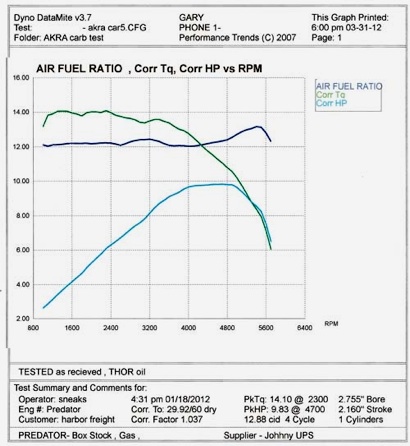
So this shows a stock engine. Does that mean max hP stock is roughly at 4600 rpms. This is the engine I'll be putting on my bug stinger build. On speed calculator what rpm would I use.

This is after air cleaner, exhaust, and jets I believe.. but before methanol

"The manufacturer stated 6.5 horsepower at 3600rpms. With the improvements we did our test results were closer to 9 horsepower at 3600rpm with maximum torque pulling 14.10 ft. lbs. at 2300rpms. The maximum horsepower of 9.83 was achieved at 4700rpms. Power started dropping off at 4900rpms and we hit a wall at 5600. I believe some valve float was limiting our revs after that."
 

jrbrtsn

GoatHerder
Messages
50
Reaction score
0
Location
Greenville, SC USA
Chill?

I guess I don't understand why anyone would think that towing a kart behind a car was a big deal. Tie a rope between them, with a scale such as this http://www.zoro.com/taylor-mechanical-hanging-scale-32kg70-lb-3070/i/G3012606/ in-line, and you are ready to go. Measure the force on a level road at 10, 15, 20, 25, 30, 35... mph. Now you know, quantitatively, how much power it takes to drive that particular kart at those speeds.

What does using a calculator have to do with towing a kart.....SHEESH! Chill.
 

Poboy kartman

Senior Moments Member
Messages
12,461
Reaction score
62
Location
White Settlement Texas
I guess I don't understand why anyone would think that towing a kart behind a car was a big deal. Tie a rope between them, with a scale such as this http://www.zoro.com/taylor-mechanical-hanging-scale-32kg70-lb-3070/i/G3012606/ in-line, and you are ready to go. Measure the force on a level road at 10, 15, 20, 25, 30, 35... mph. Now you know, quantitatively, how much power it takes to drive that particular kart at those speeds.

Maybe.....but can I get a show of hands of anyone who would actually do this????

Bueller.......Bueller......Bueller? ?????

EDIT: I'll go you one better: Post up a video of this.
 

bob58o

SuckSqueezeBangBlow
Messages
9,646
Reaction score
1,830
Location
Chicago-town USA
You could always buy a bunch of sprockets, and try them all to see which one works best. I find it much less expensive to use a calculator. :thumbsup:

HUB NEEDS TO ARRIVE!!!!
Thanks once again to the greatest teachers on the planet here at DIY School of GoKarts!

Here we go, I've learned a lot.

THIS IS JUST A ROUGH GUESTIMATE
of what performance I'm hoping for with the following setup..
(which I've decided is what i'm going to do :wai:)
based off of what I learned here in the past month

300+ LB BUGGY
18.5" Tires
7.5 : 1 Gear Ratio
TAV- 2 Torque ConverterPREDATOR 212

I'm Assuming 10% loss in this example cause I made it up. lol.
People were claiming to go 30-32mph with a TC, 6:1 ratio, 20" tires and governed to 3600 rpm(guessing on 3600).

That's around 12-15% at 3600 rpm when the TC is in Over-Drive.
Since I have a larger gear ratio and smaller tires in this example....
I picked 10% across the whole RPM range - Its incorrect, but its easy and I'm not parking this kart on the moon. (later project)

Again just a baseline guess for comparison once its running....

I hit the gass AND...

2300 RPM - TC engages and adds 2.7 : 1 advantage for combined ratio of 20.25 : 1 (Wheelies and burnouts?? lol I hope so)
The smaller (16") knobby tires will give even more low end power which would be better for off-roading and leaves front clearance the same as front tires are same size for the knobby and the street's.
6 HP, 14 FT LB Torque

The TC gives mechanical advantage as I accelerate into the low 20's.

3200 RPM - TC goes wide open into Over-Drive.
8 HP, 13.5 FT LB
[Instructions Claim 0.90 : 1 advantage. This would essentially change my ratio from 7.5:1 to 6.75:1. Same as if I had another gear on the axle and shifted to a 54T sprocket. I chose to ignore this in calculations ... or included it when I made up the 10% loss factor(however you want to look at at).]

As I continue to accelerate....

Torque begins to fall slightly but HP continues to rise steadily as I increase RPMs to around 4000 and accelerate the kart to around 25 MPH.

As I accelerate from 25 MPH into the low 30's, HP stays steady, near MAX almost 10HP. Torque falls more rapidly now. As RPMs increase from 4000 to 4800, Torque drops from around 13 FT LB to around 11FT LB.

As I try to accelerate from 30 - 35 MPF or into the 40's. I will have to increase RPM from 4800 to 5600 RPM or beyond. In this range both HP and Torque are falling. HP from 10 HP to 7.5 and Torque from 11 FT LB to 7.

I will reach max speed limited by one or a combinations of the following.
Engine Load is Limiting the RPMs (Internal resistances, kart weight, drag,.... are too great for the falling power to accelerate any further)

SOLUTION??? - More Power - 18+ LB valve springs, more modding...

Drive Train (Torque Converter belt) not 100% efficient in transferring crank rpms through the TC, Chain, Axle, and Tires to the street. Belt may slip at high RPM?

SOLUTION - ????transmition gearbox thing ???? did I just type that??

Valve Float occurs. If this happens before the TC fails, the Kart design, drive train, and gearing would appear to allow for more top Speed if RPMs were allowed to increase.

SOLUTION - 18+ LB Valve Springs

Thanks for all your help!!!!

If I'm off on my understanding of what you all have tried to teach, please let me know
 

Attachments

  • BUGGY POWER.jpg
    BUGGY POWER.jpg
    144.6 KB · Views: 6
Last edited:
Status
Not open for further replies.
Top