It's a potentially big issue because of the slop in the chains.
All chains have slop unless the tension is such that you're approaching the fatigue limits of the material. This wouldn't be very smart because at the very limit of the material, applying 5HP would result in the chain breaking. So, it's inevitable that you have "slop".
The more slop you have, the more you are allowing one engine to drag the other because for the reasons you stated Too Fast, no two "identical" engines will produce exactly the same power at the same throttle position or even run at the same RPM.
Maybe it's a big deal, maybe not. I'll make a wild guess that with chains between two 5HP engines you'll have say 9HP instead of 10HP. Might be reasonable to do this anyway, but do note that while one measely horsepower seems like nothing, it is 1/10th of the overall horsepower.
On most automotive engines regardless of style and size, share a common crankshaft which is rigid beyond the normal power levels the engine can produce. This rigidity is important. This is also why performance engine builders replace stock cranks with more expensive, fancy things like what Scat makes.
Also, more cylinders reduce this effect because while one cylinder might be dogging the engine, the other cylinders will be working hard. One dog out of eight is 1/8th whereas one out of two is half - bleah!
So we are comparing apples to oranges here but this is a fun exercise anyway so lets keep going. I'm really enjoying these types of discussions.
And yes, with EVERY multi-cylinder engine some cylinders do more work than others, for the reasons you suggest.
However, it matters less because the crankshaft is rigid.
Chains are not rigid, and always have slop.
There are instances where crankshafts have "slop" however, and I'll give you a real one. Don't forget that most metals, particularly steels, are rigid until they reach a certain point at which time they develop some elasticity, then break.
Spring steel for example has a wide range at which time it's elastic, and why springs are nifty devices for vehicles. You can find the yield point easily by overloading the vehicle and hitting a pothole. SNAP!
Materials like titanium are far stronger, and don't show their elasticity until just about the point where it fractures. It's range of elasticity is very small and way up there on the strength scale, far above steels. But when it breaks, it's usually a fragmented, stringy mess - many fragments and splinters.
That's the tradeoff. The stronger the material, the more brittle it is at it's breaking point. That's why it's often considered "better" to use softer, weaker materials and harden the surface, heat treat the entire thing, or nitride the wear surfaces because you have some elasticity where it can be abused and it won't break, but also it's stronger than the material would be untreated.
Anyway, back to crankshafts and "slop". Here is some real information that may astonish you but also illustrate the idea of "slop" in crankshafts, because there are applications where the power output of an engine approaches the metalurgic limits of the crankshaft.
Top fuel funny cars, like John Force drives, produce about 7000 ft-lbs of torque at the flywheel, with a mere 496 cubic inches. That's 14 HP per cubic inch (or so).
At that power level, even with all the exotic metallurgy and engineering involved making such an engine, the crankshaft actually twists itself during acceleration.
So much so that the cranks are deliberately and precisely machined in such a way that laying on the desk it would appear to have about a 2 degree "twist" to it down the length.
This is because at 8000 RPM, transmitting the power level that it does to the flywheel, the crankshaft twists about 2 degrees from it's "rest" shape, down the length. So, the smart teams machine the crankshaft with approximately 2 degrees of reverse twist so at full throttle, the crankshaft is straight and true.
Of course the next question is what happens when the car hits maximum speed and maintains that speed for the last moments of the race? Wouldn't the crankshaft lose it's twist?
Yes, it would, but in funny car racing that never happens because the cars are still accelerating as they cross the finish line so the twist of the crankshaft induced by the power levels remains approximately constant.
In funny cars the same thing applies to the single camshaft and the gears directly driving it from the crank. The gears actually change shape at those power levels, and this too needs to be taken into consideration both in durability and from a meshing standpoint. The mesh is much tighter at rest than it is during the race, and often times the gears aren't so round at the end of the race because they're not thick and massive enough to endure these forces for any length of time. That's why after a 4-second race they're usually thrown away and replaced.
So there are situations where crankshafts can have "slop", and that's why I went through the whole funny car thing - to show you how much the scale of the numbers matter. Certainly you won't "twist" a lawnmower crankshaft in this fashion, instead if you exceed it's metalurgic strength it will just break.
But, when you introduce chains and a jackshaft, you are introducing slop that can impact how things run. By allowing one engine to "easily" run at a different power level than another through the slop of two chains and a jackshaft, you're encouraging the scenario where one engine "drags" the other engine along. For all the reasons you mentioned - tolerances, wear, compression variances, etc, this matters more because of the slop of the mechanical link between the two engines.
Now, you may be questioning my information here and that's fine, because the scale of the numbers works both ways. If we consider two 5HP mower engines chained together, well, you didn't take chain slop into consideration you would probably expect 10HP. The reality is the slop will give you something like 8 or 9 HP rather than 10. It's not enough to bicker about, but if you're having tuning issues with the engine, it is a pain in the butt do deal with because the slop is there.
It would be far better to mount the engine's crankshafts to each other in a more rigid fashion. While I'm not designing something here maybe the best technical answer is to remove the shroud and pull start off one engine and create an adapter that slips on one engine and attaches to the flywheel of the second engine, so they are in series. A large aluminum round thing might do the trick. Then you'll not lose that 1 or 2 idealistic HP.
Your approach would depend how much of an idealistic, purist "gearhead" you want to be. I bet you can figure me out by now ;-) And, you do not have to be like me. Just don't had the HP ratings of the two engines and expect that exact output if you chain them together with a jackshaft.
I hope that was somewhat coherent because it's far past my bedtime.


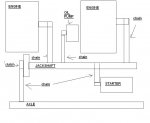 t22.JPG32.9 KB · Views: 31