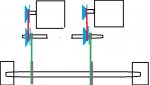
that is determined by the differential force of the drive belt, not the rate of rotation..
so even if they spin at the same rate, that tells you nothing about their diameter.
(remove one belt, and that pulley will always be at is biggest diameter)
and because of that both belts will be in good tension to transmit power, and the slower turning engine will shred the belt (well.. the 'too fast' turning driven pulley will)
'sid
I think this is what I was misunderstanding from before.

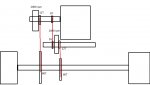
So even with a set up with both DRIVENs on a proper jackshaft, then the driven Pulleys could still have different diameters if engines were at different speeds.
For it to work... Engines and throttles would have to be synced as close to exact as possible (in order to keep the TAV ratios almost identical).
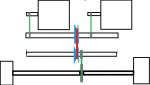
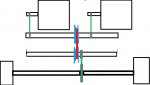
I thought that may be an issue, so I also Considered two engines turning a proper jackshaft (Jackshaft 1) via chain linkage (1:1 ratio or so)
Also On Jackshaft 1 would be a single Drive Pulley from a 40Series.
Another Jackshaft, Jackshaft 2 would hold the Driven Pulley from a 40series.
A Heavy duty chain would connect the Axle to Jackshaft 2.
Chains from each engine to Jack shaft 1 will keep enfgine RPMS in sync????
Would I also need two C Clutches as well?? Not sure how trying to start one engine would work, as pulling one recoil starter, would spin the crank, the jackshaft, and the other engine's crank as well.
One Pull, two starts??? or a need for two, at least one, C Clutches???
This set up would be more complicated and expensive to build, but may work better if the 40 series could handle the power from the two 212s
May be getting into the non-economically practical range if I need two clutches as well as the TC, but heck, now I want to try something fairly original and make momma proud

Thanks
Bob