
You are using an out of date browser. It may not display this or other websites correctly.
You should upgrade or use an alternative browser.
You should upgrade or use an alternative browser.
Tarantula in Albuquerque
- Thread starter SDCoston
- Start date
- Status
- Not open for further replies.

OzFab
Well-known member
32 mph?
OzFab
Well-known member
SDCoston
New member
32 mph?
correct me if I'm wrong, but doesn't the CVT go into overdrive at max speed if the motor is powerful enough and the resistance to sustaining speed is small enough?
I can't find the GTC TC2-1004 ratio range, but it looks like at least 2:1 overdrive is capable with the CVT - so at high motor rpm, the jackshaft 10 tooth cog could turn at least double the motor's RPM
so ... max speed 64 mph? that seems insane, am i wrong about how the torque converter works?
http://www.youtube.com/watch?v=zbvMO_tZSUg&sns=em
tomorrow, we'll take it out for the first test ride!
SDCoston
New member
does anyone know what the range of driver-to-driven ratios are on a GTC TC2 torque converter?
Mcbreja
New member
My understanding of TC's goes like this (and bear in mind I may be wildly off):
Normally, on a kart, you have the choice between acceleration and top speed. To pick one is to forsake the other. This is on a kart with a centrifugal clutch and jackshaft. The torque converter works to bridge the gap between acceleration and speed.
With the TC, you now have the option to gear higher (within reason) to allow for a greater top speed and still have to ability to get there without burning up a clutch in the process (gearing and tire size come into play here, but I'm trying to keep this simple and someone else will be likely to explain better than I could).
I was looking at the GTC site and I think their use of the word overdrive was a p**s poor decision. It gives the wrong impression as the engine/gearing is only going to allow so much and the TC is not going magically double the speed.
I'm not of the answer to your second question.
I hope this helps (or that I didn't make too big an idiot out of myself).
Normally, on a kart, you have the choice between acceleration and top speed. To pick one is to forsake the other. This is on a kart with a centrifugal clutch and jackshaft. The torque converter works to bridge the gap between acceleration and speed.
With the TC, you now have the option to gear higher (within reason) to allow for a greater top speed and still have to ability to get there without burning up a clutch in the process (gearing and tire size come into play here, but I'm trying to keep this simple and someone else will be likely to explain better than I could).
I was looking at the GTC site and I think their use of the word overdrive was a p**s poor decision. It gives the wrong impression as the engine/gearing is only going to allow so much and the TC is not going magically double the speed.
I'm not of the answer to your second question.
I hope this helps (or that I didn't make too big an idiot out of myself).
Last edited:
OzFab
Well-known member
am i wrong about how the torque converter works?
Not entirely but, I don't think it's as much as 2:1.
Where's toystory when you need him...

Edit: Yeah, I know, he's fishin'

r97
Measure twice cut once
The GTC TC2 is a clone of the comet TAV-2 (uses 30 series driver and driven) with a 8-13hp sticker slapped on it (Comet rated the 30 series to 8hp). Since the GTC TC2 is a clone it also has the same ratio range as the comet 30... 2.68:1 as a low range reduction, and .9:1 as the high range (over drive). This overdrive only occurs if you are geared correctly (as you were saying), and your belt is not severely worn.
A ratio of 2:1 would not actually be an over drive, it would be an under drive or reduction. This would mean that for even 2 engine revolutions your jack-shaft would turn once. 1:2 would be an example of an over drive, and could also be written as .5:1, that means for every half of an engine revolution the jack-shaft-would turn once. Since your CVT has a .9:1 overdrive you would (if the engine can handle the overdrive ratio) have your engine spinning .9 of a evolution for even revolution of the jack-shaft.
So, your theoretical (ungoverned) top speed would be...
((3600/(.9*(60/10)))*(18*3.14))*60)/(12*5280)= 35.6818181818 MPH
Keep in mind that is theoretical, gearing too high, having a clutch that can't handle the power, and friction can easily reduce that number. Also, make sure to actually measure your tire OD, the number listed on the sidewall is often a lie.
Toystory once had a problem with gearing too high, the engine could not handle pulling the steep gear ratio he had. Either the CVT never reached its high range, and/or the engine couldn't reach its maximum speed. When he geared lower the engine had a greater mechanical advantage and was able to reach maximum RPM, and pull the CVT into the high range. Because he was geared too high, when he geared lower he actually increased top speed and acceleration! Let me know if anything could be clarified a bit further.
A ratio of 2:1 would not actually be an over drive, it would be an under drive or reduction. This would mean that for even 2 engine revolutions your jack-shaft would turn once. 1:2 would be an example of an over drive, and could also be written as .5:1, that means for every half of an engine revolution the jack-shaft-would turn once. Since your CVT has a .9:1 overdrive you would (if the engine can handle the overdrive ratio) have your engine spinning .9 of a evolution for even revolution of the jack-shaft.
So, your theoretical (ungoverned) top speed would be...
((3600/(.9*(60/10)))*(18*3.14))*60)/(12*5280)= 35.6818181818 MPH
Keep in mind that is theoretical, gearing too high, having a clutch that can't handle the power, and friction can easily reduce that number. Also, make sure to actually measure your tire OD, the number listed on the sidewall is often a lie.
Toystory once had a problem with gearing too high, the engine could not handle pulling the steep gear ratio he had. Either the CVT never reached its high range, and/or the engine couldn't reach its maximum speed. When he geared lower the engine had a greater mechanical advantage and was able to reach maximum RPM, and pull the CVT into the high range. Because he was geared too high, when he geared lower he actually increased top speed and acceleration! Let me know if anything could be clarified a bit further.
SDCoston
New member
Thanks r97. Everything you said makes complete sense to me. The .9:1 "overdrive" ratio seems a little off by my observation of the belt with the engine running full out looked more like .6:1 or something like that ... but that was also with my kart on jackstands and no load on the engine.
I think GTC changed the spring load of the driven side to call the 1004 version of their TC2 compatible with 8-13 HP motors. Whether that actually works ... I guess we'll see.
Good to have the theoretical CVT ratios ... should those be incorporated into the max speed calculator link in the post below?
In any event, I am installing a bike computer with sensing magnets on my CVT driver and on my live axle -- if all goes OK, then I'll be able to report back speed and tach data. Not sure IF i really want to try and get the kart to it's top speed with me in the saddle though. 1st test ride tonight!
One other thing. I'm installing a cutoff switch to the steering column. Is there any magic to that? or do I just splice the switch into the wires coming out of the on/off switch on the Honda?
I think GTC changed the spring load of the driven side to call the 1004 version of their TC2 compatible with 8-13 HP motors. Whether that actually works ... I guess we'll see.
Good to have the theoretical CVT ratios ... should those be incorporated into the max speed calculator link in the post below?
In any event, I am installing a bike computer with sensing magnets on my CVT driver and on my live axle -- if all goes OK, then I'll be able to report back speed and tach data. Not sure IF i really want to try and get the kart to it's top speed with me in the saddle though. 1st test ride tonight!
One other thing. I'm installing a cutoff switch to the steering column. Is there any magic to that? or do I just splice the switch into the wires coming out of the on/off switch on the Honda?
r97
Measure twice cut once
The spring tension in the driven usually just controls when the CVT will downshift. I don't know how it could affect the amount of torque it can handle, although it might some how. You could see if the same spring on the less than 8hp model has the same part number as the 8-13hp spring. I would believe the main factor that affects the torque you can transfer is the size of surface area where the belt contacts the pulleys.
When calculating your theoretical speed you should incorporate those ratios. Unfortunately the calculator does not have an entry box for you to put in those ratios, so you have to figure them manually. I will use your setup as an example, 60t axle sprocket divided by 10t jack-shaft sprocket gives you a 6:1 ratio. Then you multiply by the ratio of the CVT, 6:1 * .9:1 = 5.4:1. Then you can enter 1 for the clutch tooth count and 5.4 for the axle sprocket tooth count on the speed calculator.
A kill switch is pretty simple. If you plan on having a kill on the engine and on the steering column, remember that both must by in the off position for the engine to start. Make sure make sure your ground, and all other connections are strong and well insulated so they will not vibrate loose or short out. Also make sure that the kill is within easy reach, and that it is NOT a momentary switch (when you turn it on or off it should stay in that position, not spring back).
When calculating your theoretical speed you should incorporate those ratios. Unfortunately the calculator does not have an entry box for you to put in those ratios, so you have to figure them manually. I will use your setup as an example, 60t axle sprocket divided by 10t jack-shaft sprocket gives you a 6:1 ratio. Then you multiply by the ratio of the CVT, 6:1 * .9:1 = 5.4:1. Then you can enter 1 for the clutch tooth count and 5.4 for the axle sprocket tooth count on the speed calculator.
A kill switch is pretty simple. If you plan on having a kill on the engine and on the steering column, remember that both must by in the off position for the engine to start. Make sure make sure your ground, and all other connections are strong and well insulated so they will not vibrate loose or short out. Also make sure that the kill is within easy reach, and that it is NOT a momentary switch (when you turn it on or off it should stay in that position, not spring back).
SDCoston
New member
r97 - your profile says you are an "8th grader" -- is that true?
r97
Measure twice cut once
It was a few months ago, come next Wednesday I will be a freshman in high school.
SDCoston
New member
It was a few months ago, come next Wednesday I will be a freshman in high school.
So you are two years older than my oldest son. I wonder if, in two years' time he'll have as good a grasp on this stuff as you do if we keep building karts.
He wants to build an Arachnid next .... but I'm not so sure.
r97
Measure twice cut once
I first got interested in engines during the summer before 6th grade, then I learned to weld and built my first go kart the next summer, I made a mini bike about 6 months later, and I have been planning a dune buggy since then. I would say if that if I could do it I'm sure your son could, especially with a dad like you, my dad never really takes part in building or fixing things but he does like the finished products. I would say that the two main things that got me to where I am (aside from the forum!) are being mechanically inclined and eager to learn about these kinds of projects.
SDCoston
New member
Was able to get some test rides in today. wow. it is fast. Got some video of my kiddos riding it...
http://m.youtube.com/watch?v=WSpkARYJFN4
http://m.youtube.com/watch?v=C7Zw4UCvhls
http://m.youtube.com/watch?v=WSpkARYJFN4
http://m.youtube.com/watch?v=C7Zw4UCvhls
OzFab
Well-known member
Great job Sean 
 I messed that one up, I must not have been thinking straight
A ratio of 2:1 would not actually be an over drive, it would be an under drive or reduction. This would mean that for even 2 engine revolutions your jack-shaft would turn once. 1:2 would be an example of an over drive, and could also be written as .5:1, that means for every half of an engine revolution the jack-shaft-would turn once. Since your CVT has a .9:1 overdrive you would (if the engine can handle the overdrive ratio) have your engine spinning .9 of a evolution for even revolution of the jack-shaft.
I messed that one up, I must not have been thinking straight
Nodroz
New member
How come I haven't noticed this thread since now? I can't imagine it.
Very nice and clean build! Good job man! It looks very good.
Very nice and clean build! Good job man! It looks very good.
SDCoston
New member
That's great! It's alive!
If you get a chance can you post some pics on your pedal setup? I'm getting ready to start working on that soon.
JCB003-
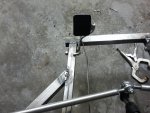
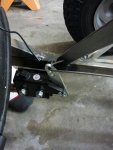
Here's how I did it. I used steel rod and I bent it to fit into the pedal arm holes. Then I welded the master cylinder mount back closer to the seat on the inner part of the frame. Fabroman says i shouldn't have it hanging below the bottom of the frame so, if you can, you should weld yours with that consideration. These first two photos show my brake pedal-to-master set up.
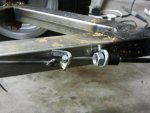
For my throttle set up i used the same steel rod on the pedal. On the end of the rod away from the pedal I constructed a bastardized clevis from some steel plate I had lying around and welded it to the rod. This is in the third picture below.
http://www.bmikarts.com/item/Throttle-Kit-400725-790
I used this kit from BMIkarts for my throttle cable. It was dirt cheap. I suspended the front end of the cable through an eyebolt that I installed into the inner side of the frame near the seat on the right (also 3rd photo). I used a nut larger than the one included in the cable kit to screw on to that black plastic piece at the end of the cable-- holding the piece fixed in the eye bolt.
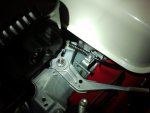
The cable easily reached my Honda 390 engine, and Honda designed their throttle arm linkage to make it easy to set up a remote throttle control with a built in cable mount(4th photo)... I assume most motors have a similar setup to easily fix the engine end of the cable for remote throttling. The cable kit had a wire-stop which I affixed to the throttle arm through a hole already present - seemingly for that purpose. The kit had a spring, which I installed between the engine's cable mount and the wire-stop attached to the throttle arm. I also had to loosen the pivot nut on the throttle arm so it would move easily.
I am betting every build is a little different, and you'll need to innovate (a little) to get something to work for you. Good luck.
Attachments
-
 7854825000_c826671f8f_k.jpg94.1 KB · Views: 27
 -
 7854828720_3124e0874e_k.jpg78.2 KB · Views: 28
 -
 7854832110_e6c3c5b680_k.jpg74 KB · Views: 30
 -
 7854835022_61c75d7194_k.jpg54.6 KB · Views: 21
- Status
- Not open for further replies.