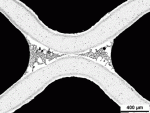
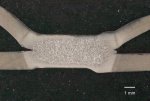
Hmm.... let's see if this works....
Let's see if I can make this work again....
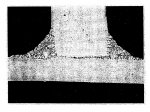
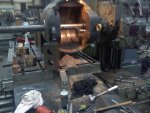
OK. If the preview is what actually goes thru, then disregard photo's #1& #3 for a moment. Photo #2 does show the example of
BRAZE WELDING (A.K.A.
brazing) that I wanted to upload; but it's from the wrong angle, and
way to much clutter. (The one I wanted is trapped in the photo editor; I managed to get it in, haven't managed to get it out.

) You're looking at the wrist pin end of the knuckle joint for a 1,200 ton cap. stamping press. In this pic, I'm reboring the thrust face area. Where this comes into the discussion is the metals; gray is the original cast iron,
yellow, is where it has been
braze welded back together.
Braze welding, while strong, doesn't come near the strength of the parent metal (in this case, high carbon grey iron). In this application, as it's on the non working load side, the repairs (to both ears) are more that sufficient to carry the load of the knuckle (approx. 4 tons), the press ram assembly ( 3~4 tons) and the weight of the top half of whatever stamping die the customer loads in it (small press; maybe 4~6 tons max.)
In this shot, I've already re-bored the wrist pin holes in line and to a common size; I'm reboring the thrust face in line with the pin holes.
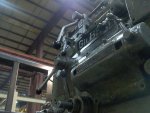
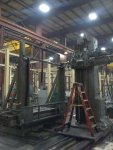
Photo's #1 are from me playing with my phone while machining the head frame for a foam saw; #1 was from my position on the
6 Foot step ladder looking up at the controls. Photo #3 is a pull back showing the machine while it faces off one of the mounting pads. The actual machine is moving left to right at just under 8 inches a minute in both shots; work piece is tide down on the stationary table. The ladder is riding along on the operator's platform, which is bolted to the base of the traveling column.
Photo's #1 and #3 are included because I'm
still trying to learn more about how to use the bumbling box of binary bit's that so many of you just can't seem to live without......