Powerland 420cc GAB 2.0

Status
Not open for further replies.

bob58o

SuckSqueezeBangBlow
Messages
9,646
Reaction score
1,830
Location
Chicago-town USA
Well maybe I found something I could fix?

http://www.gregraven.org/hotwater/calculators/valve-sizing.php

How about 38mm intake and 33mm exhaust?
This would shift powerband to higher RPMs, right?
I wonder how much?
How badly will this hurt low end?

I need to port a bit more for these valves
These would need new seats.

I planned on a valve job, but my porting may leave me needing new seats anyway.

Go big or go home! I haven't purchased anything yet. Blueprints can change quickly! lol

Who knows? I all I know is that this is going to be expensive and look somewhat like snowblower.
 

Attachments

  • valve size calc.jpg
    valve size calc.jpg
    209.8 KB · Views: 2

Joe-405

Enjoying New Projects
Messages
2,673
Reaction score
95
Location
U.S.A.
A little something something for ole bob...............

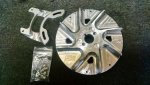
So they finally sent me my coil bracket for my new flywheel. Naturally no timing marks or instructions.

So I found on the ole interweb the bracket goes from 24*-41* total movement. I took that measurement then divided by 17 total degrees that it moves. Which is 1.33 mm. Then I marked the bracket at total then went back 6* to get my total 36* which is where I want it.

Whatcha think ? All thanks to Bob's math stuff. Lol
 

Attachments

  • IMG_20160928_182518045_HDR.jpg
    IMG_20160928_182518045_HDR.jpg
    367.7 KB · Views: 2
  • IMG_20160928_192201228.jpg
    IMG_20160928_192201228.jpg
    188.4 KB · Views: 1
  • IMG_20160928_192816379_HDR.jpg
    IMG_20160928_192816379_HDR.jpg
    237 KB · Views: 2

bob58o

SuckSqueezeBangBlow
Messages
9,646
Reaction score
1,830
Location
Chicago-town USA
A little something something for ole bob...............

So they finally sent me my coil bracket for my new flywheel. Naturally no timing marks or instructions.

So I found on the ole interweb the bracket goes from 24*-41* total movement. I took that measurement then divided by 17 total degrees that it moves. Which is 1.33 mm. Then I marked the bracket at total then went back 6* to get my total 36* which is where I want it.

Whatcha think ? All thanks to Bob's math stuff. Lol

I got to make a decent timing wheel.
 

bob58o

SuckSqueezeBangBlow
Messages
9,646
Reaction score
1,830
Location
Chicago-town USA
So the piston dish is about 8 cc (using calipers not a burette).
Flat top piston makes the 41cc chamber like a 34 cc chamber.
Next I'll study Rod length to stroke ratio.

---------- Post added at 09:46 AM ---------- Previous post was at 09:35 AM ----------

@@KartFab

The link for the 308 grind under gx390 cam shafts on Dynocams site, gives the description for that grind on a Gx200

12:1 he said was optimized CR for a smaller engine.

With more displacement (390/420) it behaves differently.
A high RPM grind on a 270cc may be good all-around cam on a 390.


He said I can do less than 12:1.
I may shoot for pump gas.
Probably 100 octane.

I read something about high CR hurting torque down low.
Got to find that.
 

bob58o

SuckSqueezeBangBlow
Messages
9,646
Reaction score
1,830
Location
Chicago-town USA
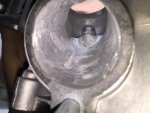
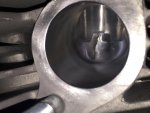
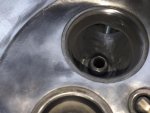
These pics help me see what I've done.

On the intake I'll hit it with a 80 sanding wheel and calls it done.

The exhaust, I might want to go back in with 80 and work some more in some spots?

---------- Post added at 03:10 PM ---------- Previous post was at 02:32 PM ----------

So for my Piston to Valve clearance....
I measured with clay, with no head gasket....

And I got 0.275".
For margin of error, let's say 0.255"
With a stock gasket, that would be more like 0.300"

Let's say we want 0.075" P2V clearance (another ~0.015" of error safety).

I've got 0.300 - 0.075 = 0.225" to play and be safe.

I will put a flat top piston with a long rod (4.45") and cut the piston (0.017") to be flush with the deck. (~8cc)

That eats up 0.083" (0.003" was in the hole + plus 0.080" from the dish)

0.225" - 0.083" = 0.142"

I could mill 0.050" to give a 33cc Chamber.

Now we are at 0.142" - 0.050" = 0.092"

So here we are left with 0.092" to fill up will extra lift over the stock cam.

0.260" + 0.092" = 0.352" Lift Cam would be biggest after milling 0.050" and putting a flat top flush with the deck.
AT LEAST MY BEST GUESS!!!! (Don't forget about my built in built in 0.040" or so.... Maybe a
0.390 - 0.400" lift could work too)


Now....

90mm / 3.54" BORE
66mm / 2.60" STROKE
Flattop Piston
Flush with Deck.
90mm/3.54" by 1.14mm/0.045" Gasket
33cc Combustion Chamber Volume

11:42 : 1 Static Compression Ratio


90mm / 3.54" BORE
66mm / 2.60" STROKE
Flattop Piston
Flush with Deck.
90mm/3.54" by 1.57mm/0.062" Gasket
33cc Combustion Chamber Volume

10.75 : 1 Static Compression Ratio


90mm / 3.54" BORE
66mm / 2.60" STROKE
Flattop Piston
Flush with Deck.
90mm/3.54" by 0.81mm/0.032" Gasket
33cc Combustion Chamber Volume

11.99 : 1 Static Compression Ratio

http://www.csgnetwork.com/compcalc.html
http://www.vegascarts.com/category-s/1822.htm
 

bob58o

SuckSqueezeBangBlow
Messages
9,646
Reaction score
1,830
Location
Chicago-town USA
http://www.badasscars.com/index.cfm...duct_id=68/category_id=13/mode=prod/prd68.htm
How do cams affect compression?


This is a good one with no single answer. There are several types of compression such as "static" and "effective" (aka "dynamic") compression. It all has to do with cylinder pressure. Static compression is the actual mechanical compression ratio number that you get by combining a given piston size with a given combustion chamber size, with a given amount of stroke and displacement of the engine. So; bore, stroke, compression height, deck height, head gasket thickness and combustion chamber size, (among others), have to do with the "static compression", but they don't dictate the actual working or "effective" aka "dynamic" compression which directly affects "cylinder pressure". The cam dictates this for the engine.

Example: two identical engines both with 9:1 "static compression". The only difference is in the cam profiles. One has no overlap with a given intake valve timing to go along with the rest of the cam's profile, and the other has a lot of overlap with a completely different intake valve timing to go with that cam's overall profile. Overlap is the time in which both valves are open as the piston pushes exhaust out and starts to suck new fuel and air into the cylinder. When the exhaust valve is closing and the intake valve begins to open, there is a time (on high performance and race cams) where both valves are actually open at the same time. As both valves are open, a little "reversion" gets pushed up the intake valve which slows the overall velocity down of the new fuel & air charge coming into the cylinder, and exhaust gas trying to still get out of the cylinder at low RPMs. This overlap period in the valve timing is what causes that "rumpity rump" sound everyone likes so much. Overlap causes a "scavenging effect" as the engine RPM increases. This is why performance cams "come alive" at higher RPMs. It's not "just" the cam making the power, it's the cam's scavenging effect working as the RPM increases which increases cylinder pressure (dynamic or effective compression). Cylinder pressure makes the power. The downside to that rumpidy rump sound in most street engines is that the overlap also causes a decrease in manifold vacuum, making power brakes a nightmare and throttle response a bit sluggish.

When you have too much overlap, you end-up with a dog for an engine at low RPM's and the car will require things to make up for it such as low rear-end gears and high stall converters to help "spool the engine up" quicker to GET IT TO those higher RPMs where it can begin to do its scavenging thing and increase cylinder pressure. When you have too much overlap in an engine without enough static compression to support it, it is what's known as being over-cammed. Lots of sound but not lots of GO, especially at low RPMs. Lots of engines out there are over cammed because guys like that rumpity rump sound, not knowing that although in many cases it may make more power at a higher RPM, it kills low-end power and torque which is what street performance engines should be concentrating on. TORQUE is what moves the vehicle below 4,000 RPM, not horsepower. Unfortunately, most guys only look at HP numbers, which is why there are a lot of turd cars out there.

Now, I get into arguments all of the time with guys who want to get technical with me, and they lose every time. They want to say that math and physics say horsepower and torque cross each other at 5,250 RPM, which is true, but that's where they CROSS, not where they are most effective! In other words, when it comes to torque, the closer your get to 5,250 RPM, the LESS EFFECTIVE torque becomes because horsepower is coming-up fast and takes over at 5,250. So the further you get below 5,250, the MORE you rely on just torque for moving that vehicle. 95% o the time for most street cars, you are driving below 4,000 RPM, and usually under 3,000, so in those RPM ranges, you are almost solely relying on JUST torque to move that vehicle, therefore, in MOST situations, everything below about 4,000 or so you are pretty much relying on torque, NOT horsepower to move that vehicle. In the real world you aren't always relying on nerd math and literal physics. There is also a real world out there that has other variables working in it.

So back to those two identical engines with different cams; if you did a compression test on either of these two 9:1 static compression engines, the engine with no overlap (or even negative overlap) would probably have about 140 -150psi or so in the cylinders. The engine with more overlap may only have 110 - 120 psi or so, depending on how much overlap the cam has, how narrow the lobe separation angle is, and most importantly... what the intake valve timing is.

Some racing engines with 13:1 or so compression only have 125psi - 150 psi or so of cylinder pressure when a compression test is done. That's less than what most bone stock engines have. It just means that the cam has a ton of overlap and has intake valve timing designed to work with the rest of the cam's profile to create that scavenging effect, which in turn actually increases cylinder pressure at higher RPMs. Not to mention, if you do a compression test on a seriously high performance engine when it's cold, all of the components are at their loosest and don't provide much of a seal because they NEED the heat in the cylinders to expand the pistons and rings to make them seal better.

Static compression always stays the same. You can't change that unless you change the pistons or the heads, the head gasket thickness, etc. This is why race engines have "power bands" and come alive at higher RPM's. It's because the cylinder pressure increases as the engine RPM comes-up. It's from the scavenging effect from the valve timing and overlap in the cam, which raises the cylinder pressure and increases horsepower with RPM. This is what you are feeling when the cam comes alive or hits its power band. if it didn't have the scavenging effect, there wouldn't be much of a power band. It would just be smooth power all through the RPM range like any stock engine has.

narrowing the lobe separation down also affects the power band. A wider lobe separation will smooth-out and "broader" the power band. On that very same cam, if you narrow the lobe separation, the power band will come-on a little higher in the RPM range, but when it comes-on, the power curve is steep and brutal. This is why hard core race cams have explosive power bands. The static compression never changed, but the effective compression surer did.

Many exotic modern cars these days have compression ratios MUCH higher than your average cars have. BMW M3's and M5's, Porsche 911's (non turbo), Ferrari's, Lamborghini's, etc., commonly have static compression ratios in the 11:1 - 12:1 area. In a regular car that is REALLY pushing it on 92 octane pump gas, but with EFI systems and knock sensors that adjust timing before detonation happens, they can get away with it. You ain't going to get away with that (reliably) with a carbureted engine, or an EFI engine without a knock sensor. As a rule of thumb (and this has a LOT of grey area), you can run upwards of 9.0 - 9.5:1 compression on pump gas with cast iron heads, and "about" one full point higher with aluminum heads because of how quick the combustion chambers cool. Can you run 11:1 static on pump gas? Sure. There are still LOTS of older muscle cars running that have compression ratios that high that run on pump gas. You just have to back the timing off a little. Timing is VERY important when dealing with compression ratios, cams and fuel octanes.

Like I said in the beginning, there is no one answer to this whole ball of wax question. There are simply WAY too many variables involved. Let's just put it this way; we COMMONLY run compression up in the 10:1 area on our street engines (with aluminum heads) on 92 octane pump gas and they run BAD ***, BUT we also commonly build them with between 9:1 - 9.5:1. It just depends on the circumstances and what our goal was with the engine.

---------- Post added at 03:52 PM ---------- Previous post was at 03:41 PM ----------

In summary.

More overlap (smaller LSA) = Peaky Power Band

Good for Racing.
Cam comes alive at Higher RPMs
Rumpity Rump sound at Idle is cause the engine is "OVER-CAMMED"
Meaning not enough static Comression for the camshaft.
At higher RPMs overlap helps due to scavenging.
Low cylinder pressure at low RPM
(Need to increase static CR to have power at low RPMs)
High cylinder Pressure at Higher RPMs
High Pressure Needs High Octane Fuel

Less over lap (More LSA) = Broader Power Band

Good for Street or Off Road Use
No need for high RPM scavenging
High cylinder pressure even at low RPMs
High Cylinder Pressure Needs High Octane Fuel
Lack of overlap means power falls off at lower RPMs
 

bob58o

SuckSqueezeBangBlow
Messages
9,646
Reaction score
1,830
Location
Chicago-town USA
Joe would you please get Tim on the Bat Phone and ask him to explain why it says

104 LSA (which is most overlap) is more bottom end
108 LSA (medium overlap) is good all around
110 LSA (least overlap) is for top end

I added the overlap parts ^

http://smallenginecams.com/
"104 LSA = MORE BOTTOM END POWER 108 LSA = BEST ALL-AROUND POWER 110 LSA = MORE TOP END POWER"


Less LSA means more overlap,
Better for High RPMs Peaky Powerband

More LSA means less overlap.
Higher cylinder pressure down low.
More bottom end.

Who is Wrong Here?

I am confused, but this time I think I am not wrong.
Everybody seems to be in agreement except STORE @ smallenginecams.com
 

Attachments

  • isky LSA.jpg
    isky LSA.jpg
    149.2 KB · Views: 1

Joe-405

Enjoying New Projects
Messages
2,673
Reaction score
95
Location
U.S.A.
Ha good luck. That's why I got the nr cam. Russell is the only one I could get a hold of !!!!

But yes the more lobe separation the more top end power. Nitrous or forced induction will change that a little bit also !
 

bob58o

SuckSqueezeBangBlow
Messages
9,646
Reaction score
1,830
Location
Chicago-town USA
Secrets of the Camshaft Scooby Doo Mystery

Secrets Of Camshaft Power
Written by Marlan Davis on December 1, 1998

Special thanks to Billy Godbold at Competition Cams and Mike Golding at Crane Cams for their assistance in the preparation of this article.

Camshaft issues always sell magazines, and readers always ask for more. Just when we thought you were sick of it, our most recent readers’ poll demanded even more info on how the camshaft works. That’s why this story will offer more on the hows and whys of camshaft specifications than any other in recent memory. This time we’ll count on you to know the basic definitions of terms such as intake opening, duration, and lift as we go into the theory of how each aspect of cam design tends to affect engine power.

Car magazines have published rain-forest-loads of issues dealing with camshafts. Why? Because the cam is one of hot rodding’s most common, most visceral, and most baffling upgrades.

Intake Opening

Looking at the intake valve first, its opening point is critical to vacuum, throttle response, emissions, and gas mileage. At low speeds and high vacuum conditions, premature intake opening during the exhaust stroke can allow exhaust gas reversion back into the intake manifold, hurting the intake pulse velocity, and contaminating the fresh intake charge. A late-opening intake gives smooth engine operation at idle and low rpm, plus it ensures adequate manifold vacuum for proper accessory operation (assuming the other three valve opening and closing points remain reasonable).

As rpm increase, air demand is greater. To supply the additional air and fuel, designers open the intake valve sooner, which allows more time for the intake charge to fill the cylinder. With an early-opening intake valve, at high rpm the exiting exhaust gas also helps draw the intake charge through the combustion chamber and out the exhaust-that’s good for purging the cylinder of residual gas, but it also increases fuel consumption by allowing part of the intake charge to escape before combustion and can make for a rough idle.

Camshaft: Intake Closing

The intake closing point has more effect on engine-operating characteristics than any of the other three opening and closing points. The earlier it occurs the greater the cranking pressure. Early intake closing is critical for low-end torque and responsiveness and provides a broad power curve. It also reduces exhaust emissions while enhancing fuel economy.

As rpm increase, intake charge momentum increases. This results in the intake charge continuing to flow into the combustion chamber against the rising piston far past BDC. The higher the engine’s operating rpm, the later the intake closing should be to ensure all the charge possible makes it into the combustion chamber. Of course, closing the valve too late will create significant reversion. It’s a fine balancing act.

In a perfect world, the optimum intake closing point would occur just as the air stops flowing into the chamber; would get the valve seated quickly and not waste time in the low lift regions where airflow is minimal and there is no compression building in the cylinder; wouldn’t be so fast that the valve bounces as it closes, allowing the charge to escape back into the intake port and disturb the next charge; and, in hydraulic street cam applications, would ensure the closing ramps are not so fast that they result in noisy operation.

Exhaust Opening

Overall, the exhaust valve opening point has the least effect on engine performance of any of the four opening and closing points. Opening the exhaust valve too early decreases torque by bleeding off cylinder pressure from combustion that pushes the piston down. Yet the exhaust has to open early enough to provide enough time to properly scavenge the cylinder. An early-opening exhaust valve may benefit scavenging on high-rpm engines because most useful cylinder pressure is used up anyway by the time the piston hits 90-degrees before BDC on the power stroke. Later exhaust valve opening helps low rpm performance by keeping pressure on the piston longer, plus it reduces emissions.

Exhaust Closing

Excessively late exhaust valve closing is similar to opening the intake too soon-it leads to increased overlap, allowing either reversion back up the intake, or the intake mixture to keep right on going out the exhaust. On the other hand, late closing events can help purge spent gasses from the combustion chamber and provide more vacuum signal to the intake at high rpm. Early exhaust closing yields a smoother operating engine. It does not necessarily hurt the top-end, particularly if it’s combined with a later intake valve opening.

As engine operating range increases, designers must move all the opening and closing points out to achieve earlier openings and later closings, or design a more aggressive profile to provide increased area under the curve without seat timing increases.

Lobe Centerline

Tailoring the valve opening and closing points on an actual camshaft is accomplished by varying the lobe centerline location, changing the LDA, and refining the profile shape itself. We’ll consider changing the centerline location first. Advancing the cam moves both the intake and exhaust centerlines an equal amount, resulting in earlier valve timing events. Engines typically respond better with a few degrees of advance, probably due to the importance of the intake closing point on performance. For racing, advanced cams benefit torque converter stall, improve off-the-line drag-race launches, and help circle track cars come off the corner.

Cam companies often grind their street cams advanced (4 degrees is typical), which allows the end-user to receive the benefits of increased cylinder pressure, yet still install the cam using the standard timing marks. One exception is Crane’s CompuCam series, which varies because of the vacuum signal requirements of the ECMs it’s designed to operate with.

Lobe Displacement Angle

Although the installer can advance and retard the lobe centerlines, the displacement angle between the centerlines is ground into the cam at the time of manufacture and cannot be changed by the end-user. Narrow LDAs tend to increase midrange torque and result in faster revving engines, while wide LDAs result in wider power bands and more peak power at the price of somewhat lazier initial response.

A street engine with a wide LDA has higher vacuum and a smoother idle. On the street, LDA should be tailored to the induction system in use. According to Comp Cams, typical carbureted, dual-plane manifold applications like 110-112 LDAs, while fuel-injected combos want slightly wider 112- to 114-degree LDAs. Fuel-injection doesn’t require the signal during overlap that carburetors need to provide correct fuel atomization, and most computer controllers require the additional idle vacuum that results from decreased overlap.

Bracket racers with higher stall-speed converters, high compression, single-plane intakes, and large carbs usually want 106-110-degree LDAs.

Engines equipped with blowers or turbos, or used primarily with nitrous oxide, typically work best with wider 110- to 116-degree separations. Race engine speeds have increased over the years causing a corresponding upward creep in LDA and duration.
 

bob58o

SuckSqueezeBangBlow
Messages
9,646
Reaction score
1,830
Location
Chicago-town USA
Duration
Duration has a marked effect on a cam’s power band and driveability. Higher durations increase the top-end at the expense of the low-end. A cam’s “advertised duration” has been a popular sales tool, but to coxxmpare two different cams using these numbers is dicey because there’s no set tappet rise for measuring advertised duration. Measuring duration at 0.050-inch tappet lift has become standard with most high-performance cams. Most engine builders feel that 0.050 duration is closely related to the rpm range where the engine makes its best power. Typical daily driven, under-10.25:1-compression ratio street machines with standard-size carbs, aftermarket intakes, headers, and recurved ignitions, like cams with 0.050-inch durations in the 215- to 230-degree range if using a hydraulic grind, or 230- to 240 degrees with a solid.

When comparing two different cams, if both profiles rate the advertised duration at the same lift, the cam with the shorter advertised duration in comparison to the 0.050 duration has more aggressive rmp. Providing it maintains stable valve motion, the aggressive profile yields better vacuum, increased responsiveness, a broader torque range, and other driveability improvements because it effectively has the opening and closing points of a smaller cam combined with the area under the lift curve of a larger cam.

Engines with significant airflow or compression restrictions like aggressive profiles. This is due to the increased signal that gets more of the charge through the restriction and/or the decreased seat timing that results in earlier intake closing and more cylinder pressure.

Big cams with more duration and overlap allow octane-limited engines to run higher compression without detonating in the low- to mid-range. Conversely, running too big a cam with too low a compression ratio leads to sluggish response below 3,000 rpm. Follow the cam grinder’s recommendations on proper cam profile-to-compression ratio match-up.

Lift
Another method of improving cam performance is to increase the amount of lobe lift. Designing a cam profile with more lift results in increased duration in the high-lift regions where cylinder heads flow the most air. Short duration cams with relatively high valve lift can provide excellent responsiveness, great torque, and good power. But high lift cams are less dependable. You need the right valvesprings to handle the increased lift, and the heads must be set up to accommodate the extra lift. There are a few examples where increased lift won’t improve performance due to decreased velocity through the port; these typically occur in the race engine world (0.650-1.00-inch valve lift). Some late model engines with restrictive throttle-body, intake, cylinder head runner, and exhaust flow simply can’t flow enough air to support higher lift.

Besides grinding a lobe with more lift, you can increase the lift of an existing cam profile by going to a higher rocker arm ratio. For example, small-block Chevys where the cylinder head runners are not maxed out may benefit from moving up from the stock 1.5:1 ratio to 1.6:1 rockers. But going up more than one tenth in rocker ratio can lead to trouble; there’s a limit to how fast you can move and accelerate the valve before the valvespring can no longer control the system. If a profile was a good design with 1.6:1 rockers, it’ll probably be unstable with 1.8:1 rockers. The correct solution is to design the profile from the ground up for use with high-ratio rocker arms.

Overlap

Duration, lift, and LDA combine to produce an “overlap triangle.” The greater the duration and lift the more overlap area, LDAs remaining equal. Given the same duration, LDA and overlap are inversely proportional: Increased LDA decreases overlap (and vice versa). More overlap decreases low-rpm vacuum and response, but in the midrange overlap improves the signal provided by the fast-moving exhaust to the incoming intake charge. This increased signal typically provides a noticeable engine acceleration improvement.

Less overlap increases efficiency by reducing the amount of raw fuel that escapes through the exhaust, while improving low-end response due to less reversion of the exhaust gases back up the intake port; the result is better idle, a stronger vacuum signal, and improved fuel economy.

Due to the differences in cylinder head, intake, and exhaust configuration, different engine combos are extremely sensitive to the camshaft’s overlap region. Not only is the duration and area of the overlap triangle important but also its overall shape. Much recent progress in cam design has been due to careful tailoring of the shape of the overlap triangle. According to Comp, the most critical engine factors for optimizing overlap include intake system efficiency, exhaust system efficiency, and how well the heads flow from the intake toward the exhaust with both valves slightly open.


Flat Tappets
Hydraulic flat-tappet camshaft and lifter systems are the most popular configuration for street applications. They provide quiet operation, low maintenance, easy installation, great response, and good power. But hydraulics can “pump up” at high rpm, leading to rapid power loss caused by valve float.

Solid flat-tappet lifters offer a stiff system that can more easily maintain control at high rpm. They require periodic valve lash adjustments, but these can be minimized with good rocker adjustment locking devices. For street use, the crossover point between hydraulic and solid lifters is somewhere between 6,000 and 7,000 rpm, depending on the engine’s specific valvetrain configuration and weight.

Mechanical cams usually need about 8-10 degrees more duration to have a comparable power band to a hydraulic lifter cam in the same engine. Also, a mechanical cam’s gross valve-lift figures don’t include lash, so the recommended lash must be subtracted to come up with the theoretical valve lift.

With flat-tappet cams, the maximum velocity allowed by the tappet before the contact point between the tappet and lobe skates off the edge and causes failure is directly proportional to the tappet diameter. A larger diameter tappet allows the use of a profile with higher maximum velocity. Profiles designed with higher maximum velocity can have more area and more lift for a given duration than similar profiles with less maximum velocity. Most GM applications use a 0.842-inch lifter foot diameter, but Fords and Chryslers use 0.875-inch and 0.904-inch, respectively. This gives these engines a theoretical advantage (albeit at the cost of a slightly heavier lifter) when restricted to a flat-tappet profile if the profile is ground to take advantage of it.

Roller Tappets
Tappet diameter becomes irrelevant with roller lifters. Solid roller lifters allow much higher velocities than flat-tappets and can tolerate the increased spring forces necessary to maintain valvetrain control with these extremely aggressive designs. The typical powerband of flat tappets is 3,000- to 3,500-rpm wide, yet roller lifters usually have a 4,000-4,500-rpm wide band. This is because rollers can hold the valve on the seat longer, then open it quicker. However, the initial departure from the valve seat is slightly slower than a flat tappet because of geometrical limitations. At some point, as rollers are designed for quicker and quicker acceleration off the seat, the designer must go to an inverted ramp profile. There is a limit to how much inversion is possible before the flanks become too difficult to grind. Overall, the increased area permitted by the roller’s higher average velocities more than compensates for its slower initial acceleration. Lifter wear was the main drawback to rollers, but new lifters are being introduced that provide greatly increased durability. Currently, the main drawback is cost.

Hydraulic roller lifters provide many of the same advantages as solid roller lifters. However, they are more rpm-limited than hydraulic flat tappets. This is due to the hydraulic roller’s higher overall weight, which makes it hard to utilize the more aggressive potential of rollers and maintain stability over 6,500 rpm without relying on very high spring forces that tend to collapse the hydraulic plunger. Further development may lead to improvements in this area, but cost still remains a problem.

http://www.hotrod.com/articles/ccrp-9812-secrets-of-camshaft-power/

---------- Post added at 04:32 PM ---------- Previous post was at 04:24 PM ----------

Ha good luck. That's why I got the nr cam. Russell is the only one I could get a hold of !!!!

But yes the more lobe separation the more top end power. Nitrous or forced induction will change that a little bit also !

I just don't get it I guess.

Same Lift
Same duration.
Different LSA.

1. )
104 LSA will have more over lap vs 110?

2.)
More overlap means lower cylinder pressure at low RPMs?

3.)
Overlap allows for scavenging which is beneficial at high RPMs?


https://www.youtube.com/watch?v=vUi1PdYn5nk
 
Status
Not open for further replies.
Top