Newly built Predator 212 quits running for absolutely no reason and won't start again. About to either scrap this POS or sell it

RB55_2018

New member
Messages
16
Reaction score
4
Hello All,
I am fairly experienced at working with small engines, both 2 stroke and 4 stroke, but for the life of me I can't understand what's going on with 212 I just built for a minibike. Below is a list of the mods I did:

Predator 212 Hemi, Stock Bore, Stock Stroke, Stock Valves, Stock Crank, Stock Flat-top Piston, Stock Rockers, Stock Head (no porting)
Governor and low oil sensor systems completely removed
Governor and low oil sensor holes plugged
ARC Billet Rod +0.020" over (torqued to spec, zero deck at TDC)
.009" Stock 212 Metal Head Gasket
PVL Flywheel with Coil Gap Set to Recommended Gap (.039")
26 lb valve springs, lash set to .003" for both exhaust and intake
Chromoly stock length pushrods
Dynocams CM camshaft
NR Racing GX390 carb billet adapter
Genuine Honda GX390 carb with adjustable main jet from EC carburetors (? pilot jet but is plenty rich at idle)
NGK BPR6ES spark plug
Using 10w-30 Royal Purple HPS oil

I originally bought this minibike used with a Predator 212 Hemi engine. I had plenty of fun with it for months and the engine never gave me any issues. Cut the low oil sensor and changed the oil a few days after I got it. A few weeks ago I bought an upgraded center-exit minibike exhaust with an RLV muffler and it ran fine in the warm weather but struggled in the cold. From experience I know it's because the cold air is denser and makes the carb run too lean. I didn't ride it for a few days since it was still cold and I got the upgraded parts before I got a chance to ride it again. I was extremely careful with the rebuild process and am almost certain I didn't mess up anything. Yesterday it started on the second pull and after messing with the adjustable main jet and idle screw it idled for 30 min with zero problems. Started back up again multiple times with no issue. I even took it for a quick ride and it was definitely making plenty of power. It was probably idling a bit too rich since black smoke was coming out the exhaust but it accelerated fine and idled stable so I figured it was fine. It was probably about 60 degrees yesterday. Today I wanted to do some top speed runs and finish tuning the main jet. It was 28 outside. I left it outside all night. It started up and idled just fine (was idling a bit fast but I corrected it) but then after about 15 seconds of hard running it COMPLETELY cuts out and dies. No warning, no sputtering, but also no nasty metal-on-metal sounds that would indicate some sort of internal failure. No white smoke or any signs of a blown head gasket either. I push it back home and try to start it again a few times, absolutely nothing. Not even a single fire. I spray some starting fluid and try again. Nothing. I pull the spark plug out and let it vent to check if maybe I flooded the engine. The spark plug was pretty black but had no oil or fluid on it. I used a blowtorch to heat it up well until the carbon buildup was gone and I install it back into the engine. Nothing, not a single fire. I pull the plug out again and check to see if maybe I blew the ignition coil. I see a very strong and consistent spark so obviously that can't be the cause. I searched online and read that too much oil may be fouling the plug. I know I probably added too much oil to the engine (definitely more than 16oz) so I drain it until the oil level is below the H mark on the dipstick. I clean the spark plug once more and try to start it again but get absolutely nothing. I open the gas tank to see if its a venting or gas feed issue (I just use an external breather filter) and there didn't seem to be any vacuum at all. I pop off the fuel line to the carb and plenty of gas flows out. I try to start it again without any success. It seems like the engine is just turning over. No way it can be a gas feed issue, especially considering that it idled for 30+ minutes yesterday without issue. I pulled apart the carb and cleaned everything except the pilot jet. It's a brand new genuine Honda carb so I'm pretty sure that it's not some gunk clogging up the jets and I also cleaned out the fuel tank and fuel line thoroughly before installing the carb. Anyway, if it was, I should have at least gotten a few fires from the starting fluid I sprayed into the intake. Assembled it and tried to start again without any success.

I have absolutely no idea what's wrong with this damn engine. Sorry for the language but I'm incredibly frustrated that after spending over $400 on parts and 30+ hours of work to build this thing properly I can't even get it to fire. I have no idea what's happening considering that I have spark but it won't even light off when spraying lighter fluid straight down the intake. The only two possibilities I can imagine right now are that the air/fuel mix at idle is way off or that the head is somehow cracked and leaking compression. Ignition seemed like the culprit but considering that I saw very good spark when I turned the engine over AND I cleaned the sparks plug to eliminate a fouled plug I really can't see it being a possibility anymore.

The first one (air/fuel off at idle) is probably more likely but, considering that:
1. It started up just fine and idled for about a minute before I got on the throttle
2. It was idling very rich yesterday without issue and the colder weather today could only make it run even leaner
3. It won't even fire when using starting fluid
I don't see how this could be the problem. I do have richer pilot jets I can try but am doubtful that it will fix the problem,

The second one (loss of compression) would be a real pain in the butt to fix. I don't understand how I could completely lose compression today after having excellent compression yesterday. I never even got the RPM high or put a lot of load on the engine. I calculated that it's about 9.3 : 1 so there's no way I'm putting excess stress on any parts. I hear people running 12:1 or higher compression on methanol or race gas as well.

ANY help would be greatly, greatly appreciated right now. I am on the verge of scrapping this engine for parts or selling it.
 

itsid

Moderator
Staff member
Messages
11,563
Reaction score
245
Location
Ruhrpott [Germany]
A broken spark plug cable could cause such..
I've seen some nice bright fireng when the spark plug was anywhere else BUT threaded in.
and as soon as it's in place It opened the gap in the broken spark plug cable enough to not fire..
(I got myself a boot with integrated testlight to finally see that issue since I couldn't belive it either back then)

So, I wouldn't rule out a simple coil /cable issue yet
sometimes the spark plug wire gets hot where cracked, you
.. but in that case you should get at elast a weak spark as well.. so you might not even notice it's broken before it's toast.
if you got s phase tester or a digital tachometer (with a pickup wire to be wrapped around the spark plug wire as you find on most 2stroke karts)
you might be able to see that "missing" firing.
if you see almost idle rpms displayed at startup.. that should not be cause of your problem.

Then it might be time to check the flywheel key.
a sheared key and a moved out of position flywheel can cause the spark to happen way too late or way too early
so the engine won't start at all.

An easy check and usaually an easy fix as well
(just add a new key, or lap the flywheel onto the shaft and torque it down real good with the help of a degree wheel)

I would not mess with the fuel mix at all tbh...
since frankly it should pop with lighter fluid no matter if your fuel mix is off or not..
if it doesn't it's either no compression or no spark...

which brings me to the last 'just to be sure' test:
compression.. spark plug out, thumb on.. a good pull and you get a good idea of if the compression is alright'ish or way too low.

Oh forgot: one more thing...
remove the valve head cover and observe the valves moving properly..
IIRC someone lost a pushrod a few years ago..
the overly heavy valve springs (together with some absurd but unknown mishap)
somehow managed to bend the pushrod enough for it no longer actuating the valve properly.
And that quickly tells if the valves are indeed opening and closing properly.

Once that's checked and you found nothing that needs to be fixed,
I'm a bit out of ideas really..
we might need some pics, maybe even a video of a starting attempt to maybe spark another idea ;) (excuse the pun)

'sid
 

RB55_2018

New member
Messages
16
Reaction score
4
Thanks a lot for the advice. I replaced the entire spark plug coil and boot with a new coil wire/boot and it didn't make any difference. Saw nice bright sparks as well and I know this coil works since I used it on another engine.

I checked lash again and there was .0025" on both valves so I know I'm not losing compression that way.
Pushrods are perfectly aligned and moving properly. They're chromoly as well so with only 26lb springs I should be fine.
I can also feel the air pushing against my thumb when I plugged the sparks plug hole so I know I have SOME compression.

I examined the flywheel and the magnet lines up with the coil right before top dead center on the piston, HOWEVER I did not check closely since I don't have a degree wheel. I'm going to loosen the flywheel nut completely now and remove the flywheel entirely and check for a sheared key. I really think it must be the flywheel since it happened when I accelerated.

On a sidenote when I sprayed the starting fluid into the intake I got some really nice backfiring and flames from the exhaust. Ignition might be occurring way after it should and causing this?

A broken spark plug cable could cause such..
I've seen some nice bright fireng when the spark plug was anywhere else BUT threaded in.
and as soon as it's in place It opened the gap in the broken spark plug cable enough to not fire..
(I got myself a boot with integrated testlight to finally see that issue since I couldn't belive it either back then)

So, I wouldn't rule out a simple coil /cable issue yet
sometimes the spark plug wire gets hot where cracked, you
.. but in that case you should get at elast a weak spark as well.. so you might not even notice it's broken before it's toast.
if you got s phase tester or a digital tachometer (with a pickup wire to be wrapped around the spark plug wire as you find on most 2stroke karts)
you might be able to see that "missing" firing.
if you see almost idle rpms displayed at startup.. that should not be cause of your problem.

Then it might be time to check the flywheel key.
a sheared key and a moved out of position flywheel can cause the spark to happen way too late or way too early
so the engine won't start at all.

An easy check and usaually an easy fix as well
(just add a new key, or lap the flywheel onto the shaft and torque it down real good with the help of a degree wheel)

I would not mess with the fuel mix at all tbh...
since frankly it should pop with lighter fluid no matter if your fuel mix is off or not..
if it doesn't it's either no compression or no spark...

which brings me to the last 'just to be sure' test:
compression.. spark plug out, thumb on.. a good pull and you get a good idea of if the compression is alright'ish or way too low.

Oh forgot: one more thing...
remove the valve head cover and observe the valves moving properly..
IIRC someone lost a pushrod a few years ago..
the overly heavy valve springs (together with some absurd but unknown mishap)
somehow managed to bend the pushrod enough for it no longer actuating the valve properly.
And that quickly tells if the valves are indeed opening and closing properly.

Once that's checked and you found nothing that needs to be fixed,
I'm a bit out of ideas really..
we might need some pics, maybe even a video of a starting attempt to maybe spark another idea ;) (excuse the pun)

'sid
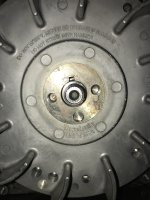
flywheel.jpg

The keyway doesn't look stripped to me, should I go ahead and pull off the flywheel entirely?

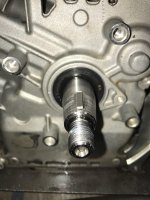
shaft.jpg

Nothing seems wrong with the shaft and keyway at all.
Am still at a total loss for what could be wrong with this Chinese piece of junk.
 

itsid

Moderator
Staff member
Messages
11,563
Reaction score
245
Location
Ruhrpott [Germany]
Odd...
So we have compression..
at least at low rpms decent..
and we have a solid spark as well.
I'm not too happy about your valve lash tbh..
0.15mm on both (rato recommendation for the 212 predator is 0.1-0.15mm IN and 0.15-0.2mm OUT)
is quite a bit from your .0025" (recommended would be ~ .006")
but frankly those freedom units are ...uhm... let's just say I'm happy that I'm metric not having to deal with that "loss in translation" ;)
Anyways that can change with upgraded parts and is best set to what the cam manufacturer asks for.
(ultimately it's the cam that decides how bumpy a ride the valve has)
I'm just saying.. maybe it's a hair too tight for a chinese engine like this so maybe it's worth trying unless your cam mfg told you to crank up.

Still .. since the flywheel is where it should be as far as I can tell...
IDK.. a fouled plug means unburned fuelmix (or worse.. broken piston ring/worn cylinder wall)
maybe you overshot and it's way too rich already.. but then again...
in this case the plug would be wet after a few tries of starting the engine.. and you said it ain't, right?

Jeez that indeed isn't your everyday behaviour is it..
If the cam would be misaligned (possible but not likely) the engine would not run after reassembly and not stop working after a few hours.
and everything I can think of changing over time due to loadchanges (flywheel, pushrods, coil)
you checked...
The plug... get a new one and try that.. maybe from a known to be running engine..
some weird plug issues have been seen before (usually an issue with sparking under compression/heat)
not common, but not unheard of either.. soooo at this point I'd try swapping the plug to rule that out.
I mean how likely would it be that the flywheel cast would slip on it's cast-in tempered hub?
never seen such happening tbh... there's a small dent on the hub and one ~60° off on the cast that perhaps coincide originally.
but really.. I cannot see that happening not without a noticeable crack in the cast.
(especially not since it's a german made flywheel *giggle*)

Anyways.. since the flywheel's off atm and I cannot think of something else to try atm.. how about (just for testing purposes)
you reinstall the original to give it a gentle idle speed tryout?
or at least compare the alignment of the magnets in regard to the cut key... just to be sure there's nothign weird going on there.

And if that's fine too.. remove the carb, clean it as good as you can
to be sure there's no clogged air vein or mixture canal or anything that riches up the mixture beyond ignitability.
maybe set it aside first and add just a tiny amount of starter spray and see if it pops after a few turns to verify
the carb to be the culprit. (cleaned dry plug assumed of course)
and yes, one spec of dirt in the fuel line/tank can be enough to render a brand new carb useless in seconds.

I do rule out witchcraft .... for now at least ;)
So if that too didn't help the tiniest bit, I'm out of ideas;
and my next step would be to pull everything apart again and check each and every tiny bit individually and in detail.
(did the pushrod caps sink into the pushrods [in case of hollow rods]
are the lifters running smoothly.. is the cam alignement still as ist should be, has the crank unusual wear marks,
are the piston rings properly offset to one another and oriented correctly..
every bit in every detail (tedious work one would really like to avoid shortly after assembling an engine I know)

Sorry.. that I cannot just point you to the loose kill switch wire you accidentally shorted out when you removed the low oil sensor.
that'd be far easier....

'sid
 

RB55_2018

New member
Messages
16
Reaction score
4
UPDATE

I finally found the culprit. Out of all the most difficult problems to find in an engine, this is probably the hardest issue imaginable to find.

I pulled the cylinder head and carefully examined everything.
The bore looked to be in near-perfect condition, indicating that this likely wasn't a piston ring failure of any sort (the bore would be scratched).
The piston was in perfect condition and showed absolutely NO sign of piston-to-valve contact.
The head seemed fine, it just had some regular carbon deposits in it.
The head gasket was fully intact.
The valves SEEMED fine and showed zero signs of piston-to-valve contact.

I went ahead and pulled the valves off the head. They still looked perfect. Didn't look bent or damaged in any way. I did a quick valve lap/grind job and reinstalled everything back into the cylinder except the pushrods and rockers. Since I don't have a compression tester and can't get one now since it's Christmas I figured that I could test compression by turning the engine over without the rockers and pushrods installed to give me a full engine seal (spark plug installed as well).

To my surprise, with everything sealed shut on the engine (head gasket installed and head torqued, valves fully closed), it was very easy to turn it over. I know that it takes an incredible amount of force to turn over an engine with good compression without the compression release on and this one was way too easy to turn over. Therefore, it had SOME compression but nowhere near enough to run properly. I also know that an engine won't fire if it has low compression.

I spent a while turning the engine over and could eventually pick out the sound of air hissing somewhere, seemingly in the head. I put my finger over multiple locations such as the exhaust port (would indicate a faulty exhaust seal), spark plug (bad threads on plug), pushrod holes (would indicate some sort of piston ring and/or bore problem), and finally, the intake port. Although it was very faint, I could feel a bit of air flowing past my finger on the compression and intake strokes along with the hissing. I'm almost certain the low compression is caused by a faulty intake valve seal.

I have absolutely no idea why the intake valve suddenly stopped sealing properly when accelerating under load at low RPMs. I had the engine spinning up into the 7,000 RPM range the day before with no issue. Maybe the colder weather had something to do with it? Although that wouldn't explain why it stopped sealing AFTER warming up (things expand) rather than before (things shrink). I'm pretty disappointed in this engine though. Don't plan on building any more if these are the kinds of issues I'm going to be dealing with. I was extremely careful in reassembling the engine so I'm sure that this wasn't caused by me being stupid by dropping the valve on the floor or hitting it against something.

I'm going to try to aggressively lap and grind the intake valve to see if I can get it to seal right. I'll report back in a bit. If this doesn't work I guess I'll order a new cylinder head or buy another engine entirely from Harbor Freight.

UPDATE

I lapped the intake valve very well with Permatex valve grinding compound and assembled everything back together. I turned off all the lights in my garage and used a super powerful handheld flashlight to check that the valve was sealing. On a sidenote, the install height for the 26lb springs was .850 and I measured it at almost exactly .850 for both valves so I know they are getting more than enough spring pressure. On a non-hemi you would definitely need to shim them to get the correct .850 height since they are pretty short springs but on a hemi they work fine with no shims. After lapping the valve I cleaned everything off very well with brake cleaner, changed the spark plug completely (as per many recommendations), and did my compression test again. I know that if it pulls a vacuum it won't make compression when it travels back up but I specifically reinstalled the plug at BDC before reinstalling it and rotating the crank so it had plenty of air in the chamber. It was definitely harder to crank over this time.

I cleaned out the pilot jet on the GX390 carb and tried to start it again after reinstalling everything EXCEPT the carburetor. I sprayed lighter fluid down the open intake and pulled the engine a few times. Suddenly I got a nice pop and it started and ran hard for a few seconds before dying (it used up all the ether starting fluid). This gave me a lot of hope so I went ahead and installed the entire carb and throttle setup. I tried to start it again and it started up great after a few pulls. Messed with the idle a bit and got it idling very stable. I completely removed the centrifugal clutch and drive chain so the engine had no load and I could rev it freely.

After a few minutes of idling I hit the throttle hard and it revved very high without issue. Sounded good as well. Again, it was definitely idling a bit on the rich side since I could smell the NO2 fumes, unburnt gas, and see black smoke coming out the exhaust but it was running which is all I really care about. Revved it a bit more and shut it down. I stored it INSIDE my garage this time since I'm worried that the cold had something to do with it not running right. It's 18 degrees outside.

I'm happy I got the engine running but I'm still not out of the woods by any means yet. Yesterday the engine died when I actually put a load and ran it so who knows if the same thing will happen again. It's going to be 42 degrees tomorrow and I'm storing the bike inside so if this is somehow a sub-freezing problem hopefully I shouldn't have it tomorrow. For good measure I will completely drain the gas later on and let the tank air out in my warm garage for a while so any water or freezable fluids should evaporate.

I'll update tomorrow when I reinstall the clutch and chain and take it for another test ride. REALLY hope that we won't have the same issue where it randomly dies out again. If it does I will jump straight to changing the carb pilot jets; I have two very rich jets but again I can't see how that could be the issue since it's already idling rich now. Merry Christmas to everyone for now!
 
Last edited by a moderator:

RB55_2018

New member
Messages
16
Reaction score
4
Odd...
So we have compression..
at least at low rpms decent..
and we have a solid spark as well.
I'm not too happy about your valve lash tbh..
0.15mm on both (rato recommendation for the 212 predator is 0.1-0.15mm IN and 0.15-0.2mm OUT)
is quite a bit from your .0025" (recommended would be ~ .006")
but frankly those freedom units are ...uhm... let's just say I'm happy that I'm metric not having to deal with that "loss in translation" ;)
Anyways that can change with upgraded parts and is best set to what the cam manufacturer asks for.
(ultimately it's the cam that decides how bumpy a ride the valve has)
I'm just saying.. maybe it's a hair too tight for a chinese engine like this so maybe it's worth trying unless your cam mfg told you to crank up.

Still .. since the flywheel is where it should be as far as I can tell...
IDK.. a fouled plug means unburned fuelmix (or worse.. broken piston ring/worn cylinder wall)
maybe you overshot and it's way too rich already.. but then again...
in this case the plug would be wet after a few tries of starting the engine.. and you said it ain't, right?

Jeez that indeed isn't your everyday behaviour is it..
If the cam would be misaligned (possible but not likely) the engine would not run after reassembly and not stop working after a few hours.
and everything I can think of changing over time due to loadchanges (flywheel, pushrods, coil)
you checked...
The plug... get a new one and try that.. maybe from a known to be running engine..
some weird plug issues have been seen before (usually an issue with sparking under compression/heat)
not common, but not unheard of either.. soooo at this point I'd try swapping the plug to rule that out.
I mean how likely would it be that the flywheel cast would slip on it's cast-in tempered hub?
never seen such happening tbh... there's a small dent on the hub and one ~60° off on the cast that perhaps coincide originally.
but really.. I cannot see that happening not without a noticeable crack in the cast.
(especially not since it's a german made flywheel *giggle*)

Anyways.. since the flywheel's off atm and I cannot think of something else to try atm.. how about (just for testing purposes)
you reinstall the original to give it a gentle idle speed tryout?
or at least compare the alignment of the magnets in regard to the cut key... just to be sure there's nothign weird going on there.

And if that's fine too.. remove the carb, clean it as good as you can
to be sure there's no clogged air vein or mixture canal or anything that riches up the mixture beyond ignitability.
maybe set it aside first and add just a tiny amount of starter spray and see if it pops after a few turns to verify
the carb to be the culprit. (cleaned dry plug assumed of course)
and yes, one spec of dirt in the fuel line/tank can be enough to render a brand new carb useless in seconds.

I do rule out witchcraft .... for now at least ;)
So if that too didn't help the tiniest bit, I'm out of ideas;
and my next step would be to pull everything apart again and check each and every tiny bit individually and in detail.
(did the pushrod caps sink into the pushrods [in case of hollow rods]
are the lifters running smoothly.. is the cam alignement still as ist should be, has the crank unusual wear marks,
are the piston rings properly offset to one another and oriented correctly..
every bit in every detail (tedious work one would really like to avoid shortly after assembling an engine I know)

Sorry.. that I cannot just point you to the loose kill switch wire you accidentally shorted out when you removed the low oil sensor.
that'd be far easier....

'sid
UPDATE

Today I tried to take the minibike out for a proper test run. Did nothing from yesterday except relocating the breather filter, installing the air filter on the carb, shortening the fuel line a bit, and adding some gas to the tank (from the same gas storage tank that I used to fill it up originally). It was 43 degrees outside. Started up within two pulls with a bit of help from the choke and idled fine, just had to decrease the idle speed a bit. I notice that these Predator 212s they always idle fast when the engine is cold but then slow down a lot after it gets up to temperature. Must be something to do with the idle air/fuel mix being a tad lean when the engine is cold then becoming richer as it warms up due to the fuel atomizing better.

I let it warm up for a minute and took it down the road. I have a nice 1 and a half mile of straight road section outside my house where you can easily do full throttle runs. Great for tuning carbs. I hit the throttle hard and it picked up speed nicely but the engine was cutting in and out for some reason and jerking me back and forth in the seat. I was really worried that this was some ignition issue but leaned out the air/fuel mix a bit by adjusting the main jet (I have an EC Carburetors adjustable main jet on the GX390 carb) and it disappeared completely. I've never had that kind of behavior when running a rich AFR on other engines with Mikuni or flatslide carbs but I guess every engine and carb setup behaves differently.

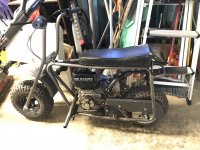
I took it for a 10 mile ride and the engine performed incredibly well. This is a DBX 10 or some other kind of little kids 100cc minibike and the power-to-weight and power-to-size ratio with this engine is absolutely absurd. Definitely NOT for kids anymore lol. The front end lifts up at the slightest touch of the throttle and it will wheelie at 50 miles an hour like nothing. Acceleration is way beyond what the small wheelbase of the frame can handle. I got the engine to rev to at least 7,000 RPM and I had no issues so at least everything seems to be somewhat ok. I'm happy with it at the moment.

In terms of future upgrades, the highest priority is better brakes. I have tried very hard getting the crappy brakes that came with it to work better but they simply lack the stopping power required to slow down a minibike with a 212 Predator and 130 lb rider above 20 miles an hour. Friction alone almost does a better job then the brakes. Really not safe to be using on any public roads with traffic at the moment but I only ride on deserted neighborhood roads so I'm fine for now. I plan on installing some hydraulic brakes that have enough power to lock up the rear wheel in the near future.

I'll also get a digital tach for it so I can see exactly what RPMs I'm getting. This will allow me to gear the minibike perfectly. Right now I'm running a 12T clutch with a 70T rear sprocket and 13.5" diameter wheels. It's working fine for now so I don't think I'll mess with it for a while. Might also get a better chain and clutch one day (just using the cheap max-torque clutch and chinese chain for now).

On a final note I REALLY like the Dynocams CM camshaft. I'm using a 21 mm GX390 carb and I absolutely love the powerband. It's got tons of low-end torque (more than enough) to get you started and it just keeps pulling and pulling. Excellent midrange and top end of course. Not like other "performance" or "racing" cams that I have used before which have poor low end torque, pick up well over a short RPM range, then suddenly drop off and quit producing power like you've hit a governor limit.

Hopefully I won't have to continue this thread but I will come back if I run into any more confusing issues. In the end, I'm almost certain that a bad intake valve seal was what caused the engine to quit. Thanks to all of you for the help!

foto_no_exif.jpg
 

JTSpeedDemon

2019 Build Off Winner!
Messages
4,026
Reaction score
162
Location
Texas
@chimmike, you might be surprised to hear that centrifugal clutches are actually the go-to for built engine performance for the most part. This is mainly because torque converters rob anywhere from 15-25% of engine HP, while clutches sap almost nothing in comparison. Not to mention the faster engage/disengage and less moving parts, plus less worries about belt alignment. These are some of the main reasons we don't see TCs on race karts, but they are great for general use yard karts. Plus they're cheaper :cornut:
The PO might've picked a CC for the power like I mentioned, but they also stick closer to the engine, so that's another thing to consider on minibikes, it's harder to get your leg in the drivetrain.
 

itsid

Moderator
Staff member
Messages
11,563
Reaction score
245
Location
Ruhrpott [Germany]
torque converters rob anywhere from 15-25% of engine HP
almost spot on ..
except the minimum is 20% .. no non-toothed belt CVT can transmit more than 80%;
so 15% would be revolutionary and is far out of reach.
especially for cvts like the ones we typically deal with here..
(their losses are likely closer to 25% if set up perfectly and in perfect condition)
while clutches sap almost nothing in comparison.
in comparision.. yeah around 5% I think it was
but you really want to disengage the running engine at some point.
and there's nothing else you can do.
disc clutches are slightly better even but way more expensive.

'sid
 

chimmike

Member
Messages
83
Reaction score
10
So strange that a stock coleman CT200 can do ~20 on the stock clutch, but then almost 40 with just a torque converter. Is it because of the overdrive factor of the TC? Y'all keep throwing wrenches in the works on me LOL. Do I spend $200 to do a torque converter swap on my stock engine CT200, or do I do a stage 2 upgrade to it and keep the stock clutch. gah.
 

itsid

Moderator
Staff member
Messages
11,563
Reaction score
245
Location
Ruhrpott [Germany]
not strange at all;
a torque converter adds quite some usefull benefits for us (well 'most' of us ;))

first and foremost: it allows you to gear higher than a cent clutch would,
since it multiplies that chain ratio with it's internal pulley ratio when necessary..
so you cannot take of with our imaginary vehicle at say 4:1 chain ratio and a clutch,
but thanks to the 2.7:1 internal ratio of a series 30 in low gear you can (since it would convert that to a 10.8:1 ratio)
and even if we assume a 30% loss that'd still be as if you'd be geared ~7.5:1 with just a clutch and thus you could.
that higher chain ratio (or rather sprocket ratio really) could then transform to additional speed once the TC shifts up
(given the engine has the torque at higher rpms of course)
and it doesn't matter really if the TC shifts up to only 1.1:1 (slightly under) or 0.9:1 (overdrive) or a simple 1:1..
and torque sensing TCs as we typically use around here try their best to keep you afloat...
say a steep hill and the engine's revving too high for it's ideal torque, the TC will shift down and climb that hill if it can
(at a slower speed than anticipated alright but still climb it)

But the main difference is it allows you to take off, where you couldn't with just a cent clutch and that sprocket-ratio.

Now.. if you shift your torque waaaay up (as many did before you) a TC is a BS idea (IMO)
and it's not even worth the effort, especially not if you set it to engage far beyond the stock rpms of your industrial engine (say 4500 engagement)
IMO that will never work out well..
I saw some rather mindbending claims with insane speeds.. yes;
but NONE so far came anywhere near their calculated top speed at that chain ratio .. all lost quite some significant amount of revolutions in the belt.
(and that's expensive slip)
Trouble is, the engine torque is too far up the rpm band, that the tc has actually much range to work with left.
it might only help you ever so slightly taking off then snap into high gear and you'd be off running essentially at a fixed ratio anyways.

So yeah IMO.. get a $200 race clutch instead! (Noram or even better a disc clutch if you can)

'sid
 

chimmike

Member
Messages
83
Reaction score
10
Sorry to diverge tracks here, but investing in a better race clutch will get me the top end I'm looking for assuming proper gearing, and take more advantage of the power modifications? hm. That'll definitely save hassle with a engine lift/move forward. Course now I have to find out if billet predator flywheels bolt on this hisun coleman ct200 engine....
 

jamyers

Well-known member
Messages
1,444
Reaction score
47
Location
Buffalo Gap, TX
Glad you found the issue with your engine - now you see the benefit of
an actual compression tester (one of the best diagnostic tools, along with a vacuum gauge)
 

RB55_2018

New member
Messages
16
Reaction score
4
interesting, not running a torque converter?
I have messed with them before and really don't like them. I know they are supposed to create a continuously variable gear ratio that would allow you to have way more low-end power and a bit better top-end as well with the overdrive but in practice I could never get them to work properly. In fact, they ended up reducing my top speed on a motorized bicycle by a lot due to something not being correct with the springs and the way the belt adjusts. I have more than enough lower-end power in my opinion so I think I'm better off without one.
 

RB55_2018

New member
Messages
16
Reaction score
4
not strange at all;
a torque converter adds quite some usefull benefits for us (well 'most' of us ;))

first and foremost: it allows you to gear higher than a cent clutch would,
since it multiplies that chain ratio with it's internal pulley ratio when necessary..
so you cannot take of with our imaginary vehicle at say 4:1 chain ratio and a clutch,
but thanks to the 2.7:1 internal ratio of a series 30 in low gear you can (since it would convert that to a 10.8:1 ratio)
and even if we assume a 30% loss that'd still be as if you'd be geared ~7.5:1 with just a clutch and thus you could.
that higher chain ratio (or rather sprocket ratio really) could then transform to additional speed once the TC shifts up
(given the engine has the torque at higher rpms of course)
and it doesn't matter really if the TC shifts up to only 1.1:1 (slightly under) or 0.9:1 (overdrive) or a simple 1:1..
and torque sensing TCs as we typically use around here try their best to keep you afloat...
say a steep hill and the engine's revving too high for it's ideal torque, the TC will shift down and climb that hill if it can
(at a slower speed than anticipated alright but still climb it)

But the main difference is it allows you to take off, where you couldn't with just a cent clutch and that sprocket-ratio.

Now.. if you shift your torque waaaay up (as many did before you) a TC is a BS idea (IMO)
and it's not even worth the effort, especially not if you set it to engage far beyond the stock rpms of your industrial engine (say 4500 engagement)
IMO that will never work out well..
I saw some rather mindbending claims with insane speeds.. yes;
but NONE so far came anywhere near their calculated top speed at that chain ratio .. all lost quite some significant amount of revolutions in the belt.
(and that's expensive slip)
Trouble is, the engine torque is too far up the rpm band, that the tc has actually much range to work with left.
it might only help you ever so slightly taking off then snap into high gear and you'd be off running essentially at a fixed ratio anyways.

So yeah IMO.. get a $200 race clutch instead! (Noram or even better a disc clutch if you can)

'sid
Great explanation!
 
Top