My Design

Status
Not open for further replies.

Simon Thomas

New member
Messages
324
Reaction score
0
Location
Sarawak, Malaysia
Rear threaded rod broken again

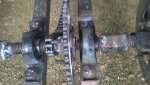
:oops:I thought after adding the pillow block bearing near the rear sprocket would reduce the stress / tension (between the rear sprocket and disk brake) and stop the recurrence of broken rod. However, last week the joint broke again after 1 km drive on the road. :mad2::furious2:

Now need to look for better solution. I agree with some earlier comments that threaded rod is not a reliable material from the experience I am having here :roflol:.

I still could not decide the material to replace the threaded rod and in the same time resolving my problem.
 

Attachments

  • 04092011071.jpg
    04092011071.jpg
    89.2 KB · Views: 34

Simon Thomas

New member
Messages
324
Reaction score
0
Location
Sarawak, Malaysia
I would just make it a one wheel drive. If you'r not going super fast, one wheel drive would be fine and eliminate the twists in your axle.

In my opinion when building this, it would be more stable with two rear wheels (or four wheel cart) and as multi purpose vehicle to carry some light stuffs on bucket if necessary. Your comment makes sense from the recent experience and repeated trouble that I have with the threaded rod:iagree:. I keep in mind your rational suggestion. Thanks.
 

Simon Thomas

New member
Messages
324
Reaction score
0
Location
Sarawak, Malaysia
Machinist and qtband make very good points, and I completely agree. You can repair that threaded rod until it's nothing but a 48" long weld bead, and it's just going to keep breaking. Even if it does survive the shear loads, it will not survive the torsional loads. You need a differential, a hardened shaft, or a one-wheel set up. The diff or dead axle (one wheel) are the preferred choices for handling.

Thanks for your rational comments:iagree:. I still have the same problem after the last post. The threaded rod broke again. Besides, the nuts welded to the rod alway came off / loose. Threaded rod is not a reliable rear axle.

Keep in mind your great suggestion. Now looking for a "hardened shaft" like you said. This would be a better solution I think.
 

qtband

Well-known member
Messages
1,766
Reaction score
60
Location
St. Louis, MO
Just try the one wheel drive option. You have everything you need so cost isn't an issue. You can still use the threaded rod you have and you can get it done quickly. Doesn't hurt to try!
 

Doc Sprocket

*********
Messages
15,677
Reaction score
142
Location
Ontario, Canada
I think a little clarification is in order, Simon- when the posters suggest "one wheel drive", they do not mean "use a single rear wheel". The intent is to have TWO rear wheels, but one is driven, and the other freewheels like the fronts.

I still suggest avoiding threaded rod at all costs. It will only cause trouble.
 

Simon Thomas

New member
Messages
324
Reaction score
0
Location
Sarawak, Malaysia
Thanks for clarification

I think a little clarification is in order, Simon- when the posters suggest "one wheel drive", they do not mean "use a single rear wheel". The intent is to have TWO rear wheels, but one is driven, and the other freewheels like the fronts.

I still suggest avoiding threaded rod at all costs. It will only cause trouble.

Toystory_4wd, thanks for clarification. It helps alot and clear the confusion. I like your suggestion:thumbsup:. I believe it is something similar in the first attached photo:wai:. Let me keep this as the last resort because at present I prefer the two rear wheels to work together to push my cart. Reason: at certain muddy road condition, I doubt the single driven wheel may not good enough.
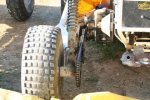
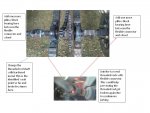
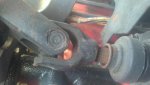
Now need to improve the weakness of my design. I would focus on the rear shaft near to the sprocket. First thing to do is replacing the threaded rod with hardened metal. It broke a few times here and continue to brake if not resolved. This is the main weakness of my rear shaft / axle design.

In the same time, I would like to improve the rear axle connecting the two wheels. Suggest to to add (i) three more pillow block bearings to hold the two wheels shafts. Also suggest to add (ii) two flexible connector (sorry don't know the technical term).

Attached is my plan. Do you think this plan works?
 

Attachments

  • IMG_5766.jpg
    IMG_5766.jpg
    68.3 KB · Views: 36
  • Presentation1.jpg
    Presentation1.jpg
    83.8 KB · Views: 35
  • 12082011909.jpg
    12082011909.jpg
    59.2 KB · Views: 22

Simon Thomas

New member
Messages
324
Reaction score
0
Location
Sarawak, Malaysia
Simplified Plan

Toystory_4wd, thanks for clarification. It helps alot and clear the confusion. I like your suggestion:thumbsup:. Let me keep this as the last resort because at present I prefer the two rear wheels to work together to push my cart. Reason: at certain muddy road condition, I doubt the single driven wheel may not good enough.

Now need to improve the weakness of my design. I would focus on the rear shaft near to the sprocket. First thing to do is replacing the threaded rod with hardened metal. It broke a few times here and continue to brake if not resolved. This is the main weakness of my rear shaft / axle design.

In the same time, I would like to improve the rear axle. Suggest to to add (i) three more pillow block bearings to hold the two wheels shafts. Also suggest to add (ii) two flexible connector (sorry don't know the technical term).

Attached is my plan. Do you think this plan works?

May be this attachment helps to simplify my earlier ilustration. Do you think this plan works?
 

Attachments

  • Presentation2.jpg
    Presentation2.jpg
    66.6 KB · Views: 30
Last edited:

Doc Sprocket

*********
Messages
15,677
Reaction score
142
Location
Ontario, Canada
The "flexible connectors" you refer to are called "Universal Joints" in North America. They should be completely unnecessary in your application.

Also unnecessary are the 7 bearings you are proposing. 3 maybe- 4 under extreme circumstances. With a decent axle shaft, 7 is a waste of money and effort.
 

Doc Sprocket

*********
Messages
15,677
Reaction score
142
Location
Ontario, Canada
The "flexible connectors" you refer to are called "Universal Joints" in North America. They should be completely unnecessary in your application.

Also unnecessary are the 7 bearings you are proposing. 3 maybe- 4 under extreme circumstances. With a decent axle shaft, 7 is a waste of money and effort. Looking at your diagram and counting from left to right, use bearings #1,3,5, and 7.
 

Simon Thomas

New member
Messages
324
Reaction score
0
Location
Sarawak, Malaysia
Substitution Plan

The "flexible connectors" you refer to are called "Universal Joints" in North America. They should be completely unnecessary in your application.

Also unnecessary are the 7 bearings you are proposing. 3 maybe- 4 under extreme circumstances. With a decent axle shaft, 7 is a waste of money and effort. Looking at your diagram and counting from left to right, use bearings #1,3,5, and 7.

Thanks for your view and provide the correct name for the universal joints:idea2:. I agree :iagree:with you to reduce the number of bearings. 4 is ideal with #1,3,5 and 7. That would still provide stronger base. Likewise, the threaded rod needs to be changed with a stronger one as well.

Yesterday, I dropped-by :sifone:at a workshop and shared my broken threaded rod problem with a machinist and he has recommended me :idea2:to use a bigger size of metal rod instead of 1" diameter threaded rod. He recommended 2" diameter rod instead. Although I have to spend some extra money here, but it helps to stop the recurrence of same trouble.

I am now looking :bannana:for bigger rod probably 1.5" or 2" diameter. I haven't surveyed the hardware / metal shop yet. Later, I need to get 4 bigger pillow block bearings to accomodate the change. Also the end needs to get threaded as well to hold the rear wheels.
 

nak18

New member
Messages
130
Reaction score
0
Location
Atlanta, Ga
Hi Nak18,

1. I use the 13" diameter car aloy rims. That's why they look pretty big:thumbsup:.
2. The hub is from a car wheel hub compatible with the rims.

Hope I answer you:cheers2:.

Do you know what car they are of off and is the spindle a regular go-kart spindle with a car hub on it?

I've saw a few build where people took the whole wheel assembly(knuckled spindle, hub, etc.,) and used heim joint to connected it.

So far, thanks for the help given. The vehicle is nice, are the cops going to trip in your area about driving it on the street?
 

Doc Sprocket

*********
Messages
15,677
Reaction score
142
Location
Ontario, Canada
As long as the steel you use is of good quality (NOT threaded rod) and well supported, there is no need to get as large as 2". He//, TRUCKS don't use axleshafts that large. 1 1/2" is plenty large.
 

Simon Thomas

New member
Messages
324
Reaction score
0
Location
Sarawak, Malaysia
Do you know what car they are of off and is the spindle a regular go-kart spindle with a car hub on it?

I've saw a few build where people took the whole wheel assembly(knuckled spindle, hub, etc.,) and used heim joint to connected it.

So far, thanks for the help given. The vehicle is nice, are the cops going to trip in your area about driving it on the street?

Nak 18,

I am not really into go-karting. I have friends here in that hobby but not me. If you want to know whether the car components are the same (or match) with go kart, I may not be the best person to advise you. May be you need to browse other threads in this forum to find more info. I only build something that is simple and feasible to complete like my buggy which I started building it when I have an old motorbike and do not know what to do with it. Slowly, I developed it into something that you see in my thread.

That's the beauty of being the DIY people:bannana::wai:. We dismantle things and re-assemble them as something else. Sometimes other people can't expect the result of the next build. I am not surprised if the DIY people dismantle the parts / components you mentioned to build other stuffs. You can do the same. Try build something that you like and you will find lots of fun doing it.

Hahaha:wai:... so far I am quite lucky when I travelled on the highway that day, the cop just thumbed-up at me. Actually they were suprised to see such 4 giants and heavy wheels (which they think impossible) can be pushed with a 100cc motorbike engine. To answer you, it is actually illegal to drive something like this on the highway in Malaysia.

I take your advice. That's why now I left it in rural area / country side. I only use it at that street area where no chance to be found by the traffic cop.
 

Simon Thomas

New member
Messages
324
Reaction score
0
Location
Sarawak, Malaysia
Good quality steel

As long as the steel you use is of good quality (NOT threaded rod) and well supported, there is no need to get as large as 2". He//, TRUCKS don't use axleshafts that large. 1 1/2" is plenty large.

Really? Then I should look for 1" diameter of good quality steel. I cannot imagine if I use a larger one, that would cost me more money as well. Some more I may waste the existing 1" diameter pillow block bearings as well.

I have a stainless steel 1/2" diameter rod used to connect my pump ski propeller with its engine. It is quite strong. Learning from this, may be I should find the same rod material.
 

machinist@large

Active member
Messages
2,865
Reaction score
28
Location
West Michigan, 49331
As long as the steel you use is of good quality (NOT threaded rod) and well supported, there is no need to get as large as 2". He//, TRUCKS don't use axleshafts that large. 1 1/2" is plenty large.

Really? Then I should look for 1" diameter of good quality steel. I cannot imagine if I use a larger one, that would cost me more money as well. Some more I may waste the existing 1" diameter pillow block bearings as well.

I have a stainless steel 1/2" diameter rod used to connect my pump ski propeller with its engine. It is quite strong. Learning from this, may be I should find the same rod material.

There are a lot of different grades of stainless; here in the States, the most common grade used for round bar is SAE# 303 and 304 (SAE stands for Society of Automotive Engineers). This should out perform the threaded rod you had to start AT LEAST several times over. Outside the States, you'll probably hear it called A1 or A2 under ISO 3506 (not to be confused with SAE A1 and A2 tool steel).

There are a whole lot of different grades out there. If you are buying used and aren't sure what it is, use a magnet. 3 series is non magnetic. If it's rust free and a magnet sticks, it's probably 4 series and will not win you any friends at your local machine shop (tougher than the hubs of h***).

Hope this helps!!:sifone:
 

Simon Thomas

New member
Messages
324
Reaction score
0
Location
Sarawak, Malaysia
Really Helpful Info

There are a lot of different grades of stainless; here in the States, the most common grade used for round bar is SAE# 303 and 304 (SAE stands for Society of Automotive Engineers). This should out perform the threaded rod you had to start AT LEAST several times over. Outside the States, you'll probably hear it called A1 or A2 under ISO 3506 (not to be confused with SAE A1 and A2 tool steel).

There are a whole lot of different grades out there. If you are buying used and aren't sure what it is, use a magnet. 3 series is non magnetic. If it's rust free and a magnet sticks, it's probably 4 series and will not win you any friends at your local machine shop (tougher than the hubs of h***).

Hope this helps!!:sifone:

Machinist@large,

This is really a useful info:thumbsup: and help me with my problem. Let me check with the shop here the type of stainless steel they have. I may take sometimes to settle this problem because now need to focus on pump ski training using the gasoline engine. I just bought a 7.5hp China made gasoline engine last few days and want to test run it on my boat within this week. Currently, I have 6.5hp and not really strong enough to race with other boat owners who use 7.5hp. To reach higher rpm, we change the carburator with motorbike carburator and change the exhaust as well:wai::auto:.

On my buggy, will keep you all update on resolving my rear shaft problem.
 

Simon Thomas

New member
Messages
324
Reaction score
0
Location
Sarawak, Malaysia
Is this the one?

There are a lot of different grades of stainless; here in the States, the most common grade used for round bar is SAE# 303 and 304 (SAE stands for Society of Automotive Engineers). This should out perform the threaded rod you had to start AT LEAST several times over. Outside the States, you'll probably hear it called A1 or A2 under ISO 3506 (not to be confused with SAE A1 and A2 tool steel).

There are a whole lot of different grades out there. If you are buying used and aren't sure what it is, use a magnet. 3 series is non magnetic. If it's rust free and a magnet sticks, it's probably 4 series and will not win you any friends at your local machine shop (tougher than the hubs of h***).

Hope this helps!!:sifone:

I took my used speaker (at the back has magnet) and put it close to my boat propeller rod and does not stick. Is the rod shown (shinny look) in the photo one of the 3 series? I intent to buy this kind of rod to substitute the broken threaded rod. This rod is quite tough when used to suppport our boat propeller. Only the diameter used is probably 1/2" or slightly less. For my buggy, I follow advice from toystory_4wd to stick with 1" diameter rod.

Do you think this is ideal to subsitute my broken threaded rod? Attached is the photo.
 

Attachments

  • 13092011091.jpg
    13092011091.jpg
    35.3 KB · Views: 15
Status
Not open for further replies.
Top