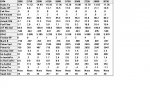
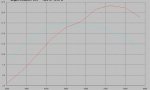
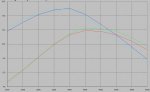
Here is the data the simulator gave me when I put my last engine together on it.
I used the 285-0211 cam.
I used higher flow numbers for the ported head.
I used a larger average port diameter.
I used bigger valves 28.5/25mm.
I used a 100 cfm carb.
I used 11 to 1 CR.
I used 100 octane gas.
Peak HP is over 20, but also over 7k RPM.
Peak TQ is 17.5 LB-Ft, but not until 5k RPM.
Here is the Analysis the Program gave me for the 285-0211 engine on my current minibike...
Analysis Report for Mild Street Engine with Desired HP Peak at 7000 RPM
Peak Tq =17.4 @ 5000 RPM 1.34 Ft Lbs per CuIn
Peak HP =21.7 @ 7250 RPM 1.68 HP per CuIn
Maximum Tq/CuIn is 1.344 Ft Lbs/CuIn.
This is somewhat high, indicating good performance, but will
produce high cylinder pressures and temperatures.
High cylinder pressures require precautions to protect against
detonation, blown head gaskets, damaged engine components like
pistons, rings, exhaust rocker arms, bearings, etc.
Maximum Exhaust System Backpressure 'Exh Pres' is 0 PSI.
This is low for a street vehicle with a full exhaust
system. This is simulating either an extremely free flowing exhaust
system or open headers or open exhaust manifolds. This may be
illegally loud for street operation.
Typical ranges of Exhaust System Backpressure are listed on page
32 in the User's Manual. You can lower the Back pressure by
increasing Exh System CFM Rating in the Exhaust Specs menu.
Lowering the Exh System CFM Rating will simulate a quieter, more
restrictive exhaust system. Most dyno tests are done with open
headers, which are simulated by selecting the 'Open Headers' from
the Exh System Type combo box.
Maximum Fuel Flow 'Fuel Flow' is 10.4 lbs/hr GAS.
This is equal to 1.8 gallons per hour of fuel flow.
For an injected engine with one injector per cylinder, you will require
at least 10 lbs/hr injectors.
Fuel Flow will only change if air flow changes or if you inject
nitrous. The Engine Analyzer assumes 12.5:1 A/F for gasoline and
5:1 for alcohol (methanol) and 3:1 for 'Very Rich Alcohol' for all
conditions. You can not richen or lean out the fuel mixture.
Minimum A/F Mixture Quality 'A/F Mxtr Qlty' is 84 %.
This is somewhat low and represents a real power loss in your
desired operating range. This can be improved by reducing intake
runner sizes, carb size, going to fuel injection, heating the intake,
increasing compression ratio, going to a lower octane fuel (the
program assumes high octane fuel has lower Reid Vapor Pressure and
therefore does not atomize or mix as well), smaller plenum, etc.
Most of the above suggestions will hurt air flow and volumetric
efficiency, and therefore hurt performance. This is where you
will have to come up with the desired compromise of good air flow
and good A/F Mixture quality.
The Maximum Average Piston Speed 'Piston Spd' is 3157 ft/min
at the Performance Calculations Maximum RPM of 8750 RPM.
This is somewhat high (if you want to run this entire speed range),
requiring light, high strength reciprocating components.
A mild street engine should limit PSN SP to a range of 2500-3000 ft/min
with production quality rods. To run at 2750 ft/min or higher, you will
need 'better than production' reciprocating components (connecting rods
& bolts, pistons, etc.).
PSN SP (average piston speed in ft/min) and PSN GS (peak piston Gs)
are indicators of how severely you are stressing the engine's
rotating components. To lower PSN SP and PSN GS, you must shorten
the piston STROKE or design the engine for a lower RPM range.
See pages 53, 54 and 160 in the manual.
Maintaining low PSN SP and PSN GS are critical for 'keeping the engine
together'. OVER-REVVING PARTS BEYOND THEIR INTENDED LIMIT IS UNSAFE
FOR THE ENGINE, YOURSELF AND BYSTANDERS.
The Intake Runner Velocity 'Int AvgVel' is 320 ft/sec
at your 'Desired HP Peak RPM' 7000 RPM.
This is somewhat high and indicates you will need a larger Intake
Runner Diameter or larger Intake Port Diameter for less
restriction and stronger intake tuning.
For these engine specs, an 'Int AvgVel' of about 260 should work well.
If the 'Int AvgVel' is approximately 30-80 Ft/Sec higher than this,
you will likely improve torque below this RPM, but lose some HP.
The Inertia tuning of this intake is tuned to 6292 RPM,
which is close to your 'Desired HP Peak RPM' of 7000 RPM.
Since this RPM is about where the HP peak should occur, peak HP
should be good. If you specify longer and/or smaller diameter intake
runners, you will likely gain Peak Torque and lose some Peak HP.
At 1 different RPMs, Spark Advance 'Spark Adv' is retarded to avoid
detonation. Retarding Spark Adv does reduce performance, but allows this
engine to safely operate with this Octane fuel.
You can reduce the likelihood of detonation, by increasing Fuel
Octane or Dew Point (humidity), or reducing Intake Air Temp or
Cooland Temp in the Running Conditions menu, or reducing
Compression Ratio in the Head(s) Specs menu. Also, anything
which reduces performance, or shifts the performance curve to a
higher RPM range will also reduce the likelihood of detonation. By
reducing the likelihood of detonation, you avoid the necessity of
retarding Spark Adv.
Retarding Spark Adv from what the engine actually wants is not
necessarily a 'bad thing'. The best performance for a particular
RPM range and Fuel Octane may come with spark retarded from optimum.
Just be sure to retard spark in the actual engine to avoid detonation
which will cause engine damage.
Also, retarding spark increases exhaust temperatures, which can
damage exhaust valves, turbo turbines, etc.
The % Exhaust to Intake Flow Capacity 'Total Exh/Int %' is 92.4 %.
This is Very high, and indicates you could be opening the
exhaust valve too early or you could improve performance by improving
intake valve flow and intake cam profile. The most common 'rule of
thumb' is to design for around 75% EXH/INT flow capability.
To reduce Total Exh/Int % :
- Increase the Intake Valve Diameter and/or Valve Flow Efficiency
- Increase the Intake Duration, Intake Tappet Lift and/or Intake
Rocker Arm Ratio in the Cam/Valve Train menu
- Reduce the Exhaust Duration, Exhaust Tappet Lift and/or Exhaust
Rocker Arm Ratio in the Cam/Valve Train menu
You can reduce Total Exh/Int % by changing other specs, but that may
also reduce performance.
Estimated Idle Vacuum 'Est Idle Vac, ''Hg' is 8.5 ''Hg.
This is EXTREMELY low, and will likely NOT idle smoothly or provide
enough vacuum to run vacuum accessories for a mild street engine.
To increase idle vacuum, reduce cam overlap by specifying a lower
(possible negative) Intake Open @ .050 and/or Exhaust Close @ .050,
larger Centerlines or smaller Durations in the Cam/Valve Train menu.
IMPORTANT: The Optimize feature at the top of the Main Screen is
an excellent way to find combinations which work well together.
Click on 'Help' in the Optimize screen for tips on this feature.
End of Analysis Report


 CL1 vs 280-0211.jpg109.1 KB · Views: 7