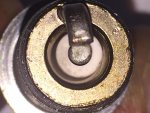
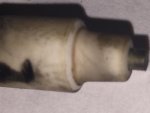
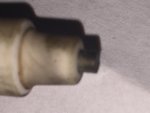
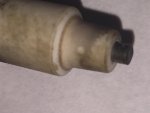
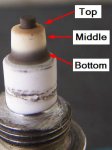
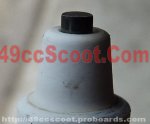
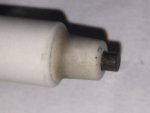
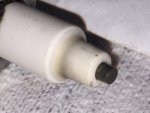
Top: This area is the idle circuit indicator. For a race engine, this area has no real application; race engines don't rely on the idle circuit the way a street engine does. However if you're tuning a street driven vehicle then this portion needs to be a dark gray/tan color. This is achieved by tuning the idle air/fuel ratio. This is done by changing the air bleed orifice size, changing the idle feed restrictions, adding or subtracting idle bypass air, or a combination of these things.
Warning Note: The initial timing has a direct effect on how much the primary throttle blades need to be opened to achieve a good idle. If the initial timing is insufficient, the transfer slot might be overexposed in an attempt to raise the idle speed sufficiently. An overexposed transfer slot will cause an noxious smelling, poor quality idle and poor off-idle response.
Middle: This is the area that will show the combustion chamber condition and air/fuel ratio at part throttle cruise (primary side only) with the power valve and secondaries closed. This is a high vacuum condition, vacuum advance will be fully activated. The mechanical advance may not be fully in. Usually about 30-50 MPH depending on the gear and weight of the car.
Bottom: This indicates the conditions at high load, low vacuum, open throttle settings. This is a priority if drag racing. Using a 5x or 10x scope you need to look right down to the bottom of the porcelain where it meets the metal body of the plug. This is the area that will have the color that you need to study and tune to. The other 2/3 of the porcelain will be burned clean by the high heat generated by WOT and high RPM, so cruise or idle characteristics will not show.