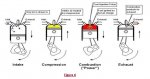
should be fairly equal, yes;
but not because it wouldn't run too well otherwise,
but because it wouldn't run too well _for long_ otherwise

(the missing lubrication would cause a major hiccup eventually the rest can be dealt with usually)
two strokes are far more complicated than one might think at first..
while you don't have to scratch your head about cam timing lift and duration,
you will have to take all that and far more into account setting the rest up.
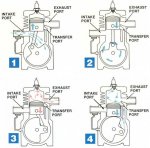
reed valves are fairly simply.. as soon as the crankcase is under low pressure (piston moving up)
it'll open and you have your mix taken in (halfway)
but then the piston drops down again and that mix has to find it's way into the combustion chamber,
therefor you need a transfer port and that then has to be perfectly timed to
get all the mix up into the combustion chamber without letting it escape back into the crankcase (the problem a large crankcase volume is not exactly helping with less compression ratio means less gas speed)
And the exhaust porting isn't any easier.. on it's way down the piston need to open the exhaust
just when there's no more noteworthy power to be extracted from the combustion itself,
while at the same time allowing the fresh mix in on the other end.
And just because you're making it a two stroke doesn't mean your engine will rev twice as high really..
it only does so if your powerband is set perfectly (and you might find one of Brets old threads [desertduler]) where he explains how to adjust the powerband by altering the exhaust geometry .. and what else is needed in order to do so properly.
in short: it's far from a quick and easy task!
Like say the common misconception of the powerband beeing some kind of supercharging effect due to intake geometry.
it's just not that..
the change in volume above and below the piston is perfectly identical
(very few exceptions with counterbalanced crankcase compressors)
So at every stroke the exact same amount of combustible gas is forced through the transfer port into the combustion chamber.
The point is.. that amount is always "too much"
in order to expell and dilute the exhaust fumes.
(also piston travel dictates the bigger than necessary amount that's why bore to stroke ratio of the piston itself is important)
The "supercharging" effect is based on the resonating hot gasses in the exhaust's resonator pipe;
at the ideal rpm (set by the geometry of the exhaust) the last bit is forced back into the combustion chamber when the transfer port is already closed up again
and if the geoemtry is perfect, that bit is also nothing but combustible gas
that's where the nice smack we all know and love comes from.
Talking about supercharging...
Bret had a great idea for a self supercharging two stroke .. last I know he hadn't made a prototype yet but that's been quite a while now.. if he ever made one..
I'd love to see that thing in action. (honestly I'd love to drive that...)
Anyways.. the proper porting of the piston (for exhaust expelling and crank case to combustion chamber filling) in relation to bore and stroke dictates where the engine likes to have it's ideal power and then you still have to make the matching exhaust for that
to get the best possible result and not waste most of the power.
and that alone is tedious enough
No frankly... converting a 212 to a two stroke isn't exactly easy,
and the result will be more than likely extremely disappointing.
If you have a trashed engine laying around, and some time to waste..
sure, give it a go.. I bet there's something to be learned in such attempt.
But personally, I think it'd be even easier if you get a set of wheedwhacker enignes
and merge them into a multicylinder two stroke instead
'sid