Figuring out gearing with a CVT

Status
Not open for further replies.

sno-kart

New member
Messages
120
Reaction score
0
...Remember that both the drive unit and the driven unit have variable effective diameter, and the driven unit (basically) responds in direct correlation with road speed.

Toystory - Very interested in what you said here. I assumed that the driven converter "opens up" as a direct result of the belt pulling on it as the drive converter closes up. But from what you said here, I gather I may be wrong.

I understand that the movement of the drive converter is directly related to the RPM of the crankshaft, but what actuates the DRIVEN converter? Thanks!
 

exenos

Project Nut
Messages
1,217
Reaction score
0
Location
Ontario, Canada
The primary clutch (drive converter) is regulated directly by the engine RPM and the secondary (driven) is regulated by the belt pulling on it. Basically the belt doesn't stretch and is forced closer to the center of the secondary while it is going to the outside of the primary.

Animation http://www.youtube.com/watch?v=twM-GLUYQ-o&feature=related

You really should spend a good couple hours reading up on how the clutches work and clutching itself. There's just so much more out there than I can explain.
 

r97

Measure twice cut once
Messages
3,793
Reaction score
8
Location
Massachusetts, USA
While I do agree that the driver is actuated by engine RPM, and that the driven sheaves moving closer tends to pull the belt further into the driven, I feel that the driven hasn't been covered. When you let off the gas, the driver opens, and the spring within the driven brings the sheaves together, pulling the belt into the low range. What hasn't been covered, is what happens when you have full throttle, and you come up to something like a hill. First your momentum carries you up the hill, but as you loose momentum more force is needed at the wheels, causing them to try and spin slightly slower than they should with the CVT in its high range. This force makes the two cams on the side of the driven force against each other, causing the driven to down shift when a load is applied.
I know that this "torque sensing cam" as Comet called it, is on most, if not all of our little industrial engine CVTs, although I know it doesn't apply to all CVTs. I just thought I would throw that in since there is a very good chance that the CVTs we use will have it.
 

exenos

Project Nut
Messages
1,217
Reaction score
0
Location
Ontario, Canada
The extra load also drags the engine rpm down, opening up the primary and closing the secondary until it balances out again. Its a combination of lowered engine rpm and what r97 posted, although what he described is a result of lowered engine rpm.
 

mysteryboy28

New member
Messages
1,582
Reaction score
10
Location
Lansing, MI
if you're using dinky little race kart tires, then the chaincase shouldn't be needed. i'm using 22-25 inch tires, so to avoid having to use a 100 tooth #50 axle sprocket i take full advantage of the chaincase.

if your CVT has an approx ratio of 1:1, your tires are 12 inch tires, then if your desired top speed is say 60 mph at 8000 rpm you will want 10t jackshaft sprocket and a 48t axle sprocket.

now comes the problem of ground clearance with 12 inch tires and a 48t sprocket. you might only have about an inch or 2 of clearance because that sprocket is pretty dang huge! keep in mind that you will be using #50 chain and sprockets to accomodate the sled motor power, which are quite a bit bigger than your typical #41 kart chain and sprocket.

now if you factored in the chaincase with the 29:17 ratio, then you would only need a 28t sprocket, giving you much better ground clearance.
 

exenos

Project Nut
Messages
1,217
Reaction score
0
Location
Ontario, Canada
He would be fine using #40 chain if he bought good quality chain and not the cheapo stuff we use normally. Dirt bikes run 420 and they can put out over 50 hp and are still well within the power limit of the chain.
 

sno-kart

New member
Messages
120
Reaction score
0
Thank you for all the help and advice. After thinking through everything and doing some more research the past two days, we figured out what we are doing. A #50 11-tooth sprocket is going on the jackshaft with a #50 50-tooth sprocket on the axle. From what I read, a 530 chain would be the correct size to use for these sprockets. Need to weld in a key to our jackshaft and should be good to go! Thanks again...
 

mysteryboy28

New member
Messages
1,582
Reaction score
10
Location
Lansing, MI
#50 and 530 are the same. 520 is a little narrower than #50 and 530.

they sell #50 chain at Tractor Supply stores - like $20 something for a nice big length of it (good enough for TWO uses!).
 

sno-kart

New member
Messages
120
Reaction score
0
Say what?? :ack2:

lol... I guess this is not something we can do?? The jackshaft does not have a key on it so we need to add one somehow. Figured we can just weld one onto the shaft and then file down the excess. I'm guessing bad idea lol? What would ya'll suggest? Thanks.
 

sno-kart

New member
Messages
120
Reaction score
0
#50 and 530 are the same. 520 is a little narrower than #50 and 530.

they sell #50 chain at Tractor Supply stores - like $20 something for a nice big length of it (good enough for TWO uses!).

Sweet, thanks. Will a #50 chain fit on a 520 sprocket?
 

r97

Measure twice cut once
Messages
3,793
Reaction score
8
Location
Massachusetts, USA
#50 and 530 are the same.

While I agree that #50 chain will fit on #530 sprockets (and the other way around), I disagree that #50 industrial chain is identical to #530 motorcycle (aka high speed) chain. A #530 chain will have closer tolerances, heat treating, etc to handle high power/high speed applications.

Sweet, thanks. Will a #50 chain fit on a 520 sprocket?

Yes it will, although if you plan to use #50 or #530 chain, you should use #50 or #530 sprockets. That said, I think that #530 or even #50 would be overkill for this. A #425 chain should fit on #40 sprockets (easy to find), and it should be more than enough for your engine, especially considering that race kart tires will spin very easily, the CVT's belt acts as a kind of cushion/dampener, and the fact that the chain-case won't be used. What ever you do just make sure to either ditch the chain case, or the secondary chain, there is no need to have both.
 

sno-kart

New member
Messages
120
Reaction score
0
...A #425 chain should fit on #40 sprockets (easy to find), and it should be more than enough for your engine, especially considering that race kart tires will spin very easily, the CVT's belt acts as a kind of cushion/dampener, and the fact that the chain-case won't be used. What ever you do just make sure to either ditch the chain case, or the secondary chain, there is no need to have both.

Definitely ditching chaincase, so it will be belt from crank to jackshaft and then chain straight from jackshaft to rear axle.

You said #40 sprockets are easy to find but I'm actually having trouble finding them which is why we went with #50. We need an 11 tooth sprocket with a 1" bore... do you know where I can find a #40 sprocket like this?

Thanks!
 

r97

Measure twice cut once
Messages
3,793
Reaction score
8
Location
Massachusetts, USA
An 11 tooth, 1" bore, 1/2" pitch sprocket might be hard to find. This is because #40 chain has a shorter pitch than a #50 chain, making the diameter of a #40 sprocket smaller than that of a #50 sprocket with the same number of teeth. It just happens to be that an 11 tooth #40 sprocket will be small enough that boring it out to 1" will result in a weakened sprocket.

You could probably have an 11 tooth #40 sprocket re-broached and bored out to 1", and be just fine. That said, I would advise you to either just get a larger sprocket, or modify your/buy a jack-shaft that it will fit a 7/8" bore sprocket (a common size). FYI, a 14 tooth #40 sprocket has approximately the same OD as an 11 tooth #50 sprocket.
 

landuse

Moderator
Staff member
Messages
18,748
Reaction score
522
Location
Pietermaritzburg, South Africa
It just happens to be that an 11 tooth #40 sprocket will be small enough that boring it out to 1" will result in a weakened sprocket.

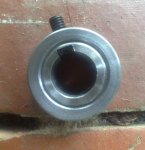
I had to get a small sprocket bored out, and what the machinist did was shrink a sleeve over the sprocket after he had bored it. Here are some pics
 

Attachments

  • 18102011640.jpg
    18102011640.jpg
    109.4 KB · Views: 4
  • 18102011638.jpg
    18102011638.jpg
    63.6 KB · Views: 4

r97

Measure twice cut once
Messages
3,793
Reaction score
8
Location
Massachusetts, USA
That is a great idea if you must use a certain size sprocket on a certain size shaft, but I think one of the other two options I mentioned would probably be less expensive, and still work perfectly. Simply moving up to a 12 tooth #40 sprocket would make getting a sprocket with a 1" bore much easier.
 
Status
Not open for further replies.
Top