

You are using an out of date browser. It may not display this or other websites correctly.
You should upgrade or use an alternative browser.
You should upgrade or use an alternative browser.
Diamonite Electrathon America Racer
- Thread starter Functional Artist
- Start date
ezcome-ezgo
G'me sumthin to write on
It's all about pressure really, not the air velocity. Although more velocity magnifies the effect.

Functional Artist
Well-known member
Hey Denny,I got to learn all the basics and view wind tunnel tests when I worked for Buick. It will give you nightmares for years. It always ends up in compromises.
Well, I'm not privy to the knowledge "in your head"
...&/so, it seems like I'm trying to learn about this stuff DIY style

&
Then, "share" any info I may have learned
...& (more importantly) how that info, may apply to a situation (like an EA racer)
I'm NOT trying to BUTT heads with you
...& I always appreciate folks like yourself & others who help out by applying your knowledge
...& giving/posting tips & tricks
So, I'm just posting about things, that I "think" I learned or understand, about the different aspects of this stuff
...& then, trying to apply some of these ideas & concepts to eventually designing & building an EA racer

...but, mainly "enjoying the journey (learning, designing & building)
...& discussing it with...my friends"

Functional Artist
Well-known member
Hey EZ,It's all about pressure really, not the air velocity. Although more velocity magnifies the effect.
Thanks for helping to expand on the conversation
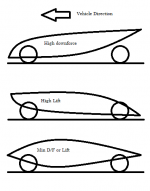
Nice illustrations
...& "reaction" labels

I agree, the frontal shape, of the top image should/would produce the most downforce
...which generally "as a rule" is not something we want to add just "willy nilly" to a race car
...but, that reaction (down force) can be a useful tool, "if" that effect would be helpful, anywhere on the racer
A couple of things to think about with the frontal shapes of the middle & bottom images is that
...from what we learned, a shape like that could add (or create) lift
Which in a road traveling vehicle would seem like a good idea (I thought so)

...like using the oncoming air to "lift" the vehicle a little bit, seems like it would make it lighter (less weight=less rolling resistance)
...but, "if" ya think about it, it's probably NOT a "good idea" for a race car, out in the real world

Because, let's say, the shape of the front of a racer produces what seems like a "good' or "acceptable" amount of lift
...but then, let's say the racer "hits a bump" in the road
...& the front of the racer "reacts" by bouncing upward
&
NOW, the lifting potential, of the shape of the front of the racer, could be/has been increased to a "not good" or unsafe amount of lifting action
...potentially causing the front (steering & braking) wheels, of the racer to "lift" off of the ground (potentially losing control)
...or even worser if there is enough "lift" produced, it could potentially "flip" the racer, over backwards

* I think I remember hearing about a race car at Lemans that "flipped" over backwards because of a situation like this

Denny
Canned Monster
I’m not trying to bully or butt heads with you either. And I didn’t think you were either. You’re just trying to wrap your head around all of it. But to truly understand you have to do some real world testing. AKA wind tunnel or yarn tufts. It’s like learning bodywork you have to learn by doing. Reading books will only let you know what you have to do. Not how to do it.
Here I’ll give you a problem to figure out as an example.
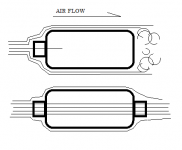
You have 2 Pepsi bottles one the small opening end is facing into the wind the big end is facing away.
Now imagine the other bottle has 2 small ends and is the same diameter in the middle as the other on the big end. One of the small ends is facing into the wind same as the other.
Which one will cut through the air with the least drag and why?
Here I’ll give you a problem to figure out as an example.
You have 2 Pepsi bottles one the small opening end is facing into the wind the big end is facing away.
Now imagine the other bottle has 2 small ends and is the same diameter in the middle as the other on the big end. One of the small ends is facing into the wind same as the other.
Which one will cut through the air with the least drag and why?
Functional Artist
Well-known member
Hey Denny,
He...he...when was the last time ya asked a question about a double ended Pepsi bottle?
From what we have been learning, it seems like the double ended bottle, should "cut through the air with the least drag" because
1.) having a "small end" at the rear, helps to bring the wind back together...smoother...easier...better
...which disturbs the flow less, causing less turbulence
&
2.) When the air is brought back together, behind the bottle, smoother...easier...better
...any "wake" produced, behind the bottle, should be smaller (smaller wake = less drag)
He...he...when was the last time ya asked a question about a double ended Pepsi bottle?
From what we have been learning, it seems like the double ended bottle, should "cut through the air with the least drag" because
1.) having a "small end" at the rear, helps to bring the wind back together...smoother...easier...better
...which disturbs the flow less, causing less turbulence
&
2.) When the air is brought back together, behind the bottle, smoother...easier...better
...any "wake" produced, behind the bottle, should be smaller (smaller wake = less drag)
Denny
Canned Monster
No, you’re wrong. You would think that to be true but you’re forgetting about the total surface area of the neck of that bottle. The large flat surface of the rear of the bottle and the abrupt end will actually disturb a smaller mass of air. You also have a smaller area for the air to pull on so less drag also.
Don’t feel bad, I got the same question wrong by the same exact thought process as you did when asked by an engineer.
I even got to see a film of it action in a wind tunnel. Your theory also of why lift in the front of a car is also kind of wrong too. The reason downforce is built into cars is to help keep the tires in firm contact with the road thereby helping the car to turn or so they may help propel the vehicle forward. See, it’s a constant battle of compromises. Do you want to get good fuel economy or do you want to move and steer? So many variables.
Don’t feel bad, I got the same question wrong by the same exact thought process as you did when asked by an engineer.
I even got to see a film of it action in a wind tunnel. Your theory also of why lift in the front of a car is also kind of wrong too. The reason downforce is built into cars is to help keep the tires in firm contact with the road thereby helping the car to turn or so they may help propel the vehicle forward. See, it’s a constant battle of compromises. Do you want to get good fuel economy or do you want to move and steer? So many variables.
ezcome-ezgo
G'me sumthin to write on
One is a weak "parachute" the other lets the air flow through it?
This is fun.
This is fun.
Denny
Canned Monster
The openings are closed solid. Pretend there is no opening.One is a weak "parachute" the other lets the air flow through it?
View attachment 151231
This is fun.
I wish I knew how to draw pretty pictures like that so I could illustrate it better. But I’m only on a My Fone.
This is one of the examples where hydrodynamics and aerodynamics don’t agree. Hence the move away from water flow benches to wind tunnels. Even the Wright brothers had to invent a wind tunnel first to invent the airplane. And wind tunnels have been an integral part of aviation design ever since.
Wind tunnels have been used in automotive design since the mid 30s I believe by GM and Chrysler and ford much later because Henry said no!
Functional Artist
Well-known member
Hey Denny,No, you’re wrong. You would think that to be true but you’re forgetting about the total surface area of the neck of that bottle. The large flat surface of the rear of the bottle and the abrupt end will actually disturb a smaller mass of air. You also have a smaller area for the air to pull on so less drag also.
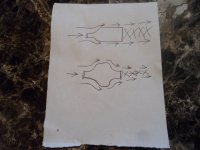
It seems like "we" (you, me & even EZ) were picturing different Pepsi bottles
I was thinkin' something like #4 (a double ended Pepsi bottle)
...it seems like you were thinkin' about something like #2 (2 Pepsi bottles put end to end)
...& EZ was thinkin' about a "flow thru" bottle

In this scenario: (the one I had in mind)
It seems like the double ended bottle, should "cut through the air with the least drag" because
1.) having a "small end" at the rear, helps to bring the wind back together...smoother...easier...better
...which disturbs the flow less, causing less turbulence
&
2.) When the air is brought back together, behind the bottle, smoother...easier...better
...any "wake" produced, behind the bottle, should be smaller (smaller wake = less drag)
The main point I was trying to "convey" with the "boat" examples was that there is an action/reaction (impact/resistance) going on, by the "fluid" impacting, with the front of the object
...& that the shape, of the front of the object has a HUGE role in affecting "how" the object behaves or reacts to those oncoming "forces"
&
That there is a whole other action/reaction (grip/friction) going on, by the fluid "rubbing against" the surface, of the object, as it "slides thru/past"
&
Also, how the shape of the rear "tail" affects what happens to the air, behind the object, as it "leaves" the surface of that object
Denny
Canned Monster
But in real life that is not how air behaves at the tail. It does not flow like that. It is much more turbulent and violent.
Even using yarn tufts like I suggested will skew the results some. That is why smoke is used instead. Now if you want to factor in rain and you will get a slightly different result again.
Oh, I was thinking double ended bottle just like you.
Even using yarn tufts like I suggested will skew the results some. That is why smoke is used instead. Now if you want to factor in rain and you will get a slightly different result again.
Oh, I was thinking double ended bottle just like you.

Whitetrashrocker
Inmate #952016
Read up on a bulbous bows on ships.
Just throwing it in the mix.
Just throwing it in the mix.
Denny
Canned Monster
Are you trying to blow his little mind!? Granted we need to get him to a confused state so he can think like the air.Read up on a bulbous bows on ships.
Just throwing it in the mix.
Functional Artist
Well-known member
Hey guys,
A while back T left this reply: "Emperical engineering at its finest!"
...but, I never heard of it so I Googled it
Empirical The term empirical was originally used to refer to certain ancient Greek practitioners of medicine who rejected adherence to the dogmatic doctrines of the day, preferring instead to rely on the observation of phenomena as perceived in experience. Later empiricism referred to a theory of knowledge in philosophy which adheres to the principle that knowledge arises from experience and evidence gathered specifically using the senses. In scientific use, the term empirical refers to the gathering of data using only evidence that is observable by the senses or in some cases using calibrated scientific instruments. What early philosophers described as empiricist and empirical research have in common is the dependence on observable data to formulate and test theories and come to conclusions.
Empirical research is research using empirical evidence. It is also a way of gaining knowledge by means of direct and indirect observation or experience. Empiricism values some research more than other kinds. Empirical evidence (the record of one's direct observations or experiences) can be analyzed quantitatively or qualitatively. Quantifying the evidence or making sense of it in qualitative form, a researcher can answer empirical questions, which should be clearly defined and answerable with the evidence collected (usually called data). Research design varies by field and by the question being investigated. Many researchers combine qualitative and quantitative forms of analysis to better answer questions that cannot be studied in laboratory settings, particularly in the social sciences and in education.
In some fields, quantitative research may begin with a research question (e.g., "Does listening to vocal music during the learning of a word list have an effect on later memory for these words?") which is tested through experimentation. Usually, the researcher has a certain theory regarding the topic under investigation. Based on this theory, statements or hypotheses will be proposed (e.g., "Listening to vocal music has a negative effect on learning a word list."). From these hypotheses, predictions about specific events are derived (e.g., "People who study a word list while listening to vocal music will remember fewer words on a later memory test than people who study a word list in silence."). These predictions can then be tested with a suitable experiment. Depending on the outcomes of the experiment, the theory on which the hypotheses and predictions were based will be supported or not,[1] or may need to be modified and then subjected to further testing.
https://en.wikipedia.org/wiki/Empirical_research
Empirical Has Roots in Latin and Greek
When empirical first appeared as an adjective in English, it meant simply “in the manner of an empiric.” In the ancient world, empirics were members of a sect of doctors who practiced medicine using treatments observed to be clinically effective, rather than treatments based on theoretical principles. This sounds all fine and good to a modern reader, but empirics were in direct opposition to Galen, the 2nd century Greek physician whose theories and practices (including the theory of bodily humors) dominated medicine in Europe from the Middle Ages until the mid-17th century. As the underdogs in this rivalry, empirics took some reputational hits, evidenced by the use of empiric to refer to someone who disregards or deviates from the rules of science or accepted practice; to be called an empiric was sometimes like being called a quack or charlatan. Empirical can still be used critically to describe ideas and practices that rely on experience or observation alone and without due regard for system or theory. But, perhaps in a bit of a case of “the Empirics strike back,” empirical more often keeps its narrower sense, and is used positively to describe evidence and information grounded in observation and experience, or capable of being verified or disproved by observation or experiment.
https://www.merriam-webster.com/dictionary/empirical
This may help explain a lot of out "head butting"
...or maybe not...who knows
A while back T left this reply: "Emperical engineering at its finest!"
...but, I never heard of it so I Googled it
Empirical The term empirical was originally used to refer to certain ancient Greek practitioners of medicine who rejected adherence to the dogmatic doctrines of the day, preferring instead to rely on the observation of phenomena as perceived in experience. Later empiricism referred to a theory of knowledge in philosophy which adheres to the principle that knowledge arises from experience and evidence gathered specifically using the senses. In scientific use, the term empirical refers to the gathering of data using only evidence that is observable by the senses or in some cases using calibrated scientific instruments. What early philosophers described as empiricist and empirical research have in common is the dependence on observable data to formulate and test theories and come to conclusions.
Empirical research is research using empirical evidence. It is also a way of gaining knowledge by means of direct and indirect observation or experience. Empiricism values some research more than other kinds. Empirical evidence (the record of one's direct observations or experiences) can be analyzed quantitatively or qualitatively. Quantifying the evidence or making sense of it in qualitative form, a researcher can answer empirical questions, which should be clearly defined and answerable with the evidence collected (usually called data). Research design varies by field and by the question being investigated. Many researchers combine qualitative and quantitative forms of analysis to better answer questions that cannot be studied in laboratory settings, particularly in the social sciences and in education.
In some fields, quantitative research may begin with a research question (e.g., "Does listening to vocal music during the learning of a word list have an effect on later memory for these words?") which is tested through experimentation. Usually, the researcher has a certain theory regarding the topic under investigation. Based on this theory, statements or hypotheses will be proposed (e.g., "Listening to vocal music has a negative effect on learning a word list."). From these hypotheses, predictions about specific events are derived (e.g., "People who study a word list while listening to vocal music will remember fewer words on a later memory test than people who study a word list in silence."). These predictions can then be tested with a suitable experiment. Depending on the outcomes of the experiment, the theory on which the hypotheses and predictions were based will be supported or not,[1] or may need to be modified and then subjected to further testing.
https://en.wikipedia.org/wiki/Empirical_research
Empirical Has Roots in Latin and Greek
When empirical first appeared as an adjective in English, it meant simply “in the manner of an empiric.” In the ancient world, empirics were members of a sect of doctors who practiced medicine using treatments observed to be clinically effective, rather than treatments based on theoretical principles. This sounds all fine and good to a modern reader, but empirics were in direct opposition to Galen, the 2nd century Greek physician whose theories and practices (including the theory of bodily humors) dominated medicine in Europe from the Middle Ages until the mid-17th century. As the underdogs in this rivalry, empirics took some reputational hits, evidenced by the use of empiric to refer to someone who disregards or deviates from the rules of science or accepted practice; to be called an empiric was sometimes like being called a quack or charlatan. Empirical can still be used critically to describe ideas and practices that rely on experience or observation alone and without due regard for system or theory. But, perhaps in a bit of a case of “the Empirics strike back,” empirical more often keeps its narrower sense, and is used positively to describe evidence and information grounded in observation and experience, or capable of being verified or disproved by observation or experiment.
https://www.merriam-webster.com/dictionary/empirical
This may help explain a lot of out "head butting"
...or maybe not...who knows
Whitetrashrocker
Inmate #952016
OK we have a new GAB.
The winner if GAFA!
I need a dictionary to follow this thread.
The winner if GAFA!
I need a dictionary to follow this thread.
ezcome-ezgo
G'me sumthin to write on
So Denny, you're saying a "boat tail" is impractical?
Denny
Canned Monster
What I’m saying is it depends. Speed, air density, direction, temperature and humidity can all factor into how air behaves. That should all be taken into consideration when designing. Like I said earlier it’s all one big compromise. Some tail pieces are better than others for different speeds or needs. Just like women.
Functional Artist
Well-known member
I was lookin' for something else...but, found this video that talks about, the front of cars "lifting" from the oncoming air
...& thought...yea!...this is what I was talking about
...so, enjoy
Please keep/hold all questions & comments until after the video...Denny 
...& thought...yea!...this is what I was talking about
...so, enjoy
Functional Artist
Well-known member
Same topic
...same car
...same info (plus some)
...presented a bit differently
...same car
...same info (plus some)
...presented a bit differently

Master Hack
Well-known member
As far aerodynamics and wheeled vehicles goes, one needs to look no farther than Bonniville for inspiration.