Nice!! One question though. P/N 8; it appears to use P/N 3 as the inner race, and P/N 9 as the outer race. Am I reading the diagram correctly? And I take it #3 are at least case hardened to be suitable inner and outer races? I know that it can be done; I've worked on enough different style machine tool clutches to know that it works just fine if all the metallurgy is correct.
Also, are you using a shielded type fit to protect the bearing from contamination? While in motion, it doesn't spin; when not in motion, it's going to spin all the time. And with the friction facing zone on one side, and the outer world on the other, running wide open could be a problem. A shielded class seal (like a shielded bearing) would give it durability into the "8's"; considering the market you are looking at, I don't know if you could actually get to the perfect "10".
For those of you who don't catch the scale I just referred to, a "shielded" bearing (for reference) can tolerate up to a slight to moderate amount of contamination. A "sealed" bearing is rated for moderate/ moderately severe contamination zones/applications. Anything higher, the price for the seals start to approach/exceed the cost of the bearing itself.
A shielded bearing will tolerate airborne contaminates that are not under pressure. A sealed bearing (garden/kart variety) is usually rated up to 1 Bar (approx. 15~16 PSI) of pressure applied at the seal joint to race. This is why uncontrolled compressed air is bad, and if you take a power washer to bearing; you are most likely going to get what you deserve.


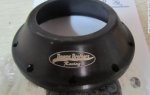
Both the clutch driver (#3) and the sprocket piece (#9) are hardened 4340 chromoly. For the surface treatment, we opted for a nitrided case to provide the high hardness and abrasion resistance necessary to interface with the needle bearing.
In our clutch, the needle bearing is a "shielded" bearing and provides protection from contamination in moderate environments. Given the larger diameter of a sealed bearing, we would have needed to increase the tooth count to >15 in order to have this type of bearing fit. Our bearing is shielded from the environment by a labyrinth seal which makes it difficult for outside contaminates to reach the bearing since it is unlikely for these particles to travel along the labyrinth to the inside, especially when rotating. That being said, we do not recommend that this clutch be used in aggressive environments, and we recommend that the clutch be taken apart, cleaned, and re-greased periodically if users are in more harsh environments.