carter bros. 2506-3016

Status
Not open for further replies.

crazykart

Crazy member
Messages
1,167
Reaction score
7
Location
Swartz Creek, Michigan
Sounds more like youre having a hard time breaking the bead, rather than the rubber tire is rusted to the rim.

Get you a flat headed pry bar, stick it in where the tire meets the rim, and start wiggling it. Work all the way around the rim like that, or until the bead seperates from the rim.

The bead is a pretty hard thing to get seperated.

You can also drive over it like PB(&j) suggested, but make sure you line up right lol.
 

itsid

Moderator
Staff member
Messages
11,563
Reaction score
245
Location
Ruhrpott [Germany]
split rims...
hmm
unscrew the two halves, inflate the tyre until you hear a slight crackling sound (the halves should split),
deflate and step on the tyre around the edges.
repeat until tyre can be removed.

'sid
 

itsid

Moderator
Staff member
Messages
11,563
Reaction score
245
Location
Ruhrpott [Germany]
Sorry.. I assumed that
a) the tyres (tubes) are already deflated (otherwise it'll be nearly impossible to unscrew all bolts)
b) inflating will be done with care
;)

But you're right.. better point out the obvious than have someone hurt in the process.

'sid
 

emsman1

New member
Messages
18
Reaction score
0
Location
Rhode Island, USA
Thanks for all the ideas. I can peal back the tire from the outer part of the rim, but it's rusted where the bead sits on the rim. I was hoping for something other than force as I want to try and save the front tires.

I will try again tonight and post pictures of what it looks like.
 

kevin.st56

Member
Messages
60
Reaction score
0
Location
Abbeville Louisiana
do like I did with my car rims.
get a scissor jack, position it between the tire and something very heavy (I live in a trailer, and it still had its hitch still attached) and start expanding the jack, pressing on the tire, and eventually breaking the bead.

this is good if your not trying to save the tires tho
 

emsman1

New member
Messages
18
Reaction score
0
Location
Rhode Island, USA
So using the scissor jack and c-clamp method, I was able to pry the rears apart. Using a tire spoon helped too. The fronts were another story. I've been at this for a couple days and I gave up :surrender: after much swearing and sweating and cut the front tires off. Guess I'm going to tractor supply to get new ones!
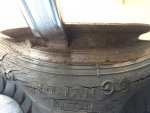
Here are the pics of what I was working with for rust.
 

Attachments

  • 20150825_213805558_iOS.jpg
    20150825_213805558_iOS.jpg
    331.3 KB · Views: 10
  • 20150825_214557561_iOS.jpg
    20150825_214557561_iOS.jpg
    378.3 KB · Views: 7

Denny

Canned Monster
Messages
11,810
Reaction score
8,270
Location
Mayberry, Indiana
I would buy new rims if I were you. you will never get them smooth enough to keep from chafing the tubes. Just me :horse:

Denny
:feedtroll:
 

emsman1

New member
Messages
18
Reaction score
0
Location
Rhode Island, USA
Update:

The kart is almost fully restored (repainted, new tires, etc.). I changed out the old lights for a set of LEDs and I've noticed that now at idle they flicker like a strobe light. Running at at speed though they are fine.

There is no battery in this setup, it comes straight off the motor (Tecumseh OHH60-71157D) using the 3 amp 12v DC output. Has anyone had this issue before and what did you do to resolve it?
 

Karttekk

Well-known member
Messages
2,021
Reaction score
726
Location
Elizabeth, PA
As far as changing tires, something like this may help. Depends on how much tire work anyone does. Nice tool to have around and safer than generic methods of tire replacement.

Thanks
 

Lefturns75

New member
Messages
68
Reaction score
1
Location
Podunkville USA in the ozarks
emsman1, the stator under the flywheel will not produce much if any current at idle, it will only produce enough current at throttle. Thats why your lights flicker or are very dim when the engine idles. That is why the user manuals for your lawn tractor with electric start tells you not to idle for long periods or the battery will not charge. At least, thats a problem you won't have to worry about with no battery.
 

Poboy kartman

Senior Moments Member
Messages
12,461
Reaction score
69
Location
White Settlement Texas
emsman1, the stator under the flywheel will not produce much if any current at idle, it will only produce enough current at throttle. Thats why your lights flicker or are very dim when the engine idles. That is why the user manuals for your lawn tractor with electric start tells you not to idle for long periods or the battery will not charge. At least, thats a problem you won't have to worry about with no battery.

Sooooo....add a small battery for when it idles....
 

emsman1

New member
Messages
18
Reaction score
0
Location
Rhode Island, USA
A battery is better than a voltage regulator then? I've seen 12v DC 3amp regulators that I could wire in as an option?

If I go the battery route, do I just wire it in direct to the alternator output? So + from motor output goes to + on battery and then + from battery to + on lights. - from battery and - from lights gets grounded to motor/frame?
 

Poboy kartman

Senior Moments Member
Messages
12,461
Reaction score
69
Location
White Settlement Texas
A battery is better than a voltage regulator then? I've seen 12v DC 3amp regulators that I could wire in as an option?

If I go the battery route, do I just wire it in direct to the alternator output? So + from motor output goes to + on battery and then + from battery to + on lights. - from battery and - from lights gets grounded to motor/frame?

I'm no electrical expert....but what a voltage regulator does is basically limit the amount of available voltage....(actually....control ...) but it doesn't generate any ....so it manages whats available.....at idle....the lights are demanding slightly more than the engine can provide....so...a very small battery is only going to lose charge on those breif periods when the lights normally dim at idle....and I really don't think it'll overcharge much otherwise....but a voltage regulator might be helpful then....but it really takes a lot to overcharge a battery where it does damage in short order.
 

afremont

New member
Messages
148
Reaction score
1
Location
houston
You could try installing a capacitor. It will smooth out the pulses and if the average voltage is enough to turn on the LEDs, they will glow at idle. If it's not high enough, then they will likely just stay off. At any rate, it should smooth out the pulses.

Find out what kind of voltages you are getting when the engine is running at speed and then find a capacitor of at least twice that voltage rating. Get one that is several thousand microfarads and just install it like you would a battery. It's worth a shot and no maintenance will be required.

Something like this should work.
http://www.newark.com/multicomp/mca...cgCFQ6CaQod4MoD0A&CAWELAID=120185550001283922
 

emsman1

New member
Messages
18
Reaction score
0
Location
Rhode Island, USA
The capacitor sounds like an interesting way to go. Here is what the manual says:

2500 R.P.M. - 8.0 Volts D.C.
3000 R.P.M. - 11.0 Volts D.C
3600 R.P.M. - 13.0 Volts D.C.

If I go with a 12v battery, do I need to worry about overcharging it? Looking to use a small 12v scooter type battery.

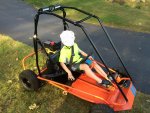
Here is a picture of the rebuilt cart.
 

Attachments

  • 20150925_212352421_iOS.jpg
    20150925_212352421_iOS.jpg
    452.8 KB · Views: 7

afremont

New member
Messages
148
Reaction score
1
Location
houston
Do you know how much current those LED lights draw? You may need to use much more capacitance to get good results. At some point, the battery is likely a better way to go, especially if you want lights when the engine isn't running.

13V is on the low end of typical battery charger output and might not charge the battery fully, but it should work and it won't be enough to cause damage to the battery over long periods of exposure. Generally chargers can supply up to 14 or so volts. Theoretically, 13.8 is the ideal voltage for a 12V lead-acid battery.
 
Status
Not open for further replies.
Top