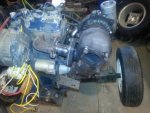
Blow-Through carbs-- how do they work? benefits?

Status
Not open for further replies.

JToTheIzzack

New member
Messages
12
Reaction score
0
Hey guys, sorry if this thread already exists, I couldn't find one on here. If there is one, some direction to it would be appreciated. Anyway, I am considering doing cheap supercharger project on my kart, using most likely an old smog pump. I don't have one yet, I'm still in the early stages of the project. I'm not looking for any huge performance gains here, it's mostly just a project for fun and cool factor, and I am most worried about fuel delivery, as this will be really low boost so I don't blow anything up. The simplest and best way I can see is putting the carb upstream of the blower, and having the fuel/air mixture sucked through, but I often see blow-through carb setups on turbo small engines on the interwebs, and I'm just wondering how they work and what the benefits are. Thanks guys!
 

OzFab

Well-known member
Messages
15,615
Reaction score
67
Location
Warwick Qld, Australia
Ok, let's talk about large scale superchargers first; of these, there are 2 basic types

Roots


& centrifugal


The commonalities between the two:
1. they both produce more horsepower (more on that in a sec)
2. they both use the power of the host engine to run

Technically, a supercharger doesn't produce horsepower, it uses horsepower, all it does is force feed more air/fuel into the engine which, in turn, produced the extra hp (I won't get into the technicalities)...

Roots style blowers have been around for eons & have their origins on large diesel engines & are sometimes referred to as GM blowers (guess why).

They work by sucking more air & force feeding it into the engine; this works great on diesel engines because the fuel is injected directly into the combustion chamber, after the blower, & doesn't require any extra fuel due to the nature of diesel fuel...

It's not as clean a system on a gasoline engine; it still works well but, due to the fuel being churned by the blower itself, some of the fuel is lost in transit & doesn't always deliver even amounts to each cylinder, meaning some cylinders will burn hotter than others... which can become dangerous... Obviously, on an EFI system, those conditions don't apply...

A decade or two ago, some genius discovered that, if you take half of a turbocharger & redesign it to run off a belt, it would make a great supercharger, more effective for gas engines than a roots style because it boosts the same as a turbo, before the carb/throttle body...

Used on a carb system, it pushes more air through the carb &, in turn, also pushes more fuel. On a fuel injection system, they're mounted before the MAF (Mass Air Flow) sensor, the computer recognises that there's more air & automatically adjusts to deliver more fuel...

Then there's turbochargers, which run off the engines exhaust; in simple terms, the exhaust gases turn a turbine, which is connected to a similar turbine, connected via a shaft; the second turbine then forces air into the engine...

Now, on a small scale, if you're thinking about those electric booster kits you've seen on ebay, don't! It's an expensive fan! A smog pump may work IF it can produce sufficient outlet pressure...

For a booster to work efficiently, it, first must produce enough boost to make a difference; second, it must run at the same speed as the engine; a fan running at a constant RPM can't do the job; even if it has enough pressure to make a difference, it will only work at low RPM; once the engine RPM rises, the engine requires more air/fuel which the fan cannot provide, therefore, creating a top end lag...

Hope this helps...
 

Doc Sprocket

*********
Messages
15,677
Reaction score
142
Location
Ontario, Canada
Interesting this comes up. I'm right in the process of adapting a Garrett T3 turbocharger sourced from a diesel 1.6L I4 VW Jetta engine onto my little Z400 I2 Kubota diesel engine.
 

Attachments

  • turbota.jpg
    turbota.jpg
    172.4 KB · Views: 19

firemanjim

Just kartin' around....
Messages
5,247
Reaction score
83
Location
Houston Texas
Interesting this comes up. I'm right in the process of adapting a Garrett T3 turbocharger sourced from a diesel 1.6L I4 VW Jetta engine onto my little Z400 I2 Kubota diesel engine.

:mad:
Good God, man! Put this in "other builds"...... Curious minds what to know..... :lolgoku:
 

Doc Sprocket

*********
Messages
15,677
Reaction score
142
Location
Ontario, Canada
I should, I should. I got a killer project in the works. 4wd side-by-side (2 seat) utility tractor... thingy. Turbodiesel Kubota (also fitted with Delco 10si alternator), 3 speed manual with aux tranny (for 6 fwd gears and 2 rev), and a whole ridiculous host of goodies in the works. Like a JD Gator or something, but homebuilt.
 

Desertduler

Active member
Messages
1,736
Reaction score
10
Interesting this comes up. I'm right in the process of adapting a Garrett T3 turbocharger sourced from a diesel 1.6L I4 VW Jetta engine onto my little Z400 I2 Kubota diesel engine.
Remember when you add a turbocharger to a engine you need to also add more fuel or the air fuel ratio will be too lean. Look at a turbocharged diesel engine and you will see a signal line from the boost side of the turbo going to an enrichment valve on the fuel injection pump. This valve is called an aneroid valve and its function is to add the correct fuel delivery to the engine in relation to the boost that is being created by the turbocharger.
Natural aspirated fuel injection pumps do not have this enrichment feature with a aneroid valve. Maybe you have this figured out already and or another way to add more fuel according to the boost.
 

Desertduler

Active member
Messages
1,736
Reaction score
10
I should have read closer you stated that this engine was turbocharged already, my bad!
 

Doc Sprocket

*********
Messages
15,677
Reaction score
142
Location
Ontario, Canada
I should have read closer you stated that this engine was turbocharged already, my bad!

No, misunderstanding. Maybe worded poorly on my part. This Kubota WAS N/A. I am adding a turbo from a TD Jetta.

The vac line you mention is news to me, I was not aware of it. I'll have to research it. I saw nothing on the VW donor engine (factory TD) nor does there seem to be a provision for it on this turbo. The only lines it has are for the diaphragm-driven waste gate. Two lines from the diaphragm. One to atmospheric pressure, one to the compressor housing.

This is really making me think. I was all over that Jetta- The owner had an overheat and cracked the head. He acquired a complete donor engine and I guided him through the parts exchange. As I knew I was going to end up with the spare turbo, I chased all the plumbing so Id be able to replicate it.

Admittedly, I have nearly no idea, and am learning as I go.
 

Desertduler

Active member
Messages
1,736
Reaction score
10
No, misunderstanding. Maybe worded poorly on my part. This Kubota WAS N/A. I am adding a turbo from a TD Jetta.

The vac line you mention is news to me, I was not aware of it. I'll have to research it. I saw nothing on the VW donor engine (factory TD) nor does there seem to be a provision for it on this turbo. The only lines it has are for the diaphragm-driven waste gate. Two lines from the diaphragm. One to atmospheric pressure, one to the compressor housing.

This is really making me think. I was all over that Jetta- The owner had an overheat and cracked the head. He acquired a complete donor engine and I guided him through the parts exchange. As I knew I was going to end up with the spare turbo, I chased all the plumbing so Id be able to replicate it.

Admittedly, I have nearly no idea, and am learning as I go.
Ok then let me put it this way,If you are at sea level on the average if you take a column of air one square inch from there to the ionosphere that column will weigh 14.7 lbs. The ideal air fuel ratio is on the average 14.7 lbs or 1 bar to one part of fuel for gasoline and a leaner ratio for diesel.Now imagine adding another atmosphere on top of what is already at your altitude then add the boost and you would have to double the fuel by twice the amount in order to maintain the correct air fuel ratio.I have a 2009 Jetta tdi diesel and the air fuel ratio is corrected by the computer,you would indeed need a way of inriching the fuel compared to the boost that is being made by the turbo.
 

Desertduler

Active member
Messages
1,736
Reaction score
10
The more air or atmosphere that a engine takes in the more fuel it will need to maintain the correct air fuel ratio this rule applies with correcting the air fuel ratio with carburetor jetting also. Very important.
 

Desertduler

Active member
Messages
1,736
Reaction score
10
So as far as jetting goes remember high altitude and high temperature and high humidity requires leaner jetting because there is less atmosphere for the engine to take on and just the opposite with low altitude and low temperature and low humidity requires a richer setting.
 

Desertduler

Active member
Messages
1,736
Reaction score
10
Also most turbocharged diesel engines have camshaft lobe centers ground at 112 degrees to let the exhaust out earlier to spool the turbo up quicker and have piston cooler nozzles that spray oil from the main oil galleries to the underside of the pistons to aid in cooling them.
 

Doc Sprocket

*********
Messages
15,677
Reaction score
142
Location
Ontario, Canada
Very interesting tidbit about the exhaust cam lobe. The academic stuff about atmospheric pressure and stoich ratios, I did know. You have given me more to consider, though. I love researching and learning, thanks!

BTW- I explained that very same 1" column of air to someone the other day... they looked at me funny... :D

The diesel and turbo stuff is new to me. Jetting a 4-stroke gasoline engine, I do in my sleep. I have pin vises and jeweller's bits, and do it fairly frequently, including soldering and drilling smaller when needed.
 

Desertduler

Active member
Messages
1,736
Reaction score
10
Very interesting tidbit about the exhaust cam lobe. The academic stuff about atmospheric pressure and stoich ratios, I did know. You have given me more to consider, though. I love researching and learning, thanks!

BTW- I explained that very same 1" column of air to someone the other day... they looked at me funny... :D
Yeah I have had the same response many times before also.You will get it figured out you are smart!
 

Desertduler

Active member
Messages
1,736
Reaction score
10
Very interesting tidbit about the exhaust cam lobe. The academic stuff about atmospheric pressure and stoich ratios, I did know. You have given me more to consider, though. I love researching and learning, thanks!

BTW- I explained that very same 1" column of air to someone the other day... they looked at me funny... :D

The diesel and turbo stuff is new to me. Jetting a 4-stroke gasoline engine, I do in my sleep. I have pin vises and jeweller's bits, and do it fairly frequently, including soldering and drilling smaller when needed.
You know what you are doing.You understand. :thumbsup:
 

Desertduler

Active member
Messages
1,736
Reaction score
10
Funny thing I have a spark plug in my tool box at work that I will have to post a picture of it that I have had for almost 40 years that if I remember right was called a Accutune plug that has a pyrex window surrounding the insulator of the plug that allowed you to look into the combustion chamber as the engine ran and you can see the color of the combustion taking place throughout all of the range of the fuel delivery.Blue was just right and of course yellow,red and orange was rich and white or light blue was lean.I used it along with an exhaust analyzer on gasoline engines on a engine and chassis dyno.Times have changed for sure but it worked pretty good!
 

JToTheIzzack

New member
Messages
12
Reaction score
0
Glad I could make a good discussion happen here, but I already know how superchargers work, and what they do. I know how to buy a bolt-on kit and make it work on a full sized motor, that's not the issue at hand. I am trying to get info on blow-through carbs for small engines, fabrication info, and what benefits they bring. As far as I can tell, putting the carb before the pump is the best way to do it, and draw the air through as on a full size roots blower. Since many smog pumps are just mini roots blowers, adapting a carb north of it and running a belt drive seems to be the way to go. I am wondering why one would go to the trouble of making a blow through system, and how to do so.
 

Doc Sprocket

*********
Messages
15,677
Reaction score
142
Location
Ontario, Canada
Funny thing I have a spark plug in my tool box at work that I will have to post a picture of it that I have had for almost 40 years that if I remember right was called a Accutune plug that has a pyrex window surrounding the insulator of the plug that allowed you to look into the combustion chamber as the engine ran and you can see the color of the combustion taking place throughout all of the range of the fuel delivery.Blue was just right and of course yellow,red and orange was rich and white or light blue was lean.I used it along with an exhaust analyzer on gasoline engines on a engine and chassis dyno.Times have changed for sure but it worked pretty good!

You actually HAVE one of those? Wow! They are LEGENDARY! I've never seen one in use, but have seen references to them and pics on the internet. Amazing. Frame that thing! ;)
 
Status
Not open for further replies.
Top