Ok, let's talk about large scale superchargers first; of these, there are 2 basic types
Roots
& centrifugal
The commonalities between the two:
1. they both produce more horsepower (more on that in a sec)
2. they both use the power of the host engine to run
Technically, a supercharger doesn't produce horsepower, it
uses horsepower, all it does is force feed more air/fuel into the engine which, in turn, produced the extra hp (I won't get into the technicalities)...
Roots style blowers have been around for eons & have their origins on large diesel engines & are sometimes referred to as GM blowers (guess why).
They work by sucking more air & force feeding it into the engine; this works great on diesel engines because the fuel is injected directly into the combustion chamber,
after the blower, & doesn't require any extra fuel due to the nature of diesel fuel...
It's not as clean a system on a gasoline engine; it still works well but, due to the fuel being churned by the blower itself, some of the fuel is lost in transit & doesn't always deliver even amounts to each cylinder, meaning some cylinders will burn hotter than others... which can become dangerous... Obviously, on an EFI system, those conditions don't apply...
A decade or two ago, some genius discovered that, if you take
half of a turbocharger & redesign it to run off a belt, it would make a great supercharger, more effective for gas engines than a roots style because it boosts the same as a turbo,
before the carb/throttle body...
Used on a carb system, it pushes more air through the carb &, in turn, also pushes more fuel. On a fuel injection system, they're mounted
before the MAF (Mass Air Flow) sensor, the computer recognises that there's more air & automatically adjusts to deliver more fuel...
Then there's turbochargers, which run off the engines exhaust; in simple terms, the exhaust gases turn a turbine, which is connected to a similar turbine, connected via a shaft; the second turbine then forces air into the engine...
Now, on a small scale, if you're thinking about those electric booster kits you've seen on ebay,
don't! It's an expensive fan! A smog pump
may work
IF it can produce sufficient outlet pressure...
For a booster to work efficiently, it,
first must produce enough boost to make a difference; second, it must run at the same speed as the engine; a fan running at a constant RPM
can't do the job; even if it has enough pressure to make a difference, it will only work at low RPM; once the engine RPM rises, the engine requires more air/fuel which the fan cannot provide, therefore, creating a top end
lag...
Hope this helps...


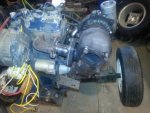


 It's on my phone....