Best welds thread :D

Status
Not open for further replies.

DS13

Annoying the Neighbors!!!
Messages
437
Reaction score
0
Location
Elysburg, PA
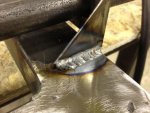
A little walking the cup on stainless. Little underfilled i must point out though :censored:
 

Attachments

  • 1396962370507[1].jpg
    1396962370507[1].jpg
    52.4 KB · Views: 33

andrewmacc

Canadian Wonderboy
Messages
66
Reaction score
1
Location
Surrey BC Canada
I have not heard of turning up heat meaning voltage.

Yes wire feed speed and voltage are separate. Voltage increases or decreases the arc length and therefore width. Turning the "heat up" has little if nothing to do with voltage, if you are welding you don't even set voltage till wire feed speed is set. That 2v difference you are talking about can make a big difference in weld appearance and whether it has wetted out. Amperage is what consumes the wire not voltage.

Unless you have a machine that displays amperage, you are using the hokey little voltage knob to control your "heat" input. Any hobbyist machine will not display amperage. Once you get into the industrial machines and critical welds, sure, but even at our shop we just dialed it in through voltage and a good eye and ear (old machines with the wfs notches all worn off). 30v and a good hiss and you knew you were at spray transfer, and off you went.

Voltage will determine whether you have a flat or ropey weld, low voltage is a shorter arc, and high voltage is a longer arc, blah blah. But without sufficient voltage, you're not going to obtain the sufficient amperage to consume the wire at the rate necessary.

Try to weld 1" plate at 15v and whatever speed you choose. You're not going to create sufficient fusion, because you can't achieve the appropriate amperage. Period. So it would be fair to say that there is a critical relationship between voltage and amperage. Voltage is what gets you into that usable range of wirespeed to achieve the necessary amperage.

I can try to clarify my thoughts if they seem a little wonky to follow.
 

DS13

Annoying the Neighbors!!!
Messages
437
Reaction score
0
Location
Elysburg, PA
Unless you have a machine that displays amperage, you are using the hokey little voltage knob to control your "heat" input. Any hobbyist machine will not display amperage. Once you get into the industrial machines and critical welds, sure, but even at our shop we just dialed it in through voltage and a good eye and ear (old machines with the wfs notches all worn off). 30v and a good hiss and you knew you were at spray transfer, and off you went.

Voltage will determine whether you have a flat or ropey weld, low voltage is a shorter arc, and high voltage is a longer arc, blah blah. But without sufficient voltage, you're not going to obtain the sufficient amperage to consume the wire at the rate necessary.

Try to weld 1" plate at 15v and whatever speed you choose. You're not going to create sufficient fusion, because you can't achieve the appropriate amperage. Period. So it would be fair to say that there is a critical relationship between voltage and amperage. Voltage is what gets you into that usable range of wirespeed to achieve the necessary amperage.

I can try to clarify my thoughts if they seem a little wonky to follow.


I do not have a hobbyist machine so I think what is lost here is which transfer method we are talking about... you are talking about spray and I am talking about Short Circuit. So yeah there is some differences between the two transfer methods. Wertles used SC and the response was to turn up heat, i just have never heard of voltage being used to turn up "heat". So his WFS may be fine for the metal he is using although it looks a little cold, he needs better parameters cause im sure it didnt sound like it should.
 

fowler

New member
Messages
5,463
Reaction score
16
Location
Bullsbrook West Aus
Yea turn up the heat is not
Wire speed

Who knows what technical term u wanna use

But think of it line this

Your welder is set to run perfectly while u weld together your 2mm sheeting

Once your completed that u must weld some 10mm plate

U need more penertration (or heat )to do the new task
U don't just turn up your wire speed u turn up the amps
Then set the wire speed to suit that setting
 

machinist@large

Active member
Messages
2,865
Reaction score
28
Location
West Michigan, 49331
I have not heard of turning up heat meaning voltage.

Yes wire feed speed and voltage are separate. Voltage increases or decreases the arc length and therefore width. Turning the "heat up" has little if nothing to do with voltage, if you are welding you don't even set voltage till wire feed speed is set. That 2v difference you are talking about can make a big difference in weld appearance and whether it has wetted out. Amperage is what consumes the wire not voltage.

In MIG welding, the voltage is how you adjust your arc, and hence your weld bead size, as opposed to Stick/Tig, where your voltage is the constant, and you adjust your your amperage. In your response above, you already have admitted that a "2v difference" can be rather radical; it's because on straight MIG machines, as well as multi mode units, in MIG mode you control your arc size with the voltage setting. You balance your wire speed against that, not the other way around.

I do not have a hobbyist machine so I think what is lost here is which transfer method we are talking about... you are talking about spray and I am talking about Short Circuit. So yeah there is some differences between the two transfer methods. Wertles used SC and the response was to turn up heat, i just have never heard of voltage being used to turn up "heat". So his WFS may be fine for the metal he is using although it looks a little cold, he needs better parameters cause im sure it didnt sound like it should.

Spray transfer or short circuit, if you are using a MIG process machine, you control your heat range using the voltage control. :confused: If this issue is that great, call the tech support line for your machine; if yours is from the two main US MFR's (Lincoln or Miller/Hobart) they most definitely will be able to help you understand the distinctions.....
 

Gary P

New member
Messages
16
Reaction score
0
Location
South Carolina
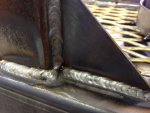
Here are some of my best MIG welds.

Those welds look strange. They have a TIG'ed Aluminium look to them. Did you stop and start a bunch of times? Never seen a MIG weld with a rippled effect like that, looks like a bunch of tack welds overlapping each other.
 

f150skidoo

New member
Messages
3
Reaction score
0
Location
Ontario, Canada
Those welds look strange. They have a TIG'ed Aluminium look to them. Did you stop and start a bunch of times? Never seen a MIG weld with a rippled effect like that, looks like a bunch of tack welds overlapping each other.

Its cursive e pattern on a continuous bead to make MIG look like TIG.
 

redsox985

Active member
Messages
4,092
Reaction score
11
Location
PA
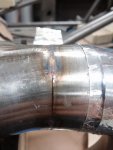
I think this might be one of my best. TIG 304SS with no filler for some custom headers.
 

Attachments

  • 2014-03-11 03.18.06.jpg
    2014-03-11 03.18.06.jpg
    64.6 KB · Views: 19
  • 2014-03-11 03.19.10.jpg
    2014-03-11 03.19.10.jpg
    76.8 KB · Views: 26
Status
Not open for further replies.
Top