I disagree I'm afraid.
There are still many hints left to be found..
And some questions you left unanswered!
IS IT FUEL?
wipe your finger and smell it..
if it's water or oil you MUST change your engine oil!
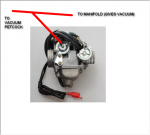
get your OLD carb, and open up the top cap..
A CV carb has a rubber diaphragm as a piston collar. (part 15 in the pdf karttekk linked)
Check if the old one has a ripped diaphragm or not.
if it is, carefully pull the piston comp up (still part 15) and push it down again,
and see if you get any resistance from the piston.
Such things can (if not working properly) act as a vibration fuel pump
It's meant to do the exact opposite (reduce vibration)
but it can can weird quickly if the diaphragm is ripped or punctured.
so instead it might be
pulling fuel up the main jet on the up stroke (partly intended behaviour)
and pushing it out the manifold on the downstroke (should've been evaporated but sometimes just isn't)
and if it does so quicker than anticipated
that'd explain a wet plug and fuel building up in the cylinder.
If you see such, chances are you have an old fuel/oil mix accumulated in your cylinder,
and yes that can lead to white-blue'ish smoke
(fuel can pass the piston rings reduce the viscosity of oil and wash tiny amounts of oil sticking to the cylinder wall below the piston up into the cylinder on the piston's down stroke.
When in doubt: change the engine oil,
at least check its level and smell test it for fuel.
I'd let the engine idle for a few seconds (half a minute or so) at a time allowing it to fully cool down after each run.
just so to be sure about the following question:
Does the amount of smoke reduce, stays the same at or builds up?
And don't forget if you see such wet cylinder chances are you have some sort of smoking liquid now built up in your exhaust as well.
If it gets less and less smoke you should hear the engine running "stronger" and smoother over each run. (happier we call it)
That is another hint.. telling me the problem is now likely gone,and we're removing the accumulated crap from inside the cylinder the hard way.
After say a total run time of ~5 minutes or so [say ten rounds]
you should know it get's better or worse or doesn't change at all.
Now say
did NOT GET BETTER over the individual runs, or not noticable after say five such runs..
Do yourself a favour and remove one variant from this equation,
remove the exhaust from the engine..
it's a terrible loud aggrevating thing to run the engine w/o any exhaust.
BUT it helps you fixing this issue perhaps.
do the remaining runs and see if you still see clouds emerging from the exhaust port.
if you don't see any such smoke.. reinstall the exhaust.. it'll be solely his fault now proceed as below.
if
it GOT BETTER (and only if) start the engine up, and allow it to idle for several minutes until you can be sure it reached operating temperatures looong ago

.
if it's a happy running engine w/o hiccups and/or jerks,
rev it to 30%.. and I'm fairly certain you will see another intense cloud coming out the exhaust
rev it up and down a few times (as high as you feel confident) to flash off as much of whatever built up inside the exhaust chamber.
And in worst case
it got worse or -no matter what- wouldn't reduce at all.
I guess now it's time to see if you are willing to dig deeper.
you could open the cylinder head (remember my first reply?)
to see if there's something wrong with your cylinder piston or other.
And then decide if it's being worth to repair or not.
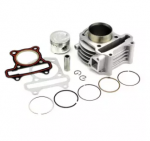
It doesn't make sense to buy a cylinder kit, if all you need is a fresh head gasket and four new bolts, right?
It doesn't make sense to buy a new cylinder kit if your head is fully cracked between the valves.
etc...
take a peek inside and judge what needs replacing..
and if it is cylinder piston or rings, I guess 17bucks justify replacning everything
'sid


 But it was cheap.