Advanced Hemi 212cc Predator Build

Status
Not open for further replies.

bob58o

SuckSqueezeBangBlow
Messages
9,646
Reaction score
1,846
Location
Chicago-town USA
If you're using a TAV backplate and not a driven on a jackshaft, go ahead and cut the studs flush at the nuts after torquing down the side cover.

I figured I'd do this, but wasn't really sure the room I'd have for the nuts.

---------- Post added at 11:45 PM ---------- Previous post was at 10:49 PM ----------

NR Racing Cam Series gives a good picture of how changing intake center line and lsa affect the powerband. They give descriptions like "Small Track" or Ultra Torque or Large Track.

252-0207

252 lift
102 Intake center line
107 lsa

252-0611 (made up maybe)

252 lift
106 Intake Center line
111 lsa

Going from 102 to 106 generally changes from torque to medium track.
Going form 107 to 111 generally widens the powerband.

NR has a lot of options that are well explained.
 

bob58o

SuckSqueezeBangBlow
Messages
9,646
Reaction score
1,846
Location
Chicago-town USA
Before I read chancer's link, there is still more Cam GAB...

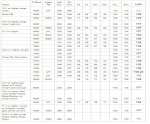
While I was bbq'ing my exhaust (poorly again) I pieced together SOME (not complete yet) small engine cam examples. It is helpful to me to see it all together with all the specs. I didn't include what grind, what lift, or from which supplier. Wanted to see how duration, timing events, lsa,.... affects the powerband.

This is probably better than the previous 5 pages together. At least for me!
 

Attachments

  • Cam vs Power Band.jpg
    Cam vs Power Band.jpg
    313.9 KB · Views: 11

bob58o

SuckSqueezeBangBlow
Messages
9,646
Reaction score
1,846
Location
Chicago-town USA
Since you were talking about Exhaust,
Give this a quick read:
http://www.diygokarts.com/vb/showthread.php?t=31828

Interesting theory on Pipe length, GAB on that.

First part uses speed of sound, which changes with temp.
The pressure waves travel at speed of sound.
Exhaust valve opens, pressure wave is created
The pressure wave travels at the speed of sound towards the end of the exhaust.
When the pressure wave hits the open end, it gets reflected back as a negative (or vacuum) wave.
When timed correctly, the negative (or vacuum) wave will help with evacuating the residual gasses as well as pulling in the intake charge.

P = (850 * (180 + (Exhaust Opening Degrees BBDC)) / RPM ) - 3

If using 0.050" event timing EO is 39 degrees BBDC for the Black Mamba Jr cam.

P = (850 * (180 + 39)) / RPM) - 3

P = ((850 * 219) / RPM) - 3

P = (186,150 / RPM) - 3

For Street Tuning Set RPM to Peak Torque
For Racing, Set RPM to Peak HP

For dizzy me and Rocky, Hit the One in the Middle?

@ say 2200 RPM
P = 81.61"

@ 3000 RPM
P = 59.05"

@ 3600 RPM
P = 48.71"

@ 4200 RPM
P = 41.32"

@ 4500 RPM
P = 38.37"

@ 4800 RPM
P = 35.78"

@ 5100 RPM
P = 33.5"

@ 5400 RPM
P = 31.47"

@ 5700 RPM
P = 29.66"

@ 6000 RPM
P = 28.03"

@ 6500 RPM
P = 25.64"

@ 7000 RPM
P = 23.59"

@ 7500 RPM
P = 21.82"


Diameter
http://www.gomog.com/allmorgan/exhaustbackpressure.html

"Back pressure at it's most extreme form can lead to reversion of the exhaust stream - that is to say the exhaust will flow backwards, which is...er... is not good. The trick is to have a pipe that that is as narrow as possible while having as close to zero back pressure as possible at the RPM range you want your power band to be located at. Exhaust pipe diameters are best suited to a particular RPM range (remember the pulses!). A smaller pipe diameter will produce higher exhaust velocities at a lower RPM but create unacceptably high amounts of back pressure at high rpm. Thus if your power band is located 2000-3000 RPM you'd want a narrower pipe than if your power band is located at 8000-9000 RPM."


ID = ((cc / ((P + 3) * 25))^(1/2)) * 2.1

IF P = 35.78"
and cc = 212

ID = ((212 / ((35.78 + 3) * 25))^(1/2)) * 2.1
ID = ((212 / (38.78 * 25))^(1/2)) * 2.1
ID = ((212 / 969.5)^(1/2)) * 2.1
ID = ((0.219)^(1/2)) * 2.1
ID = 0.4676 * 2.1

ID = 0.982"

You get the idea.


You can shift where peak torque is made to optimize for driving conditions or probably tune for where peak torque or peak HP is already for most "measurable" gains.

---------- Post added at 11:51 AM ---------- Previous post was at 10:52 AM ----------

I've been looking for this post.

Luckily rk970 only posted like a dozen times so it was easy to find! Thank you very much BTW!!!


Join Date: Apr 2016
Location: Coupeville, WA
Posts: 13
Thanks: 0
Thanked 10 Times in 8 Posts
Default
You cannot use the .050" cam timing values when calculating dynamic compression ratio!... compression starts when the intake valve closes. Not when it is still hanging open .050"..
This is what tim sent me
(For F*** sakes)
RK
"Hi Robert,

The NO LASH valve timing at .006" lifter rise on the mamba JR is:

intake open 29.275

intake close 57.275

exhaust open 57.275

exhaust close 29.275

Thanks,

Tim"

---------- Post added at 12:38 PM ---------- Previous post was at 11:51 AM ----------

Since you were talking about Exhaust,
Give this a quick read:
http://www.diygokarts.com/vb/showthread.php?t=31828

Interesting theory on Pipe length, GAB on that.

This sounds about right for a go kart! How do it go on a minibike tho?????

"H-LOOP"

This 4 stage loop pipe makes the best torque and horsepower yet. Honda and Clone motors like a long pipe hence the loop. You get the length needed and it will fit inside the kart. It can be used with a 1 5/16 muffler or our Clamp on Flare (COF). The mounting kit is included.

33” IL

1st Stage .902 ID
2nd Stage 1.020 ID
3rd Stage 1.150 ID
4th Stage 1.212 ID

Like a glove for making power based around 5k (I've read it quits rapidly above 5500), which is ~35 mph with 7.5 to 1 gearing and a 30 series with 16" tires! Or 40 mph with the 18.5" tires.

Since this all plays together in tuning.
How fast do I take street corners?
Probably right around 35 mph!!!!

But I want to get to 7000.

So maybe the supersnake
Curved (supersnake), very broad powerband. New bend moves pipe away from driver's arm. This pipe would work on a box stock motor with an aftermarket air filter for example.

(.902, .930, .960" ID 20.50" IL)

http://www.robertsonstorquetubes.com/honda.htm
 

chancer

ɔ ɥ ɐ u ɔ ǝ ɹ
Messages
9,358
Reaction score
90
Location
COMFORT, TEXAS
I figured that would keep you busy for a while LOL!
So are you gonna GAB an Exhaust pipe now?
 

bob58o

SuckSqueezeBangBlow
Messages
9,646
Reaction score
1,846
Location
Chicago-town USA
http://www.cartechbooks.com/techtips/cylinder-head-math-for-engine-performance/
I posted this link just a few posts ago, but never really explained it.

Without a flow bench, this gives ideas how how a head should be proportioned with various valve sizes and lifts...

I guess all (or most) of this should be considered when attempting to do your own head work.
Some of the 2's are really ^2's. Just remember Areas have a Length^2 term to get sq inches and that helps figure out which two's are really squares.

And just like I calculated before, and I think it was Denny who pointed it out as well....

My throat is small if I use this..

Head porters contend that the upstream cross-sectional area (in the port itself) should be 90 percent of the flow diameter of the intake valve for a race engine and 0.85 percent for a street engine. Some feel that 90 percent is good across the board. This is based on the valve’s flow diameter at the inner edge of the valve seat. It’s a reasonable assumption although the throat diameter directly above the valve seat may be even smaller and that is what the air actually sees. And it doesn’t account for the partial blockage caused by the valve guide and stem. For now however, we are simply relating port cross-sectional area in the port itself to the flow diameter at the valve seat.

For example, a 2.02-inch intake valve has a flow diameter of 1.717 inches if we’re going by the 85-percent rule. To calculate the equivalent port cross-sectional area, use the following formula.

Flow Diameter for Street Engine = valve diameter x 0.85

2.05 x 0.85 = 1.7425 inches

Port Area = (flow diameter2 ÷ 4) x 3.1417

(1.74252 ÷ 4) x 3.1417 = 2.38 square inches

1.06" x 0.85 = 0.901" Flow Diameter
(((0.901 x 0.901) / 4) x 3.14) = 0.634 sq inches (0.8" x 0.8" square)


BUT IT IS CLOSE IF I USE THIS...

Another way of evaluating port cross-sectional area comes from the (now out of print) SA-Design book DeskTop Dynos by Larry Atherton. His formula for calculating minimum port cross-sectional area offers an alternative method of estimating the minimum requirement based on cylinder volume times engine speed divided by an empirical constant of 190,000.

Minimum Port c/s Area = (bore^2 x stroke x RPM) ÷ 190,000

A 350-ci engine with a 4-inch bore and a 3.48-inch stroke running at 6,000 rpm calculates as follows:

Area = (4.002 x 3.48 x 6,000) ÷ 190,000 = 1.758 square inches

For 6000 RPM, like my cam.

((2.756 x 2.756 x 2.165 x 6000) / 190,000) = 0.52 square inches (0.72" x 0.72" square)

My crude measurements of the awkward shaped throat gave me about 0.51 square inches (0.71" x 0.71" square)
 

bob58o

SuckSqueezeBangBlow
Messages
9,646
Reaction score
1,846
Location
Chicago-town USA
Pretty sure this says that the throat becomes the limiting factor above a 0.156" lift?

Another important thing to consider is the saturation point of the port with regard to valve curtain area versus port cross-sectional area. It’s typically somewhere in the mid-lift range (roughly 0.300 to 0.400 inch) for most applications. Beyond this point, the valve curtain area becomes larger than the port cross-sectional area (c/s) and the port itself becomes the restriction. You can determine this point with the following formula:

Valve curtain vs. port saturation lift point = valve lift x port c/s ÷ valve curtain area Example: for a 2.02-inch valve at 0.400 lift and a port cross-sectional area of 2.15 square inches measured at the hump in the port wall adjacent to the pushrod.

Valve Curtain Area = 2.02 x 0.98 x 3.14 x 0.400 = 2.486 square inches

Port c/s = 1.87 x 1.15 = 2.15 square inches Saturation Point = (0.400 x 2.15) ÷ 2.486 = 0.346-inch lift

So 0.346 inch lift is the point where the valve curtain area exactly equals the port cross-sectional area. Above this valve lift the port cross section becomes the controlling factor in flow capacity. (For an in-depth look at how much this affects cylinder head performance, take a look at Chevy Small-Block Cylinder Heads by Graham Hansen, published by CarTech.)


Valve Curtain Area = ((Valve Diameter x 0.98) x 3.14) x lift
= 1.06" x 0.98 x 3.14 x lift
= 3.26" x lift(inches)

Throat Area = 0.51 square inches

0.51 (in*in) = 3.26 (in) x Lift (in)

Lift (in) = 0.51 / 3.26

Lift is 0.156" when Valve Curtain Area EQUALS Throat (or Port C/S) Area.

To equal the Valve curtain area at .275" on a 27mm valve, you would need a Port C/S area that is 0.90 square inches (0.95" x 0.95" square).


????
This last part has me a bit confused, like usual. LOL

---------- Post added at 03:23 PM ---------- Previous post was at 02:24 PM ----------

HEAD IS ON!!!!!!!!!!!!
0.027" gasket

A little thread locker on the threads that go into the block, washers, nuts, 20 ft lbs (using analog torque wrench this time). I used the thread locker, inserted the studs, and torqued all in one sitting.

Dang it feels good (even though my port c/s area may be a bit small).

I left Tim Isky a message about their cams and compression ratios.
Not sure if I'll get a call back or not.

Trying to see if the 22 degree overlap is enough to bleed off enough of the 11.1 : 1 compression at low rpms to prevent detonation (or if I need higher than 93 octane?).


Pretty sure this cam is perfect for 11 : 1 on 93 octane, but we will see!
 

bob58o

SuckSqueezeBangBlow
Messages
9,646
Reaction score
1,846
Location
Chicago-town USA
I will get her to pose for a pic on the bike when I take her for a ride. She is always concerned as to how her boobs look when taking pictures. lol

---------- Post added at 12:50 AM ---------- Previous post was at 12:45 AM ----------

Also I have. on the way, new carb studs. Apparently I CANNOT TURN A NUT OR BOLT. When I was drilling them though the old carb adapter and into the head, They bent. (BTW you are not supposed to do that, I'm just no good at this).

Also I got an inline primer pump cause I wanted to. Think cold starts will be easier?
 

Denny

Canned Monster
Messages
11,653
Reaction score
8,093
Location
Mayberry, Indiana
I will get her to pose for a pic on the bike when I take her for a ride. She is always concerned as to how her boobs look when taking pictures. lol

Tell her I said they look great. :thumbsup:

Man if my girl friend ever sees I'm dead meat!
Wait, what am I concerned about the GF's are bigger and firm and I can interact with them. :wai:


Denny
 

chancer

ɔ ɥ ɐ u ɔ ǝ ɹ
Messages
9,358
Reaction score
90
Location
COMFORT, TEXAS
I will get her to pose for a pic on the bike when I take her for a ride. She is always concerned as to how her boobs look when taking pictures.

I have the same concern. :rolleyes:
[edit]
Use a selfie stick to get the best angle!:lolgoku:
 
Status
Not open for further replies.
Top