40 series torque converter

Status
Not open for further replies.

Bansil

Painter of gnomes....
Messages
1,414
Reaction score
1,117
Location
Mnts of the farthest NE TN you can go
Any Chinese knock offs? the 30 series seem to work fine and I have several of them.

All I can find is drives and drivens, may have to just make up a jack shaft.

Will 5/8 jack shaft work with a 13+ hp engine? I can not find 3/4 id small sprockets

Thanks
 

bob58o

SuckSqueezeBangBlow
Messages
9,646
Reaction score
1,857
Location
Chicago-town USA
How small of a sprocket are you looking for? And for what pitch chain?
5/8” will probably be ok.
 

Bansil

Painter of gnomes....
Messages
1,414
Reaction score
1,117
Location
Mnts of the farthest NE TN you can go
I am thinking 10 tooth with a 60 tooth with 18" tires I should be near 5.5 to 1 ratio, which I believe will work for the karts use.

Next option would be a 72 tooth for 7 to 1

Any opinions?

Kart will be about 650 lbs loaded with 2 adults and gear

#40/41 chain is what kit is setup for

I may just buy a kit after researching all the pcs I need to buy and then fab a mount and jackshaft. I wouldnt be saving that much with time and all
 

JTSpeedDemon

2019 Build Off Winner!
Messages
4,026
Reaction score
162
Location
Texas
5.5/1 is WAAAY too high!
That's what I've got on my very simple, light yard kart.
7/1 with a TAV should work in my head.
650lbs!!!
That's why you need an excellent reduction.
 

bob58o

SuckSqueezeBangBlow
Messages
9,646
Reaction score
1,857
Location
Chicago-town USA
10T #40/41 3/4” bore sprocket is not uncommon.
And a 40 series does not have the 0.9 :1 overdrive, so 60 :10 is 6:1 when fully shifted.
I run 60: 11 on my heavy 2 seater buggy with slightly modified 420cc, 40 series TC, and 18” tires.

What engine are you using??

https://www.ebay.com/itm/40B10H-3-4...255080?hash=item33957bde28:g:Jz4AAOSwfC9XPLLs
https://www.rollerchain4less.com/40B10-34-Finished-Bore-Sprocket-40BS10H-34_p_544.html

Here’s a 40 series knockoff that comes with a backplate, but 40 series aren’t designed to be used with a backplate. It will function, but not ideal. The belt will be crooked when it shifts.
https://www.ebay.com/itm/Go-Kart-To...AOSwCglag0u6:sc:FedExHomeDelivery!60632!US!-1
 

Bansil

Painter of gnomes....
Messages
1,414
Reaction score
1,117
Location
Mnts of the farthest NE TN you can go
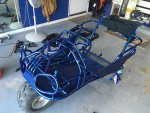
13 hp predator, this started as 6.5 tav2 cyclekart, and wife said...bigger for this and this.

So I am basically going to build a 2 person kart with swing arm rear, solid front.

Forr play, going back and forth to boat (steep hills, short runs tho) 350 of wt is us, 50 lbs of stuff and then cart.

Of course it becomes a toy and work horse after or before play
 

itsid

Moderator
Staff member
Messages
11,563
Reaction score
248
Location
Ruhrpott [Germany]
650 lbs and 18" wheels with a 13hp engine and a series 40 TC should be okay
with 5.7:1 or lower .. 6:1 would be good (given the engine has 25.7+ Nm of torque)

And yeah, mount the series 40 properly (inboard on seperate jackshaft!)
it'll be more reliable and even reduces transmissional power losses.

'sid
 

Bansil

Painter of gnomes....
Messages
1,414
Reaction score
1,117
Location
Mnts of the farthest NE TN you can go
Okay so (please correct me if I am thinking wrong.) The 40 series uses a symmetrical belt, same angles on belt and VC pulleys...so when rpm increases/decreases wouldnt the belt just move up and down?

And not side to side like the unsymmetrical belt pulleys on the 30 series?

What is ideal distance between drives and driven for stock belts, 9.750 inches?

Thanks ya'll :cheers2:
 

itsid

Moderator
Staff member
Messages
11,563
Reaction score
248
Location
Ruhrpott [Germany]
You misunderstood!

Yes the belt is symmetrical (same angles on both sides of the belt..)
whereas the belt on a asymmetrical system (say series 30) has two very different angles.

The sheaves always have the same angle as the belt;
on a series 40 the same as the opposing sheave (being symmetical)
on a series 30 NOT the same as the opposing sheave (asymmetrical)

In order to reduce or increase the effective diameter of the pulley
(the height at which the belt runs)
the sheaves move away from each other to lower the diameter,
or closer together to increase the diameter.

And that's where the belt offset is coming from...
One of the sheaves has a fixed position, the other one moves away/towards that fixed sheave
Therefore the centerline between the two sheaves move laterally in or out.
And with that centerline the belt moves in and out as it of course moves up and down.
(think of it sliding down the angle of the fixed sheave)

The idea now is to have the belt move the same amount and distance on both pulleys.
(that is achieved by an inboard mounted driven pulley on a symmetrical system like the sereis 40)
If you mount the driven outboard (as you would need to on a backplate setup)
the two centerlines move in opposite directions, adding up to a total offset of up to 7/8"

Therefore in order to compensate the outboard mounted driven would need to float on the jackshaft so it can take up the offset from the belt..

And unfortunately those stupid series 40 backplates do not allow for such lateral movement of the driven.. thus they're causing premature belt wear.
(avoid them if possible!)

'sid
 

Bansil

Painter of gnomes....
Messages
1,414
Reaction score
1,117
Location
Mnts of the farthest NE TN you can go
Okay that makes sense, thank you!

I assumed (insert eeeaawwe, eeawee sounds):cornut:
That both pulleys floated like our VS sawes etc do to keep alignment

So bearings would not be ideal, due to the hardened inner races sliding on "soft" jack shaft.

And linear bearings would be $$$

Best bet would be oil impregnated bushings, so they could float on jack shaft with sprocket non moving, and lined up with axle sprocket.

Or?
I really appreciate you answering these seeming basic questions, thank you!!
 

Snaker

Active member
Messages
341
Reaction score
183
Relying on the driven to float to compensate for that much offset is jury riggin at best in my opinion. In the snowmobile CVT world a small amount of float is added but that is to compensate for the engine torque twisting in its mounts. And it is questionable if even that small amount is effective in prolonging belt life.

A belt doesn't have any real leverage to push a pulley laterally. The more torque (hp) forces applied, the more the pulley will be held down at its position. The fixed sheaves have to be on opposite sides of a symmetrical CVT to work properly in my opinion.

I saw a Utube video a while back where someone experimented with a 40 series or a copy and installed the drive pulley backwards with the fixed sheave outboard and the driven with the fixed sheave inboard. He claimed in fit good. Wish I would have saved it.
 

itsid

Moderator
Staff member
Messages
11,563
Reaction score
248
Location
Ruhrpott [Germany]
there is no bearing in the driven pulley.. in fact there mustn't be
it's keyed to the shaft so it can transmit the rotational forces..

A slottet bushing might help but then again you'd need either a smaller diameter jackshaft
or a larger bore driven pulley to have the room for one, it then has to be either fixed to the pulley laterally so it slides on the shaft or long enough so the pulley can slide on the bushing surface..

I'd say an oiled jackshaft provides enough slip for it to work most of the time as well.

In any case you need the jackshaft (or bushing OD) to be perfectly clean at all times
(while riding that thing..)
And that's where the trouble starts.

Again belt offset is 7/8" on a series 40 with an outboard mounted driven
And that's the amount of float (according to Comet) you'd need to make it happen!

A seperate jackshaft doesn't take much more room than a backplate really,
and it's just sooo much better and less hassle to install and maintain,
that I cannot see any reason for running the series 40 outboard.
Much less using a backplate that's preventing the belt to run straight;
really that is a brain fart idea and
there is very good reason Comet themselves never offered such thing.

'sid
 

dukeboy

New member
Messages
3
Reaction score
0
hello i also have a question regarding torque converters, 1978 honda odyssey, put a 301 on it with 40 series drive clutch matched up to the original honda much largerdriven pulley, lots of torque no top end at all, do you think a smaller 7 inch 40 series driven would improve top end speed?
 

67StingrayJ

Member
Messages
73
Reaction score
0
You misunderstood!

Yes the belt is symmetrical (same angles on both sides of the belt..)
whereas the belt on a asymmetrical system (say series 30) has two very different angles.

The sheaves always have the same angle as the belt;
on a series 40 the same as the opposing sheave (being symmetical)
on a series 30 NOT the same as the opposing sheave (asymmetrical)

In order to reduce or increase the effective diameter of the pulley
(the height at which the belt runs)
the sheaves move away from each other to lower the diameter,
or closer together to increase the diameter.

And that's where the belt offset is coming from...
One of the sheaves has a fixed position, the other one moves away/towards that fixed sheave
Therefore the centerline between the two sheaves move laterally in or out.
And with that centerline the belt moves in and out as it of course moves up and down.
(think of it sliding down the angle of the fixed sheave)

The idea now is to have the belt move the same amount and distance on both pulleys.
(that is achieved by an inboard mounted driven pulley on a symmetrical system like the sereis 40)
If you mount the driven outboard (as you would need to on a backplate setup)
the two centerlines move in opposite directions, adding up to a total offset of up to 7/8"

Therefore in order to compensate the outboard mounted driven would need to float on the jackshaft so it can take up the offset from the belt..

And unfortunately those stupid series 40 backplates do not allow for such lateral movement of the driven.. thus they're causing premature belt wear.
(avoid them if possible!)

'sid

What the heck! I bought a 40 series from Go Power Sports and it came with a back plate. I even watched their video and they didn't say anything about floating the driven 7/8". All they said was the back of the two (driven and drive) had to be in line. Now I'm mad! :mad:

Do I need to post photos or do you guys get what I'm saying?
 

itsid

Moderator
Staff member
Messages
11,563
Reaction score
248
Location
Ruhrpott [Germany]
What the heck! I bought a 40 series from Go Power Sports and it came with a back plate. I even watched their video and they didn't say anything about floating the driven 7/8". All they said was the back of the two (driven and drive) had to be in line. Now I'm mad! :mad:

Do I need to post photos or do you guys get what I'm saying?

Nope, we know that thing

And of course they DO NOT tell you about the floating driven, since they cannot provide a floating driven with a backplate
(that's impossible to make since it'd need to move through the plate itself)

If they'd tell you, you wouldn't buy it, would you?

Yeah, it still kinda works,
it eats belts like crazy but it does move a kart
at the cost of some additional powerloss (I'd say another 15% or such)
and for them that's enough justification to earn a few more bucks
selling this -excuse me- brainfart of a contraption.

I'd be mad too tbh..
send it back, buy a cheap knockoff off ebay
(it's the same thing anyways just with an expensive backplate jackshaft)
then buy a seperate jackshaft instead (from GPS if you want to)

And have a well working TC instead.
(with the jackshaft engine plates it doesn't even require more room or anything, and frankly it's as easy to install on a kart)

'sid
 

67StingrayJ

Member
Messages
73
Reaction score
0
Nope, we know that thing

And of course they DO NOT tell you about the floating driven, since they cannot provide a floating driven with a backplate
(that's impossible to make since it'd need to move through the plate itself)

If they'd tell you, you wouldn't buy it, would you?

Yeah, it still kinda works,
it eats belts like crazy but it does move a kart
at the cost of some additional powerloss (I'd say another 15% or such)
and for them that's enough justification to earn a few more bucks
selling this -excuse me- brainfart of a contraption.

I'd be mad too tbh..
send it back, buy a cheap knockoff off ebay
(it's the same thing anyways just with an expensive backplate jackshaft)
then buy a seperate jackshaft instead (from GPS if you want to)

And have a well working TC instead.
(with the jackshaft engine plates it doesn't even require more room or anything, and frankly it's as easy to install on a kart)

'sid

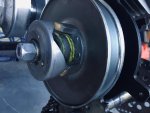
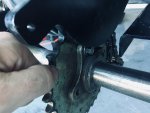
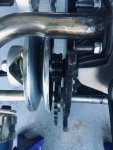
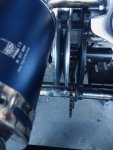
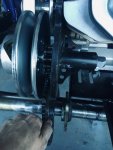
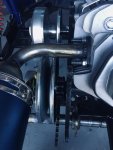
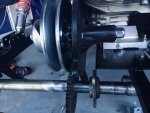
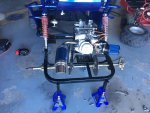
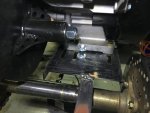
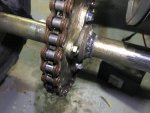
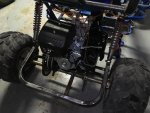
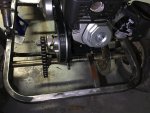
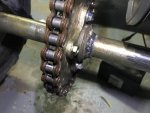
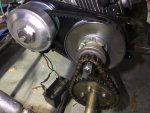
Thanks for the reply. Seriously ****ed off right now. I'm going to get in touch with GPS and see if they will even take it back at this point. I paid an arm and a leg for the thing. Before I do that though take a look at these photos and tell me if I really can't make this work. I'm about a days worth of work from getting back on the trails...

The chain on the buggy is a 520? I forget to be honest. I posted what chain it is in another topic. Its the chain that came with the buggy (carter 150), and did not fit the sprocket GPS sent with the 40 Series CVT and back plate kit.

Originally I had the sprocket on the outside of the driven pulley. But when I gave the throttle the tension on the chain was enough to flex the engine mount to where the chain would slip teeth. I'm either going to weld in another bar along side the mounting plate to stiffen things up, or move the sprocket. But before I go welding I wanted to try the sprocket between the back plate and the driven pulley. The theory there is the distance between where the engine mounting plate and the sprocket is less therefore would flex less. Originally, the hub for the sprocket was welded on to the axle but I grinded out the weld and relocated it. I tack welded the hub in place and gave it a try with the sprocket between the plate and driven and it seemed to work well. Meaning no slipping teeth. But this created a new problem in itself. The bolt heads and nuts either hit the back plate or the driven pulley. The space between the back plate and driven is less than an inch. Again I guided out the tack welds so for now (as pictured) it's loose on the axle waiting everyone's feedback. I tried my best to take photos of this. I could potentially get a longer jackshaft so the driven pulley can "float" like it's supposed to, say F it and let the thing eat up belts, or come up with a new idea.

HELP!
 

Attachments

  • IMG_1472.jpg
    IMG_1472.jpg
    198.2 KB · Views: 10
  • IMG_1471.jpg
    IMG_1471.jpg
    214.1 KB · Views: 11
  • IMG_1470.jpg
    IMG_1470.jpg
    247.3 KB · Views: 9
  • IMG_1469.jpg
    IMG_1469.jpg
    207.7 KB · Views: 9
  • IMG_1468.jpg
    IMG_1468.jpg
    239 KB · Views: 8
  • IMG_1467.jpg
    IMG_1467.jpg
    249.9 KB · Views: 8
  • IMG_1466.jpg
    IMG_1466.jpg
    247.7 KB · Views: 9
  • IMG_1465.jpg
    IMG_1465.jpg
    303.8 KB · Views: 11
  • IMG_0992.jpg
    IMG_0992.jpg
    269.3 KB · Views: 9
  • IMG_0989.jpg
    IMG_0989.jpg
    252.5 KB · Views: 8

67StingrayJ

Member
Messages
73
Reaction score
0
More photos of the first iteration of the CVT and sprocket. Like I said above, the engine plate flexed and shortened the distance between the axle and jack shaft causing the chain to slip teeth. I could stiffen up the frame/engine plate, or... something else.
 

Attachments

  • IMG_0987.jpg
    IMG_0987.jpg
    337.7 KB · Views: 10
  • IMG_0988.jpg
    IMG_0988.jpg
    328.5 KB · Views: 11
  • IMG_0989.jpg
    IMG_0989.jpg
    252.5 KB · Views: 9
  • IMG_0990.jpg
    IMG_0990.jpg
    262.9 KB · Views: 9
  • IMG_0991.jpg
    IMG_0991.jpg
    286.6 KB · Views: 6
  • IMG_0992.jpg
    IMG_0992.jpg
    269.3 KB · Views: 7
  • IMG_1044.jpg
    IMG_1044.jpg
    292.6 KB · Views: 7
  • IMG_1045.jpg
    IMG_1045.jpg
    349.1 KB · Views: 7
Status
Not open for further replies.
Top