Honda GX390 hard to pull starter string

bladeZjack

Member
Messages
48
Reaction score
32
Hello everyone,
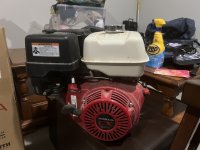
I recently got this Honda GX390 given to me. Previous owner not familiar with the engine. There was no spark plug on it when I got it. Pull start string was easy to pull. But when I placed a spark plug on, pull starter spring is now much harder to pull. It feels like it builds up pressure inside and stops the pull string from turning. I’ll do some research on YouTube also. Thank you!
 

Attachments

  • IMG_1027.jpeg
    IMG_1027.jpeg
    2.4 MB · Views: 1

bladeZjack

Member
Messages
48
Reaction score
32
Yes compression is good. But it won’t let the pull string pull all the way. It gets stuck in the middle of the pull. It feels like there is significant push back.
 

bladeZjack

Member
Messages
48
Reaction score
32
Okay rope. Yes it’s that bad. What might be wrong with it? I’m pretty sure it’s not normal. LOL!
 

Master Hack

Well-known member
Messages
4,376
Reaction score
7,052
Location
Mountain top Labratory
So, without a spark plug it pulls over all the way without resistance?
With the plug it hits a solid stop? Wrong spark plug? Compression release malfunction? Need to eat some spinach? I have a 390, and it is difficult to pull the "string" at best. With compression, if you keep tension on the string, the compression will leak down slowly. If there is a mechanical malfunction it won't.
OR:
the rope is honked up in some way.
 

Edwin Spangler

Well-known member
Messages
1,077
Reaction score
1,073
You need to measure the pull somehow. Ill bet its acting completely normal.... Ive been wrong before, maybe once.
 

Hellion

Murderator
Messages
9,232
Reaction score
4,207
OR, it could be the valves are woefully out of adjustment -- too much valve clearance. Had that scenario but with an electric starter and a much larger engine.

The starter would engage but could only turn the engine over a half revolution and then the engine would "seize". After the pressure from the combustion stroke would leak down (a little later) you could repeat the start procedure but not really ever get it started. I only got it started after much fiddling or a stroke of luck. Watched a few YT videos, Donyboy or Taryl, or whomever and they said it could be the valve clearances.

And sure enough, there was too much clearance. The rockers were excessively 'rattly' when the valves were closed. After I adjusted them to factory specs, the engine began turning over and lighting off 💥 like a champ afterwards; night and day difference.
 

panchothedog

Well-known member
Messages
2,923
Reaction score
3,961
Pull starting an engine with 25 cubic inches of displacement should be a little bit hard. Once you verify that the valves are properly adjusted ( most of these engines are .003" ) so the compression release is engaging, then slowly pull the rope until it starts to get difficult ( the compression stroke ). Now let the rope rewind all the way back into the engine. Now pull hard and fast and all the way out. Trying to pull the engine over slowly, or starting anywhere else other than just before TDC on the compression stroke is a formula for failure.
 

Hellion

Murderator
Messages
9,232
Reaction score
4,207
Trying to pull the engine over slowly, or starting anywhere else other than just before TDC on the compression stroke is a formula for failure.

Seems like there's a pro technique for everything that seems simple on its face. Neophytes think, "well, you just yank on this rope over and over til it starts" but there's a technique that simplifies it even further and reduces effort at the same time.

Great point on the engine displacement. The bigger the engine gets, the harder it is to pull over with a recoil starter and it becomes an electric start engine past a certain point (anything over 8hp industry-wide, probably).
 

bladeZjack

Member
Messages
48
Reaction score
32
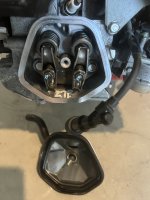
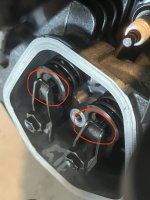
Thank you guys so much for the input. I’m beginning to get a better understanding of how the engine works. I’ve also searched some YouTube videos on Hondas with hard to pull rope starters. Seems a lot to do with the valve and probably the decompression lever on the cam shaft. I opened the valve cover and noticed the left side is really tight, no clearance at all. The right side is very loose. I’m planning to do some adjustments using a clearance adjustment tool. I’m hoping it’s not the decompression lever on the cam shaft because based on the YT videos, it seems to be pointing that way.
 

Attachments

  • IMG_1070.jpeg
    IMG_1070.jpeg
    793.7 KB · Views: 3
  • IMG_1071.jpeg
    IMG_1071.jpeg
    1.1 MB · Views: 3
  • IMG_1069.jpeg
    IMG_1069.jpeg
    1,007.6 KB · Views: 3
  • IMG_1068.jpeg
    IMG_1068.jpeg
    1.6 MB · Views: 3
  • IMG_1066.jpeg
    IMG_1066.jpeg
    534.2 KB · Views: 3

CartMan007

Member
Messages
87
Reaction score
86
Location
St. Louis
Definitely the valves. I had the same issue with my engine, which started with loud backfiring then hard to pull start. Adjusting the valves took care of that. As a newbie to engines myself, I thought it would be daunting but it's not bad at all.
 

bladeZjack

Member
Messages
48
Reaction score
32
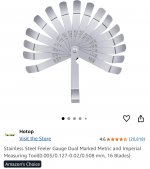
Thank you. I’m planning to purchase this feeler gauges from Amazon but looking at the specs it looks like the thinnest is .005
Someone mentioned the valve needs to be adjusted to .003”
What specs do I need for the feeler gauges?
 

Attachments

  • IMG_1075.jpeg
    IMG_1075.jpeg
    474.8 KB · Views: 2

CartMan007

Member
Messages
87
Reaction score
86
Location
St. Louis
More complicated question than you think! I've seen it done so many ways with so many measurements. Some people use lower, some higher. Some even use different sizes for intake vs. exhaust.

I used .004" and mine's been running fine.

A few tips:
1. Make sure you know the measurement of feeler gauge you're getting from Amazon. I got mm instead of inches. I converted but it was just more annoying than anything

2. You will need to check what will fit (.003 or whatever you choose) but you also need to check was SHOULDN'T fit --anything bigger than the size you choose.

3. You might have different looking valves than what you've researched, but its the same process. I found out the hard way.

4. It should fit snugly. Tight, but not too tight. You'll know. But then the next higher (thicker) feeler gauge should not be able to pass through the lash at all.

5. You'll see a lot of opinions on top dead center (TDC) vs. other points of adjustment, I just found the point where each valve was "most open" and adjusted there. I'm sure someone will scream at me but I haven't had an issue at all and literally every video/forum/content maker was saying something different.

I also made a video. I'll link it. When I did TDC, I was still getting a loud knock. When I did it my way, no issues. But test it and do what works for you.

 
Top