Diamonite Electrathon America Racer

Functional Artist

Well-known member
Messages
5,281
Reaction score
2,720
Location
Toledo, Ohio
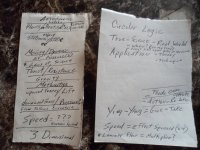
Been doin' some more researchin' on aerodynamic theory/concepts :smartass:
...& thinkin'
...& drawin'
...& realizing that there are so many "variables"
...& so, many "layers" :huh:

Stuffsa gettin' kinda DEEP :innocent:
...some notes :devil2:
SAM_3879 (1).JPG
 

Denny

Canned Monster
Messages
11,525
Reaction score
7,956
Location
Mayberry, Indiana
Been doin' some more researchin' on aerodynamic theory/concepts :smartass:
...& thinkin'
...& drawin'
...& realizing that there are so many "variables"
...& so, many "layers" :huh:

Stuffsa gettin' kinda DEEP :innocent:
...some notes :devil2:
View attachment 151154
Aerodynamics will make your head hurt! For every action there is an equal and opposite reaction. Down force = drag, it’s a deep rabbit hole.
 

bob58o

SuckSqueezeBangBlow
Messages
9,646
Reaction score
1,826
Location
Chicago-town USA
You forgot about the laws of spelling.
Yin and Yang. Not Ying. I know this because my favorite Yoga videos on YouTube are 20 min Yin Yoga classes for lower back pain and sciatica.
 

Functional Artist

Well-known member
Messages
5,281
Reaction score
2,720
Location
Toledo, Ohio
Aerodynamics will make your head hurt! For every action there is an equal and opposite reaction. Down force = drag, it’s a deep rabbit hole.
Hey Denny,
Oh...yea...we're goin' there :devil2: :innocent:

I'm going to try-n-break it down into simpler sections
....to document what I "think" I understand

*Feel free to confirm &/or disprove :thumbsup:

Remedial Aerodynamics 101

First,
I drew up a simple airfoil
...& then, labeled the sections (frontal area, body, tail & wake)
...&/so, I figure we can use that same concept to label most any shape, traveling thru a fluid, (air or water)
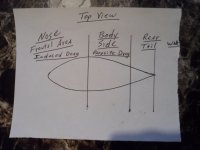
SAM_3853 (1).JPG
Next, let's start with a simple (2D) rectangular shape to help show the difference between the frontal surface area & the body surface area
...& to help keep any math kinda simple, let's say it's 1" (tall) x 2" (wide)
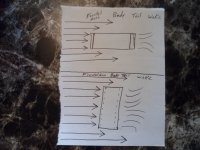
SAM_3859 (1).JPG
So, the object in the top drawing has a 1" (tall) frontal area
...& a 2" (long) body
But,
If the object was turned 90* it would "now" have a 2" (tall) frontal area
...& a 1" (long) body

* The air colliding with the "face" would be Induced Drag
...& the air "rubbing" all of the way along the side of the "body" would be Parasite Drag

Notice, in the drawings, below, how the air can go over the object (causing Parasite Drag)
...collide with the front or "face" (causing Induced Drag)
...&/or can go under it (also causing Parasite Drag)

So, the object in the top drawing would have less Induced drag
...but, more parasitic drag
...& the "wake" should/would be proportional to the frontal area

Whereas the object in the lower drawing would have twice as much Induced drag
...because the frontal area is twice as tall
But,
...only 1/2 as much Parasitic drag
...because the body is only 1/2 as long
...& then, the "wake" behind this object should/would also be, proportional to the frontal area
 

Functional Artist

Well-known member
Messages
5,281
Reaction score
2,720
Location
Toledo, Ohio
You forgot about the laws of spelling.
Yin and Yang. Not Ying. I know this because my favorite Yoga videos on YouTube are 20 min Yin Yoga classes for lower back pain and sciatica.
Hey Bob,

Ying & Yang were a couple of "hot" Aisin chicks (twins) I went to school with
...& maybe they had trouble with pronunciation
...or I just had trouble hearin' them :huh:

Oddly enough

...one was a giver
...& the other was a taker (go figure...) :lolgoku:
 

Denny

Canned Monster
Messages
11,525
Reaction score
7,956
Location
Mayberry, Indiana
Far more complicated than your diagrams show. To keep from tripping yourself up you should only think in 3 dimensional space. Because any 2 of the others will affect the third. And versa visa. The perfect aerodynamic object has yet to be found. No lift, no downforce and no wake.
 

Functional Artist

Well-known member
Messages
5,281
Reaction score
2,720
Location
Toledo, Ohio
Far more complicated than your diagrams show.
Hey Denny,

Yup, of course :thumbsup:

It seems like it would be best to start off with "baby steps"
...to make this stuff super simple
...which should help (me/us) get a grip of & understand the different/individual concepts better

Then, we can start "stacking" the different "layers"
...& then, discuss & even (hopefully) expand on how the different concepts affect each other (beneficially or detrimentally)
...but also, how each of these concepts interacts with each other (enhancing &/or cancelling)
To keep from tripping yourself up you should only think in 3 dimensional space.
Yup, were headin' in that direction
...& we'll get there soon ;)
Because any 2 of the others will affect the third. And versa visa.
I'm noticing more & more that there's a lot of Circular Logic in Science, Math, Electronics
...& even Life in general
The perfect aerodynamic object has yet to be found. No lift, no downforce and no wake.
I'ma workin' on it...just give me a...second or two :innocent::devil2:
 

Functional Artist

Well-known member
Messages
5,281
Reaction score
2,720
Location
Toledo, Ohio
Hey Bob,

This is Remedial Aerodynamics 101
...Advanced Aerodynamics 110 is down the hall :smartass:
&
It looks like you should be the teacher for that class ;)

I'm/we're "heading" in that direction
...but, still have quite a bit of a ways to go, to get there :popcorn:

I'm really interested in learning about this stuff
...so, I have more knowledge, to be able to (hopefully) make better "educated guesses"
...which (hopefully) lead to better designs :thumbsup:

But, my overall goal with this thread
...& these exercises, are to break this stuff down to "so simple a caveman can do it" terms
...to show others/everyone that this aerodynamic stuff (like most things in life) isn't "Magic"
&
That there are actual reasons of "why" stuff happens
...& then, discuss how we can "work" or manipulate some of these different concepts, to "work to" our advantage :2guns:

So, I'm going to try-n-lay out some of the concepts & info in a "simple as heck" style
...& would appreciate any helpful comments along the way :cheers2:
 

Denny

Canned Monster
Messages
11,525
Reaction score
7,956
Location
Mayberry, Indiana
Ahh, but some part of aerodynamics is black magic. The kind that bites you in the a$$ when you least expect it. But seeing how we are dealing with such low speeds and forces here it shouldn’t hurt too much.

I just hope we don’t break our Bob with this discussion. o_O
 

bob58o

SuckSqueezeBangBlow
Messages
9,646
Reaction score
1,826
Location
Chicago-town USA
Ahh, but some part of aerodynamics is black magic. The kind that bites you in the a$$ when you least expect it. But seeing how we are dealing with such low speeds and forces here it shouldn’t hurt too much.

I just hope we don’t break our Bob with this discussion. o_O
I’m already quite broken. lol

And I never took a fluid dynamics class, so I don’t know much except what I learned watching wind tunnel videos of the Cletus Car. Besides that… I just think about how and why airplane wings and carburetors work. That’s my limited experience with fluid dynamics.

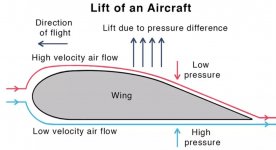
Curved surfaces are longer in length than straight ones. The extra length means as an object moves through it the air must move faster along the curve. This creates low pressure… so the plane lifts towards the crown of the curve on the wing.

That’s all I gotIMG_7817.jpeg
 

ezcome-ezgo

G'me sumthin to write on
Messages
5,854
Reaction score
2,813
Location
Atlanta, GA
One interesting concept that has emerged in the last quarter century is the idea of surface absorption, or allowing the air moving around an object to actually blend into the surface using micro or larger holes. This creates a kind of viscous envelope around the object that reduces the parasitic drag referred to above. I have loved this kind of stuff since I was a child.
 

Denny

Canned Monster
Messages
11,525
Reaction score
7,956
Location
Mayberry, Indiana
One interesting concept that has emerged in the last quarter century is the idea of surface absorption, or allowing the air moving around an object to actually blend into the surface using micro or larger holes. This creates a kind of viscous envelope around the object that reduces the parasitic drag referred to above. I have loved this kind of stuff since I was a child.
That’s the same idea as dimples in a golf ball and not polishing to a mirror shine an intake port. Or using oil as a cushion bearing in an engine.
 

Functional Artist

Well-known member
Messages
5,281
Reaction score
2,720
Location
Toledo, Ohio
I’m already quite broken. lol

And I never took a fluid dynamics class, so I don’t know much except what I learned watching wind tunnel videos of the Cletus Car. Besides that… I just think about how and why airplane wings and carburetors work. That’s my limited experience with fluid dynamics.

Curved surfaces are longer in length than straight ones. The extra length means as an object moves through it the air must move faster along the curve. This creates low pressure… so the plane lifts towards the crown of the curve on the wing.

That’s all I gotView attachment 151165
Hey Bob,

That's kinda what I thought too :huh:
...but, I've been reading, Composite Construction for Homebuilt Aircraft (Jack Lambie)
...& it has a little bit of a different explanation :2guns:

Here are a couple of excerpts

"Lift
Wings sustain an airplane by accelerating air downward. This causes a reaction upward as Isaac Newton explained many years ago, with his third law of motion. There is an equal and opposite reaction to every action.
Some students of flight have been ingrained with the theory of flight as described by Daniel Bernoulli of the eighteenth century. He correctly noted that when air speeded up the pressure dropped, and when retarded the pressure increased."
(page 13.)

"Bernoulli's theory was used to describe how an airplane wing lifts, causing confusion for many. Most texts, including FAA manuals, used a description of lift which says. "A wing airfoil is shaped so the air must go further over the top than the bottom. Since the air molecules must meet at the back of the wing the air goes faster over the longer curve of the top of the airfoil. Most of the lift of a wing comes from this air speeding upover the curved top of the wing, creating low pressure, which sucks the wing up."

"Unfortunately, Bernoulli's Theory only describes the secondary effect of how the forces are transferred to the wing. It does NOT describe the basic phenomena. By using it as a primary description, many pilots can't understand how an airplane flys upside down, or why an undercambered airfoil produces more lift than one with a flat bottom. In a convoluted way, Bernoulli's (theory) can be used to understand those effects. But, is has been such a poor choice of lift descriptions that has set back the simple understanding of basic aerodynamics for over a generation." (page 14. & 15.)

"In science what is considered "true" is the simplest explanation that covers the most the most phenomena. Newtons "Action-Reaction" wins easily. It covers every motion from running, (pushing back on the ground drives you forward) to swimming and propellers, (accelerating water or air in one direction drives you in the other), and rockets (which blast out a great mass of fuel down to react them upward)." (page 16.)
SAM_3898 (1).JPG
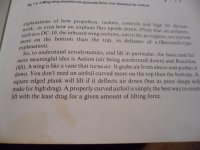
"So, to understand aerodynamics, and lift in particular, the basic and far more meaningful idea is Action (air being accelerated down) and Reaction (lift). A wing is like a vane that turns air. It grabs air from above and pushes it down. You don't need an airfoil curved more on the top than the bottom. A square edged plank will lift if it deflects air down (but its poor shape will make for high drag). A properly shaped airfoil is simply the best way to create lift with the least amount of drag for a given amount of lifting force." (page 17.)
SAM_3899 (1).JPG

"Another test of a "true" theory's simplicity is considering how close it is to human experience." (page 16.)

* Here is some personal commentary on Sir Issac Newtons Theory
...from my own personal/human experience :cheers2:

I remember riding in a car, when I was a kid & sticking my hand out the window to "play" with the air

I remember that "if" I held my hand "level" or horizontal it would "cut" thru the air, with out much reaction
...but, "if" I angled (or tilted) the front of my hand upward (~45*) my hand (& arm) would "lift" (I was creating lift) just like an airplane wing ;)
...& "if" I angled (or tilted) the front of my hand downward (~45*) my hand (& arm) would "dive" (I was creating down force)
...& also, "if" I angled (or turned) my hand vertical (~90*) my hand (& arm) would be pushed directly backwards
(kinda like how the sail on a sailboat, catches the wind) :thumbsup:
 

bob58o

SuckSqueezeBangBlow
Messages
9,646
Reaction score
1,826
Location
Chicago-town USA
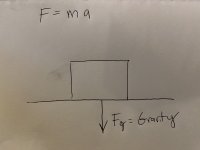
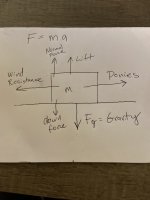
It’s interesting. I have to think about the forces that act on the wing. Equal but opposite forces are like gravity pulling you down but the floor pushing you up. The force of gravity and the normal force are equal and opposite so you don’t accelerate in any direction.

Im thinking about the force of the wing on the air causing the air to accelerate, so there should be an equal but opposite force from the air onto the wing. But this wouldn’t cause acceleration. If forces are equal but opposite, nothing moves. *I Have to think about this more …

I still believe that the difference in pressure is the force that moves wings. Also as far as your hand goes…. I imagine the shape of the air moving past your hand looks similar to the shape of air going past a wing. Just imagining here, but there might be dead zones of “trapped” air?
The shape of the pockets of trapped air might mean the “moving” air moves along a path similar to what it what experience going past a wing?

I dunno?

People don’t do physics with words.
got to draw the free body diagram with force arrows otherwise you get zero credit for the problem. Lol

Physics is just drawings, then math is letters and numbers. Words have no place in physics lol
 
Last edited:

bob58o

SuckSqueezeBangBlow
Messages
9,646
Reaction score
1,826
Location
Chicago-town USA
The recent disturbance in the Physics Force comes from the question… can you put a fan on a boat and use it to blow your own sail. I believe this falls into the action - reaction realm.

This shows how a blade on a propeller can simulate a wing. Pushing the air one direction and the prop blade moving in the other direction.

 
Last edited:
Top