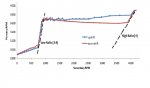
I also have a yellow spring for the 30 series, but I haven't used it yet. Nor have tried any hole but the middle with the stock spring.
The stiffer yellow spring "should" delay the start of the shift without changing the engagement RPM. The three holes "should" also change the RPM at which the shift starts.
If your "dead spot" is really just the RPM at which the TC shifts (I wouldn't call it a dead spot), then using the yellow spring will just push that "dead spot" to a higher RPM.
So perhaps the shift occurs at 3600 RPM with the stock spring in the middle hole. If you use stock spring in the next hole (more preload on the driven spring), then perhaps the TC won't shift until 4k RPM (just guessing to give an example - like I said, I never tried it). If you use the first hole (less preload on driven spring), then perhaps the TC starts to shift at 3200 RPM.
If you use the yellow spring in the middle hole, then maybe the shift happens at 4200 RPM.
Yellow spring in next hole (more preload), maybe 4800 RPM is when it shifts.
Yellow spring in first hole (less preload), maybe 3600 RPM is when it shifts.
I just tossed some numbers in there to give you an idea of how the driven unit spring / hole selection might change how the TC behaves. More preload (either by using a stiffer spring or using the hole with the most preload) will push the "dead spot" to a higher RPM. Less preload will pull the "dead spot" to a lower RPM.
The garter springs/weight packs in the Driver unit will change when the TC engages, but will also change the RPM when the TC shifts. The TC is obviously not going to shift at 3600 RPM if you don't engage until 4k RPM. Even with the stock spring in the middle hole, if you have 4k RPM engagement, the shift point may not be until 4800 or 5k RPM.
Again don't come back and tell me the numbers I used are wrong. I know they probably are. Just easier to explain concepts when using some numbers for examples.
I haven't found too much info about tuning these TC's. They are mostly used for backyard fun. Serious racers, who provide a lot of the information I find useful, don't use TC's. Well some might in Outlaw classes, but I haven't come across too much info.
What makes sense to me and what I target is engagement at Peak TQ RPM and shift at Peak HP.
If a stock engine makes peak torque at 2500 RPM and peak HP at 3600 RPM, then I want my TC to engage at 2500 RPM and shift at 3600 RPM. If my engine makes peak TQ at 4k RPM and peak HP at 6000 RPM, then I'd first adjust the driver unit to engage at 4k RPM and see where the shift happens. If it shifts too early or too late, then I'd play with the Driven unit.
Happy tuning and please report any findings.
---------- Post added at 11:31 PM ---------- Previous post was at 11:17 PM ----------
Here is where I found that graph.
SAE Baja stuff...
https://www.cogentoa.com/article/10.1080/23311916.2017.1398299.pdf
You can also research snowmobile clutch tuning as the concepts are the same.