Mike10gs
Mike10
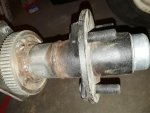
I'm sure unless I'm going blind. It all comes out together. It was bolted then welded. The sprocket that is. The whole wheel hub comes off but it's the sprocket is welded


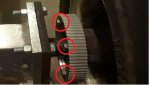
....I would just need to put on a belt clutch correct and put it to the sprocket just like I would with chain right. Or is it a total different thing....
...An option might also be to ditch that brake rotor and weld a sprocket to the pulley.
Might be able to mount the caliper in a way where the sprocket is used as the brake rotor...
How about a clutch on the crankshaft going to a sprocket on a jackshaft (connect by chain).
Then a cog belt pulley on EACH end of the jackshaft with a cog belt driving each rear wheel.
You can put a hub and the brake rotor also on the jackshaft.
Synchronized dual powered rear wheels without a live axle or differential. It'd be different.
I had to read a times to (I think) get what you were saying. I think you sometimes forget how much you know bob58o lol.
Are you saying to use a sprocket that would get used exactly like a brake rotor? That the caliper would be large enough to go over the sprocket? Why not just weld a brake rotor instead? What about the sprocket teeth?
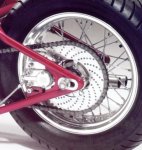
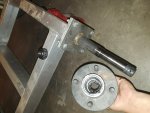
I don't know what is going on with those hubs.
If I was set on using that brake kit, I'd be looking into a live axle swap.
Or if wanting to keep the cog belt setup, then the brake disc can go on a jackshaft.
Clutch on crankshaft connected by chain to sprocket on jackshaft.
Brake disc (with hub) also on jackshaft.
Then another cog pulley thing on the right side of the jack shaft aligned with the pulley on the passenger side rear wheel.
These bolt looking things don't hold anything?
If you're going to use the sprockets it has now, you'll first need to know what type of chain they use.
Different chain has different tensile strength ratings. Depends on the power of the go kart plus the weight. Also, some sprockets are harder to find than others depending on the chain type needed. Depending on tooth count or material it's made out of (steel/aluminum).
Whatever clutch you use, it needs to be able to have a sprocket that uses the same type of chain as the axle sprocket(I refer to it as axle sprocket because most go karts have a fixed axle with one sprocket. I know your setup is a little different with each tire having it's own sprocket. None the less, it's the same idea). Over time, sprockets do wear out. At some point you'll likely need to replace the hub/sprockets you have now because the sprockets will have worn out and it's welded together.
If it's a weird chain type/tooth count and you decide to choose a different chain type axle sprocket when you replace it, you'll have to also replace the chain and clutch sprocket. In a perfect world, when your axle sprocket needs to be replaced, so will your clutch sprocket and chain, but that'll rarely happen.
Plus, changing the sprocket on the clutch may be different enough that things will need to be realigned (axle sprocket to the clutch sprocket/torque converter driver pulley to the driven pulley).
That brings up which clutch to use. Centrifugal clutch or torque converter(T/C). Each has it's pros and cons. It just depends on what you want out of the kart and how you want it to drive. It's be best to watch some YouTube videos that compare and contrast the 2 to help you make a decision.
In general, a T/C will go from the engine shaft (driver pulley) to a jackshaft (with driven pulley). Those are connected by a belt. Then a chain goes from the jackshaft sprocket to the axle sprocket with a chain.
A centrifugal clutch attaches to the engine shaft and is connected to the axle sprocket with a chain.
T/C's are popular for helping increase acceleration, but centrifugal clutches are more efficient and are commonly used on race go karts.
Watch some videos and read http://www.diygokarts.com/vb/showthread.php?t=18371
You'll have a much better idea after that.
Edit: as bob85o pointed out, a jackshaft will be needed no matter what route you go. Without a jackshaft the engine can only power one tire. T/C or centrifugal clutch will need a jackshaft. You may already know this, and I'm sure other people seen this as obvious, but somehow I completely missed including that point in this post.
How about a clutch on the crankshaft going to a sprocket on a jackshaft (connect by chain).
Then a cog belt pulley on EACH end of the jackshaft with a cog belt driving each rear wheel.
You can put a hub and the brake rotor also on the jackshaft.
Synchronized dual powered rear wheels without a live axle or differential. It'd be different.
I've edited my post.
I don't know much and my ideas come and go and my fingers type and don't care if the words makes sense. LOL
I was trying to point out that it is not a live axle and if only powering one wheel, the brake also has to be on that wheel.
On a minibike, you can have a sprocket on one side of the rear wheel and a rotor on the other side because the frame of the minibike is on both sides of the wheel.
On a one wheel peel kart, if the sprocket goes on the inside of the hub, where does the brake disc go? How do you mount a caliper?
I was thinking something like this, but don't know how it'd work with a hydraulic caliper/pad set up.
Sure you could weld a rotor to the pulley, if it has a large bore to fit around the hub thing that I cannot figure out. But looking at it, it seems you'd need a two piece sprocket or rotor welded on and I don't know how I feel about that.
The one thing about putting the brake on the jackshaft is that if your chain goes (or in this case - your belts) so do your brakes. Just like a band brake around the clutch. If the chain goes, no more brakes.
 Just like this little car lol
.... I was hoping to go with centrifugal clutch. At this point i want to go with what's cheaper....
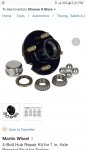
That makes sense. Or....drill them out big enough and put in lug nuts. Though for me, I'd just go with new hubs at that point. I don't like worrying about keeping things concentric trying to avoid wobble.
---------- Post added at 03:29 PM ---------- Previous post was at 03:28 PM ----------
It can be toss-up as to which one is cheaper. Plus you have to keep in mind quality. Don't compare a high-quality centrifugal clutch to a low-quality torque converter, and visa versa.
Clutches wear out like belts wear out, but clutches are more expensive than belts. Although, if this kart is more for going fast and staying fast, a centrifugal clutch can easily last a long time (think big oval track), plus it'll give more efficient power to the wheels.
Lot's of slowing down and speeding up can quickly wear out a centrifugal clutch (lots of sharp curves, trail riding, or in general going slow). A torque converter is much better at acceleration and won't wear out as quickly as a centrifugal clutch from constant accelerations. A few clucthes will quickly be more expensive than a torque converter.
As much as I would like this to only be on road. It won't. It will see more trails. Not extremely bumpy but some. A torque converter will help with this?