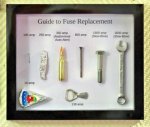
Sooooooo, let's explain HOW to use a fuse in one of many applications. MY guess is IF we take, say a headlight and mount it, such as mine is. It's automatically grounded. The battery is grounded to the frame, so therefor there's no need to run a ground wire from the battery to the headlight because the bike frame will complete the circuit.. WE only need to supply a 'hot' wire instead with an interruption of sorts en-route to the headlight. That would be a simple ON/OFF toggle switch as used on mini bikes, go karts, dune buggies, etc. NOW I spose that every hot wire that comes off the battery should have a fuse near the battery. In cars we call this a FUSE BLOCK or FUSE JUNCTION. They usually have fuses to things we didn't know our automobiles had

...
It is easy to add fuses but I spose some find it a tedious job of breaking out the heat shrink tubing, wire splicers, and the solder and solder gun. I dislike the ugly new style fuse holders and prefer the barrel type where you give the 'tube' a twist and remove the two halves and remove the cylinder type fuse. I have many housings and fuses still, so no shortage here. I prefer to use a fuse on expensive items but not for cheap NO STRESS items. The fuse is there ONLY in case a wire gets pulled apart, the toggle switch malfunctions(and yes they do, trust me), or the wire lays on something hot and melts the protective poly coating against metal so that the wire is exposed and possibly about to short against the metal. PLACEMENT of the fuse is never an obvious answer but you need to consider your wire route and at what point/placement is the fuse best suited at.
I took a fun comical shot at even the suggestion of the title because it's elementary. We do understand the risk of not using a fuse and sometimes it's ok to not use a fuse. It just depends on the situation. It's all up to the individual and their situation and nobody can change that. I know that there have been times when I didn't have a fuse and I had to be very careful. I also prefer 14 gauge wire or thicker for all of my work, especially for longer runs. I use 00 gauge for Battery to battery runs for low loss situations such as charging, etc. IF you ever were a serious STEREO system installer in automobiles, then you know where I'm coming from. THICK WIRE is LOW LOSS and LOW HEAT. The more wire thickness the more wire to keep the other wires cooler. Blah blah blah..............
It never dawned on me that anyone would ever wonder if a fuse should become part of their electrical work. It just came naturally for me. And please! If you aren't sure, use thicker wire if you have it. Thin like 18 or higher, wire might as well be a weak fuse in it's self!! Copper can only take so much heat. That is why speaker wire IS NOT recommended for electrical wiring even though light amounts of electrical signal flow through it to the speakers.......and yes, even speakers have fuses!! BTW, holding a stereo amplifier speaker wire to your tongue and turning up the volume is quite an experience


 , why would anyone not use one? Are there any disadvantages?