AI says:
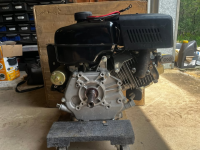
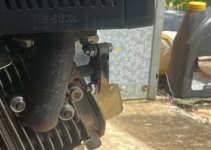
"I have a Lifan 9hp, which I believe is 270cc. There is a little oblong pot-metal part attached via welded tube to the exhaust manifold. It is grey and has 16 little holes in its side. Will you please tell me the purpose and function of this little part?
The part you are describing is a Pulse Air Injection Valve (often called an Aspirator Valve or a secondary air injection valve), which serves as a mechanical emissions control device. [1, 2]
The Purpose and Function
Your Lifan 9hp (270cc) engine is a Honda GX270 clone. To meet strict EPA and CARB emissions standards, manufacturers add this component to reduce unburned hydrocarbons (harmful exhaust emissions) without needing a complex electronic computer system. [1, 3]
It functions using simple physics:
- Sensing the Pulse: Every time the exhaust valve opens, a high-pressure pulse of hot exhaust gas travels down the manifold. Right behind this pulse, a momentary negative pressure (a vacuum) is created in the tube. [4, 5]
- Drawing in Fresh Air: The 16 little holes on the side of the pot-metal body act as an air intake. The vacuum pulls fresh, oxygen-rich ambient air through those holes and past a one-way reed valve inside the oblong housing.
- Igniting Unburned Fuel: This fresh oxygen is injected directly into the scorching hot exhaust stream. The sudden introduction of oxygen causes any leftover, unburned fuel vapors leaving the cylinder to ignite and burn up inside the muffler before exiting into the atmosphere. [1, 6]
- One-Way Protection: When the next high-pressure exhaust pulse hits, the internal reed valve snaps shut. This prevents toxic exhaust gasses and flames from shooting out of those 16 little holes.
Common Issues to Watch For
Because this part is subject to intense heat cycles and exhaust soot, it is prone to a couple of minor issues over time:
- The "Ticking" Noise: If the internal reed valve wears out or gets stuck open with carbon buildup, you will hear a distinct, loud ticking or fluttering noise. This happens because exhaust gases are actively blowing back out of the 16 holes.
- Backfiring: If the valve fails or leaks, too much oxygen can enter the muffler at the wrong time, causing a loud pop or backfire when you decelerate or shut down the engine.
If the valve ever fails or rusts out, many equipment owners choose to cut the tube, remove the valve, and weld the hole shut (or install a standard, non-emissions exhaust manifold) to eliminate a point of failure. [2, 7]
To help you troubleshoot or maintain this system, are you experiencing any performance issues like backfiring or a ticking noise, or are you planning to modify the exhaust for a project?
[1]
https://www.reddit.com
[2]
https://www.youtube.com
[3]
https://www.ebay.com
[4]
https://www.cmpoparts.com
[5]
https://www.reddit.com
[6]
https://www.amazon.ca
[7]
https://sdusdfamilies.org