
You are using an out of date browser. It may not display this or other websites correctly.
You should upgrade or use an alternative browser.
You should upgrade or use an alternative browser.
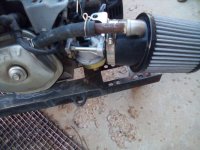
What do you do with the breather after installing velocity stack?
- Thread starter Oilpan4
- Start date

ezcome-ezgo
G'me sumthin to write on
Ok. Go for it.

bob58o
SuckSqueezeBangBlow
Why put it back into the intake?
Emissions control?
You are talking about the hose from the valve cover?
I usually find some kind of breather filter and modify the stock hose if needed. I don’t remember the hose size or size of filter that works best.
Emissions control?
You are talking about the hose from the valve cover?
I usually find some kind of breather filter and modify the stock hose if needed. I don’t remember the hose size or size of filter that works best.
Attachments
-
 IMG_3880.png1 MB · Views: 10
 -
 IMG_3881.png533.7 KB · Views: 9
 -
 IMG_3882.png1.5 MB · Views: 9
Denny
Canned Monster
Because with it back in the breather he will have less chance of an oil leak, and his engine will last longer too!
I figure it allows the engine to burn any gasoline blow by. It's only a stage 1 engine, intake, timing advanced, governor increase limited by UT2 coil, slight compression increase and exhaust. Not worried about a little bit of oil causing pre-ignition.

Hellion
Murderator
- Messages
- 9,187
- Reaction score
- 4,159
You can vent it straight to the ground, like they did with the old cars (before EGR, PCV valves and such). They didn't use catch cans either :
In other words, all the moisture and combustion by-products (gasoline, oil mist, water vapor etc) was allowed to vent out of the engine and into the environment. I imagine the roads were maybe a bit more coated with engine by-products back then than nowadays but all combustion engines still leak and there's a dark stain down the middle of all freeways and highways to prove it.
Still, most of what came out of the road draft tube was vapor unless it is allowed to collect and condense.
https://mossmotoring.com/crankcase-ventilation/In the twenties (and probably even before) through the early sixties, engine air flow depended on a simple road draft tube. A metal tube, connected to the crankcase, was brought down near the bottom of the oil pan. The rear-facing half of the tube was cut at an angle, so that forward motion of the car created a small amount of reduced pressure, compared to the atmosphere.
In other words, all the moisture and combustion by-products (gasoline, oil mist, water vapor etc) was allowed to vent out of the engine and into the environment. I imagine the roads were maybe a bit more coated with engine by-products back then than nowadays but all combustion engines still leak and there's a dark stain down the middle of all freeways and highways to prove it.
Still, most of what came out of the road draft tube was vapor unless it is allowed to collect and condense.

Master Hack
Well-known member
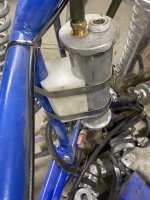
Ghetto fab catch can?
Hellion
Murderator
- Messages
- 9,187
- Reaction score
- 4,159
All the older industrial engines with a one-way breather valve (Briggs flathead for example) pumped the effluent right back into the carburetor, but downstream of the air filter. It was not blown into the air filter but under it or past it.
From a pure performance standpoint, it's not what you want pumped back into the engine (even though it may contain unburned fuel) the rest is vaporized moisture (H2O) that had collected in the crankcase oil, oil vapor that blew by the rings or the valve seals/stems (there's always a tiny amount) and various particulates, combustion by-products and maybe dirt that got in past the air filter or bad gasket. Reminder to make sure your air filter is good.
Ever see some guys racing around without an air filter? There's tons of them who claim "it runs better".
From a pure performance standpoint, it's not what you want pumped back into the engine (even though it may contain unburned fuel) the rest is vaporized moisture (H2O) that had collected in the crankcase oil, oil vapor that blew by the rings or the valve seals/stems (there's always a tiny amount) and various particulates, combustion by-products and maybe dirt that got in past the air filter or bad gasket. Reminder to make sure your air filter is good.
Ever see some guys racing around without an air filter? There's tons of them who claim "it runs better".
Hellion
Murderator
- Messages
- 9,187
- Reaction score
- 4,159
Ghetto fab catch can?
That's hardly ghetto, Master Hack, that looks first rate and proper. Ghetto is just a piece of old tubing dangling in an empty soup can that's duct taped to a frame member.

Denny
Canned Monster
That’s what he had before.That's hardly ghetto, Master Hack, that looks first rate and proper. Ghetto is just a piece of old tubing dangling in an empty soup can that's duct taped to a frame member.
Master Hack
Well-known member
Just upgraded from that setup!Ghetto is just a piece of old tubing dangling in an empty soup can that's duct taped to a frame member.
bob58o
SuckSqueezeBangBlow
I was thinking about doing this. My carb has a passage in the air horn (used for a power jet). I could run a line from the valve cover to the catch can then a tube from the top of the can back to the air horn.All the older industrial engines with a one-way breather valve (Briggs flathead for example) pumped the effluent right back into the carburetor, but downstream of the air filter. It was not blown into the air filter but under it or past it.
Wouldn’t the pumping action of a single cylinder cause the block to pull air in from the air horn every compression stroke.
I was thinking it would mess up air flow in the air horn. Assuming there is some type of intake inertia tuning, I figured it might be disturbed.
BrownStainRacing
Well-known member
- Messages
- 1,367
- Reaction score
- 1,486
I use 2) one way check valves to keep the crankcase pressure as low as possible.I was thinking about doing this. My carb has a passage in the air horn (used for a power jet). I could run a line from the valve cover to the catch can then a tube from the top of the can back to the air horn.
Wouldn’t the pumping action of a single cylinder cause the block to pull air in from the air horn every compression stroke.
I was thinking it would mess up air flow in the air horn. Assuming there is some type of intake inertia tuning, I figured it might be disturbed.
Pressure goes out when the piston is coming down. Air does not get pulled in when the piston is on its way back up, with one way check valves.
You could put 1 between the valve cover and catch can.
When that blower starts huffin, you might need to make more vent holes in the block and valve cover for more check valves,


I don't like the idea of contaminated air being pulled into the fresh air intake.

2 Pcs 12mm 1/2" Fuel Non-Return One Way Check Valve Petrol Diesel Oil Aluminum | eBay
Find many great new & used options and get the best deals for 2 Pcs 12mm 1/2" Fuel Non-Return One Way Check Valve Petrol Diesel Oil Aluminum at the best online prices at eBay! Free shipping for many products!
www.ebay.com
bob58o
SuckSqueezeBangBlow
I forgot who mentioned it, but I liked the idea of running a vent/vacuum line to the exhaust using the exhaust flow to pull out air from the block.I use 2) one way check valves to keep the crankcase pressure as low as possible.
Pressure goes out when the piston is coming down. Air does not get pulled in when the piston is on its way back up, with one way check valves.
You could put 1 between the valve cover and catch can.
When that blower starts huffin, you might need to make more vent holes in the block and valve cover for more check valves,
I don't like the idea of contaminated air being pulled into the fresh air intake.
2 Pcs 12mm 1/2" Fuel Non-Return One Way Check Valve Petrol Diesel Oil Aluminum | eBay
Find many great new & used options and get the best deals for 2 Pcs 12mm 1/2" Fuel Non-Return One Way Check Valve Petrol Diesel Oil Aluminum at the best online prices at eBay! Free shipping for many products!www.ebay.com
Ive got 2 vent locations in the block (governor hole and side cover) and two in the valve cover. I like the check valves.
BrownStainRacing
Well-known member
- Messages
- 1,367
- Reaction score
- 1,486
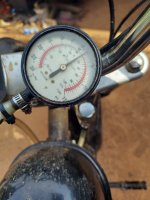
When you get it up and running, use 1 of those ports to install a vacuum/pressure gauge and see for yourself how much pressure is actually under that piston as it is moving up and down.I forgot who mentioned it, but I liked the idea of running a vent/vacuum line to the exhaust using the exhaust flow to pull out air from the block.
Ive got 2 vent locations in the block (governor hole and side cover) and two in the valve cover. I like the check valves.
I was seeing as much as 20 psi spikes on the gauge with the stock valve cover and baffle as the rpm was at a steady 4500.
The stock pcv is jus not designed to work at that higher rpm, on these lil turd motors.
I found that 2 check valves had the same results as 3 or more, but that's for N/A engines that I tested.
Attachments
-
 20230604_162854.jpg1.8 MB · Views: 1